Impact Resistant Woven Metal Screen Design for Crusher Discharge Applications
Placing a woven metal screen directly at a crusher discharge outlet subjects it to severe punishment from falling rock. Achieving reliable performance here requires a specialized design that prioritizes impact-resistant structural integrity. This involves strategic choices in material, weave, and installation to withstand the immense forces and ensure long-lasting operation.
Material Selection: Building a Tough Foundation
The material is the first defense. For the extreme impact at a crusher discharge, standard steels often fail. High-tensile steel woven screen provides an excellent balance of strength and fatigue resistance. Alternatively, high-manganese steel offers the unique benefit of work-hardening upon impact, its surface becoming progressively harder and more resistant to deformation and abrasion. The choice depends on the specific ore type and the balance between initial investment and long-term wear life under continuous pounding.
Reading the Impact Load Like a Plant Engineer
A crusher discharge is messy in a way static drawings never capture, because the material does not fall politely through a hole—it tumbles, bounces, stacks, and re-accelerates, so the Woven Wire Mesh sees both vertical impact and horizontal scrubbing at the same time. Primary jaw or gyratory outlets throw big lumps with high kinetic energy, while cone and impact crusher discharges tend to deliver a denser, faster stream of smaller but sharper fragments that chew at wire crowns and abrade crimp contact points. If the screen is placed too close to the rotor or too flat relative to the material trajectory, local panels take the full hit instead of the load being spread across the deck, and that is where premature failure begins. Good design starts with reading the discharge curve: top size, lump density, moisture, fines content, belt or chute velocity, drop height, and how often the crusher dumps a surge load during tramp event or uncrushable rejection. Once those numbers are honest, the mesh is no longer selected by guesswork—it is engineered as a structural member that must flex enough to avoid brittle fracture but stay stiff enough to keep aperture accuracy under pounding.
Wire Diameter, Crimp Geometry, and Panel Stiffness
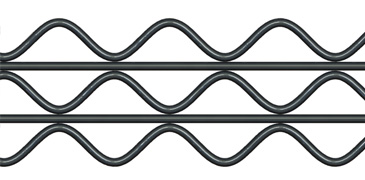
People often assume “thicker wire” automatically means better impact resistance, but a brutally thick Woven Wire Mesh can actually fight the support structure, transmit more shock back into the frame, and crack at the clamped edges if the panel cannot breathe with the vibration. The smarter route is balancing wire diameter, aperture ratio, crimp style, and panel aspect ratio so impact energy dissipates through controlled deflection rather than concentrated stress risers. Double-crimp, lock-crimp, flat-top, and intermediate crimp profiles each behave differently: flat-top meshes favor free material flow and reduced pegging, while lock-crimp constructions resist movement at wire crossings and hold shape better when lumps land hard and sideways. At a crusher outlet, the crimp is not decoration—it is the mechanical joint that decides whether a crossing stays seated or walks out of position after a few thousand impacts. Panel stiffness also comes from how the mesh is framed, whether marginal rods or baffle bars are used, how tension is applied, and whether the discharge zone uses a reinforced leading edge or impact grid ahead of the fine-sizing section. The best designs treat the mesh, the frame, the tensioning hardware, and the wear liner upstream as one organism, because a world-class mesh bolted to a floppy adapter will still die young.
Support Grids, Drop Zones, and the Hidden Architecture
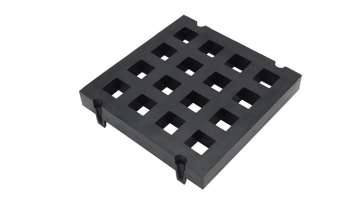
What separates a crusher-discharge screen that lasts six weeks from one that lasts six months is rarely the mesh alone—it is the architecture around it, starting with how the plant handles the first moment of contact. A well-placed impact grid, sacrificial wear bar, or stepped discharge shelf can intercept the heaviest lumps, slow the stream, and redirect energy so the working Woven Wire Mesh grades material instead of acting as a punching bag. Support stringers and cross members must match the mesh pitch and load path; if they are too widely spaced, the panel drums and fatigues, and if they are too aggressive they create dead zones that trap rock and grind the wire from underneath. In recycling and quarry applications, tramp steel, rebar, and uncrushables turn the discharge point into a sabotage zone, so designers often specify hardened edge wires, heavier selvage, replaceable impact modules, and quick-release frames that let crews swap only the abused section instead of the entire deck.
Weave and Reinforcement: Engineering for Strength
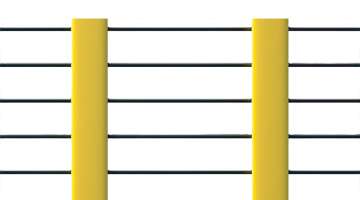
The design of woven wire screen must use robust weaves. A double-crimp or lock-crimp pattern is essential, as it mechanically locks wires at every intersection, preventing movement under load and greatly increasing the panel's rigidity. Incorporating reinforced border edges—using heavier-gauge steel channels—is critical. This frame absorbs and distributes impact energy across the entire panel, preventing edge failure. For handling large feed, adding support bars beneath the screen cloth provides extra backing to prevent sagging and localized damage.
Installation and Maintenance: Ensuring Lasting Performance
Even the best-designed metal weaving screen requires correct installation. At the crusher discharge, the screen must be installed with uniform, high tension. A tightly tensioned screen acts as a cohesive unit that dissipates impact energy effectively. Using polyurethane tension mats underneath can dampen vibrations and reduce metal fatigue. Regular inspections for loose tension or damaged edges enable proactive maintenance, preventing unexpected failures and costly downtime.
The design of impact-resistant structural performance for crusher discharge screens is a specialized task. It demands a holistic approach combining tough material selection, a reinforced locked weave, and precise installation. By integrating these elements into the design, operations can deploy a woven metal screen that not only survives the initial impact but maintains its structural integrity and screening efficiency over a long service life, ensuring reliable material flow from this critical plant location. Reach out to our team for customized impact-resistant screen solutions for your crusher discharge screening system.