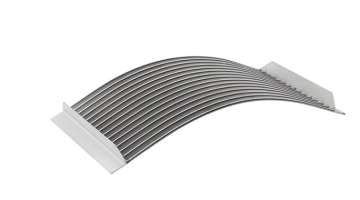
Performance analysis of welded screens in the coarse screening process against impact from large materials
For quarry, mining and construction recycling operators who have watched standard woven screens tear or warp within weeks under constant impact from 100mm+ large rock and rubble, targeted performance analysis of welded screens in coarse screening processes delivers 2 to 4 times longer service life and cuts unplanned downtime by nearly 40% compared to traditional mesh decks. Unlike fragile woven screens that shift and come apart under repeated heavy impact, properly engineered welded screens lock every intersection of high-tensile steel wires in place, maintaining consistent slot sizing even when taking repeated direct hits from oversized feed material.
Impact Resistance Structural Performance
The core performance advantage of heavy-duty welded screens lies in their welded joints, which are completely fused, solving the problems of wire loosening and shifting inherent in woven metal mesh. These screens are made of high-strength alloy steel, capable of withstanding repeated impacts from large materials without easily deforming. Their open-frame design allows even smaller particles to pass through quickly, reducing material accumulation and unnecessary pressure loads.Field tests show well-designed welded coarse screens can handle continuous feed of 150mm rock chunks without weld breakage, outperforming standard woven alternatives by a wide margin.
What “Large Material Impact” Actually Means in Numbers
Operators talk about “big rock,” but impact severity is a combination of mass, drop height, particle shape and how often the lump arrives, not just top size. A 300 mm angular granite chunk falling from a transfer point carries far more destructive energy than the same mass landing off a feeder with a cushion of fines underneath, and a slabby piece of iron ore strikes with an edge load that concentrates stress into one or two weld nodes instead of spreading it. On a scalping deck the bed is usually thin and the strikes are discrete, so the screen sees repeated point impacts rather than a uniform pressure; that distinction matters, because welded screens are excellent at distributed load and merely tolerant of repeated point impact, and the difference shows up at the intersections. Any performance review that quotes “maximum particle size” without drop height, bulk density, top-size frequency and deck slope is not really analysing impact — it is guessing with extra steps.
Rigidity Versus Resilience: Why Welded Screens Behave Differently From Woven Cloth
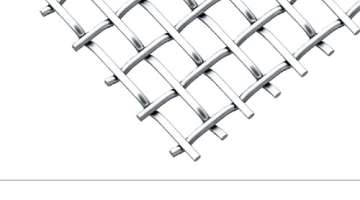
A woven screen survives impact partly by cheating: the wires flex, the crimp settles, and individual intersections slide a few tenths of a millimetre so the local stress peak never fully develops. That flexibility costs you aperture stability, because after a few hundred hours the openings have drifted and the product cut has loosened. A welded screen refuses to play that game — the fusion zone locks the geometry, which is why welded screens hold aperture accuracy dramatically better on coarse duties — but the price is that the impact has to be absorbed by the steel itself and by the support structure behind it. High-strength welded mining screens with full-penetration resistance welds are reported to deliver several times the tear resistance of woven alternatives and to keep their opening accuracy where woven cloth loses it.The practical conclusion is not “welded is better” in the abstract; it is that welded screens trade the self-relieving behaviour of woven mesh for dimensional stability, and that trade only pays off if the panel, the support bars and the deck frame are engineered as one load path.
The Weld Node Is the Impact Bottleneck, Not the Wire
When a welded screen fails under big feed, it almost never fails because the wire snapped in the middle of a span — it fails at the node, where the heat-affected zone has changed the steel’s microstructure, where residual stress from welding is highest, and where the stiffness jumps from flexible wire to a frozen joint. Full-penetration resistance welding gives a strong joint, but “strong” in a static pull test is not the same as “tough” under a hammering load: a node can be hard enough to resist deformation and brittle enough to initiate a fatigue crack after a few hundred thousand cycles of impact plus vibration. That is why a serious performance analysis checks fusion depth, hardness across the weld and heat-affected zone, and whether the welding procedure left the node harder than the parent wire without enough toughness to absorb shock.If the weld is stronger than the wire but more brittle than it, the screen will not deform gracefully — it will crack at the joint and then let a whole row of apertures go.
Real-World Operational Performance Metrics
Practical site performance analysis tracks three key metrics that matter most to coarse screening teams: first, the percentage of slot size deviation after 720 hours of continuous heavy impact operation, which stays below 5% for qualified welded screens to keep separation accuracy consistent. Second, the maximum single impact load the screen can absorb without weld failure, which is calibrated to match the average largest material size in the user’s specific feed stream. Third, anti-clog performance, where the rigid welded open structure reduces pegging and blockage by up to 25% compared to flat woven mesh decks.
If you’re tired of frequent screen tears and downtime caused by constant large material impact in your coarse screening line, our engineering team can run a custom on-site performance assessment tailored to your exact feed material specs to help you pick the most durable welded screen setup for your operation.