Vibrating Screen Equipment: 5 Core Factors Determining Actual Screening Efficiency
Most plants talk about screen efficiency like it is a number on a report, but on the floor it is something you feel: the fines fall clean, the oversize reports back to the crusher, the deck does not blind after rain, and the mill feed stays inside the size envelope the metallurgist actually tuned for. When efficiency drops, people blame the mesh, the operator, or the orebody, when really it is usually a stack of small decisions—feed distribution, motion, media, deck load, maintenance—all fighting each other at once. A Vibrating Screen Equipment is not magic: it is a tuned system where the particle has to stratify, present itself to the aperture, and pass or reject without the deck getting in its own way. Get five things right and the machine looks brilliant; ignore them and even a premium deck turns into an expensive vibrating liability.
Feed Distribution and Bed Depth
The first factor is the one nobody photographs. If the chute dumps the whole load on the left third of the deck, the right side becomes decoration, bed depth on the hot side triples, stratification collapses, and near-size particles never reach the aperture because they are buried under their louder neighbors. Good Vibrating Screen Equipment performance starts at the feed box: a distributor, a cascading lip, or at least a worn-in chute that lays the material across the width so the bed is thin enough to let fines migrate downward. Too deep a bed smothers the screen, too thin a bed wastes deck area and throws material off the end uncut. Old hands will tell you the screen is only as good as the first meter after the chute, and they are right—stratification is won before the ore ever meets the wire.
Stroke, Frequency, and Deck Angle
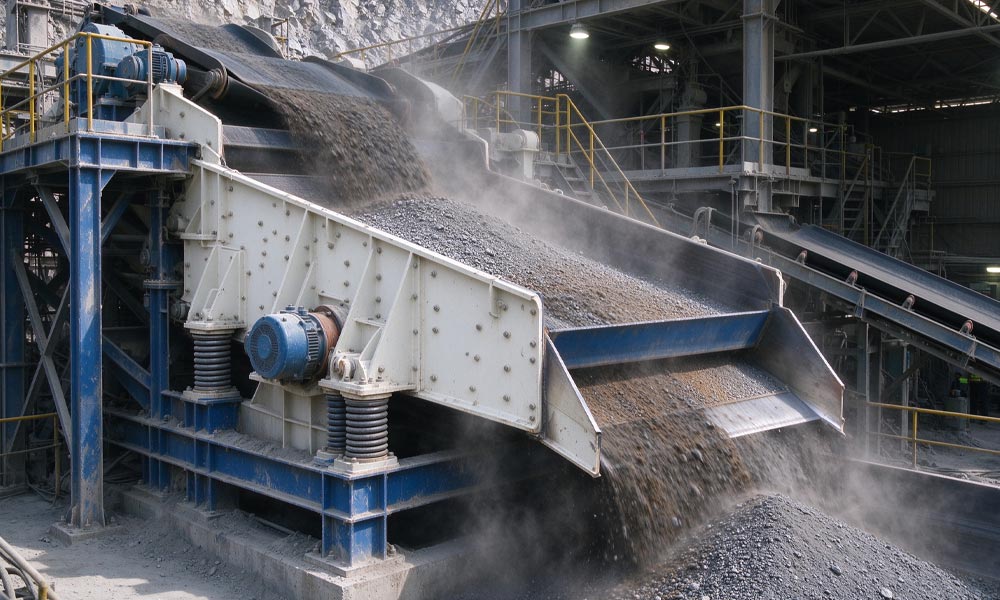
Motion is the second factor, and it is where plants quietly sabotage themselves. Stroke length sets how far the particle jumps, frequency sets how often, and deck angle sets which way the bed travels. A coarse scalp deck wants a longer stroke and a steeper angle so boulders move out fast; a fine wet deck wants higher frequency, lower amplitude, and a flatter angle so the near-size fraction gets a hundred chances to find the hole. When a Vibrating Screen Equipment is commissioned with the wrong orbit—say a coarse-ore stroke left on a 3 mm classify deck—the cut point goes soft, blinding climbs, and the metallurgist starts dumping reagents to cover a screening problem. The deck should be measured with a stroke meter on both ends, not guessed by ear, because a few millimeters of orbit difference can move the d50 by a full size class.
Screen Media and Aperture Geometry
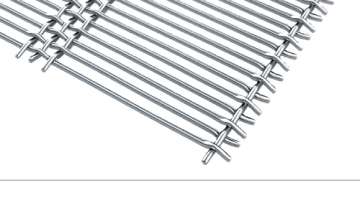
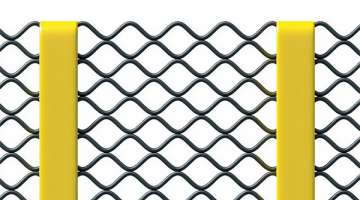
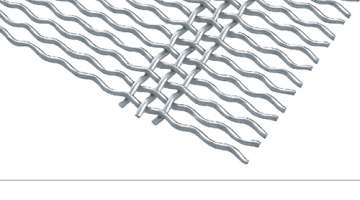
Third is the surface itself, and this is where the catalogue lies. Square holes blind, slotted holes self-clean, PU flexes sticky fines off the crown, wedge wire drains slurry, manganese eats impact, and 65Mn wears abrasives without crying. The right Vibrating Screen Equipment media is zonal, not universal: punch plate or manganese up top, lock-crimp woven wire on dry coarse sizing, polyurethane on the abrasive secondary deck, wedge wire where water has to leave the solids. Aperture must be matched to the true target cut, not the nominal mesh number—because in fine wet duty the effective cut often sits well above the hole, and a panel specified by legend instead of by PSD will ship the wrong product for weeks before anyone measures it.
Feed Rate, Moisture, and Near-Size Load
Fourth is the ore behavior nobody controls but everybody has to live with. Throughput that exceeds deck area turns the screen into a conveyor; moisture above the sticky threshold pastes the wires; and a PSD where 15–20 percent of the feed sits near the cut size is a pegging invitation no mesh can fully refuse. A Vibrating Screen Equipment that runs beautifully on dry porphyry can blind by lunch on a clay seam, so the circuit needs spray bars placed where slime actually forms, scalping ahead of the fine deck, and the discipline to throttle feed when the pit sends mud. Efficiency is not a fixed rating—it is a moving target the plant negotiates with the orebody every shift.
Maintenance Discipline and Condition Monitoring
Fifth is the unglamorous one: reliability. Bearings heat, springs soften, bolts back off, exciter masses drift, support bars cut the crown, and a deck that was perfect at commissioning becomes a different machine three months later. Plants with real Vibrating Screen Equipment efficiency do not wait for smoke—they log bearing temperature, check stroke and orbit monthly, torque the structural bolts on a route, measure aperture drift per panel position, and change media by crown loss instead of calendar panic. Condition monitoring turns efficiency from a lucky streak into a managed curve: the screen tells you it is tiring before it fails, and the plant books the window instead of eating the breakdown.
If your screen blasts fines into the coarse pile after rain, blinds on the clay seam, ships oversize to the mill, or simply never hits the cut point it was bought for, the problem is rarely one broken part—it is five factors quietly out of tune. Send us the ore type, PSD, moisture and clay load, deck positions, stroke and frequency, media photos, bearing-temperature history, and the size envelope your mill or flotation circuit actually depends on, and we can tune the Vibrating Screen Equipment as a system instead of swapping panels and hoping: feed distributor and bed-depth correction, stroke-orbit and deck-angle remap, zoned media from manganese to PU to wedge wire, feed-rate and spray strategy for sticky near-size ore, and a maintenance calendar driven by temperature, aperture drift, and tonnes screened. Do that, and the screen stops being the noisy box everyone complains about—stratification sharpens, the cut point holds across the shift, oversize goes back where it belongs, fines report clean to the next stage, and the Vibrating Screen Equipment finally runs at the peak the flowsheet was drawn for in the first place.