Getting Fine Particle Screening Right with Twill-Weave Metal Mesh
For fine particle separation in mineral processing, battery material production and powder processing industries, twill-weave metal mesh overcomes the bottleneck of plain weave mesh. It delivers stable micron-grade classification while maintaining superior mechanical strength, lowering frequent mesh replacement work and keeping consistent product grading during continuous long-run production.
Why Plain Weave Hits a Wall Before the Microns Get Interesting
Plain weave is honest and boring in the best way: one wire over, one wire under, square openings, predictable open area, easy to certify against ASTM E11or ISO 3310-1. The problem appears when mesh count climbs. To make a finer square aperture with plain weave, the wire has to get thinner, and at some point the wire is too thin to survive tensioning, abrasion, and the constant flexing of a vibrating frame. The cloth either loses dimensional stability, frays at the edges, or develops micro-kinks at every crossing that quietly change the effective aperture. That is the wall most plants run into around the upper end of square-mesh screening: they want a tighter cut, the only plain-weave option is a gossamer wire, and the screen becomes a maintenance event rather than a process asset.
How Twill Weave Changes the Load Path
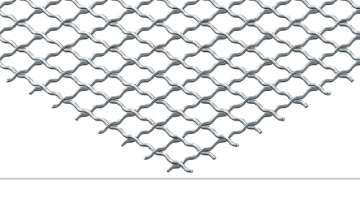
A Twill Weave Metal Mesh shifts the geometry: the weft wire passes over two warp wires and under two, the next weft offsets by one, and the surface develops that familiar diagonal rib. Mechanically, the wire bends less sharply at each crossing, so the metal carries load with lower internal stress during weaving and during service. That single change lets the weaver use a thicker wire at the same mesh count, which means more tensile strength, better resistance to wire displacement, and a cloth that does not quietly drift out of tolerance under high-frequency vibration. The aperture is still essentially square in a standard twill, but the structure behind it is tougher, so the screen holds its cut while a plain weave of equal fineness would be busy stretching and kinking. On a vibrating deck, that difference shows up as fewer change-outs and a d50 that stays put.
Fine Cut, Open Area, and the Throughput Compromise
The trade nobody mentions in the sales brochure is open area. A twill weave usually gives slightly less open area than a plain weave at the same mesh count, because the diagonal structure and heavier wires eat into the free space. On coarse duty that matters; on fine duty it is often the price worth paying, because a fragile plain weave that blinds in twenty minutes has an effective open area of zero by late morning. A Twill Weave Metal Mesh keeps flowing because the wires are robust enough to be cleaned, ultrasonically de-blinded, backwashed, or brushed without destroying the cloth, and because the diagonal ridges give particles a slightly different path than a dead-straight square hole. For dry powder screening — graphite, battery cathode, pharmaceutical intermediates — pairing twill mesh with ultrasonic vibration is one of the most reliable ways to keep a 325 or 500 mesh deck alive.
Aperture Stability Is the Real Product
What plants actually buy when they specify twill is aperture stability, not "a finer mesh." A fine cut is only useful if it stays a fine cut. Plain weave can give you the number on day one and lose it by week two; twill, with its thicker wire and lower crimp stress, resists the slow creep that turns a 75-micron screen into an 90-micron screen with no visible damage. In mineral processing, that stability protects flotation reagent economy, protects medium recovery ahead of dense-media cyclones, and protects product grade in any circuit where "a few microns of slip" compounds into tonnes of misplaced material per month. The screen media is the cheapest place in the flowsheet to defend a cut, and twill is one of the few woven structures that lets you defend it without dropping to a wire so thin it tears.
If you require twill-weave metal mesh for fine powder or mineral classification, our engineering team can recommend suitable wire diameter and mesh count according to your target micron cut, vibration parameters and material abrasion characteristics.