Two Methods for Installing and Securing Steel Gratings: Welding and Fastening with Mounting Clips
When it comes to locking down steel gratings in plants, mines, or industrial sites, the installation method matters—a lot. The wrong setup doesn’t just annoy maintenance crews; it risks real safety hazards, like grating panels that budge under heavy loads, trip workers, or just drop out of place. That kind of mistake leads to unexpected downtime and, worse, potential injuries. Most folks end up choosing between two approaches: welding or using mounting clips. Pick the right one, and you’re looking at a big drop in long-term costs and headaches.
What the Fixing Has to Survive Before You Choose a Method
Before comparing the two, it is worth naming the loads, because a fixing system that only has to resist gravity is a different problem from one that has to resist a vibrating plant floor. Steel gratings are nominally a walking surface, but in service they see point loads from dropped tools and staged equipment, lateral racking when the supporting steel flexes, uplift from wind on elevated walkways and from water or slurry surge in drainage channels, and — the one that actually breaks fixings — repeated small relative movement. Every maintenance visit, every thermal cycle, and every machine start-up nudges the panel, and a fixing that cannot accommodate that movement either loosens progressively or cracks at its most brittle point.
Welding: Permanence, Rigidity and the Coating Bill You Pay
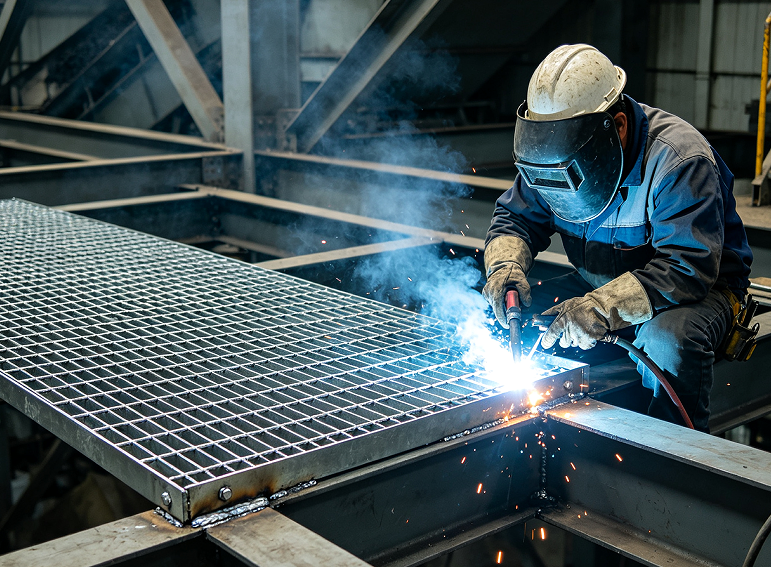
Welding is the traditional answer, and in the right place it remains the right answer, because a properly executed weld turns the grating and its support into a single rigid unit with no fastener to loosen and nothing to re-torque. On permanently installed walkways, on structural platforms that will never need lifting, and on areas subject to heavy or impact loading where a clip could be sheared, welded fixing gives a level of certainty that clamping struggles to match. The paperwork is the first cost: hot-work permits, fire watch, and in some plants a full shutdown of adjacent operations, all of which can make a two-hour welding job into a two-day administrative exercise. The technical cost is more serious and more often ignored — welding burns the zinc off hot-dip galvanized steel gratings in the heat-affected zone, destroys the sacrificial protection exactly where corrosion is most likely to start, and produces zinc oxide fumes that require extraction and respiratory protection. Any site that welds galvanized grating and then walks away without a zinc-rich repair system has created the rust line it will be repainting in three years. There is also a metallurgical caution worth stating: welding to the bearing bars rather than to the cross bars preserves load path, and welding a dissimilar stainless panel to carbon steel support introduces a galvanic couple that will show up as accelerated corrosion at the joint.
Mounting Clips: Speed, Reusability and the Discipline
Clip fixing — saddle clips, G-clamps, or purpose-made brackets that hook over the bearing bar and bolt to the support flange — has become the default in process plants for one overwhelming reason: it makes the grating removable. A panel that can be lifted in minutes is a panel that gets lifted, which means the cable tray, the sump, the valve or the chute underneath is actually inspectable instead of theoretically inspectable, and that single difference prevents more failures than any amount of extra steel. Clips also preserve the coating completely, since there is no heat, no grinding and no bare metal, so hot-dip galvanized steel gratings stay fully protected through installation and through every subsequent removal. They accommodate thermal expansion and minor structural movement far better than a rigid weld, and they can be specified as tamper-resistant for public or remote locations.
Welding Installation: Permanent Fix for Heavy-Duty Scenarios
Welding fixes the steel grating in place for good. You weld each load bar directly onto the steel support below. This locks everything together so even heavy forklifts or falling equipment won’t shake anything loose. That’s why busy ports and big industrial yards almost always go with welding—no one wants a grating coming undone in a high-traffic zone. You do need to grind smooth and repaint the welds to fight off rust, but that’s a small price for rock-solid stability.
Mounting Clip Fastening: Tool-Free Access for Easy Maintenance
Mounting clips, on the other hand, are the answer if you need to get under the floor every so often such as cleaning, inspections, or upgrades. Each clip secures the steel grating tightly with no drilling or welding needed. Need to lift a single panel? Just grab a wrench, pop it off, and you’re done. Power stations and water plants swear by clips because they need fast, tool-friendly access all the time. Plus, since there’s no welding, you don’t mess up the steel supports—a nice bonus for any area that changes layout a lot or only needs a temporary floor.
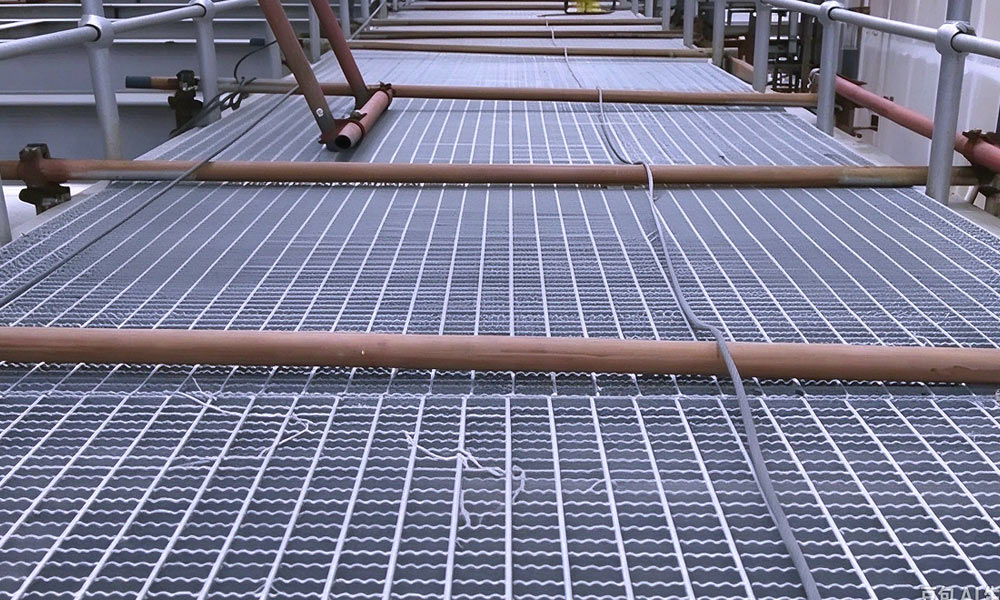
Both welding and clips can install and secure a steel grating., but they fit very different needs. Welding is your best bet for permanent, high-traffic areas where you want things to stay put. Clips shine in spaces that demand flexibility and regular access. Match your choice to how the area gets used, and you’ll get safer walkways, a smoother maintenance routine, and real savings over time.