Spare Parts Inventory Management of Screen Manufacturers: How to Reduce Stockout Risks for Customers
For mining operations, a screen downtime event without a critical spare part can halt production at immense cost. Traditional inventory models force a poor choice between customer capital tie-up and manufacturer stockouts. For screen manufacturers, transforming spare parts inventory management into a strategic service is key to customer loyalty. This requires a proactive shift from stocking parts to predicting demand and building a resilient network that actively reduces stockout risks for customers.
Implementing Predictive Demand Forecasting
Moving beyond sales history is essential. Leading manufacturers now integrate deeper data: aggregated telemetry from connected screens on runtime and load, regional ore abrasiveness indexes, and historical consumption patterns for specific wear parts. By building a predictive model, a manufacturer can anticipate, for example, that customers in a high-silica region will need primary deck panels 20% faster. This enables strategic pre-production and positioning of high-probability items near key markets before urgent orders arise.
Know Which Parts Actually Kill Uptime
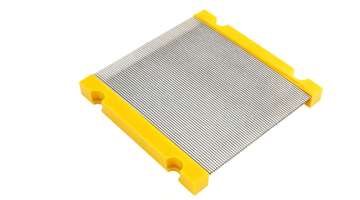
The first maturity step in Spare Parts Inventory Management is refusing to stock everything equally, because equal stocking is how a warehouse ends up full of cheap washers and empty on the one tapered polyurethane panel that fits the discharge deck. Screen plants should rank spares by failure frequency, lead time, unit cost, and consequence of absence. High-wear, short-life items—screen panels, rubber buffers, clamp bars, side seals, tensioning hooks—deserve local stock or at least a fast replenishment lane. Long-lead, high-consequence items—exciter bearings, specialized drive shafts, custom fabricated decks, rare alloy mesh—deserve forecast sharing, safety stock, and sometimes a consignment bin inside the customer’s own storeroom. A vibrating screen has maybe thirty to fifty recurring consumables and a handful of nightmare-long components; the manufacturer that maps those correctly stops guessing and starts protecting the exact parts that turn a planned changeout into a crisis. Customers should ask the supplier for that ranking, because a vendor who cannot tell you which SKU causes 80% of their downtime either has no data or is hiding it.

Data, Not Hope: Forecasting From Real Wear Curves
Hope is the enemy of Spare Parts Inventory Management. "We’ll order when they call" works for office supplies and fails miserably for screening plants, because by the time the operator reports torn panels, the wear was already three weeks old and the replacement would have taken two minutes during a planned stop. Better manufacturers build wear curves from install records: panel serial, deck position, ore type, moisture, stroke, tonnes screened, pull date, crown loss, aperture drift, and failure mode. From that history, the system forecasts "feed-end PU panels on Customer A’s copper scalper typically last 9–11 weeks," so the ERP auto-reserves stock in week 7 and prompts a pre-shipment reminder in week 9. This is not futuristic wizardry; it is just treating screening media like the consumable it is. A screen maker who sells hundreds of decks learns that limestone quarries blind mesh differently than zinc concentrators erode polyurethane, and Spare Parts Inventory Management that ignores application context will stock the wrong hardness, the wrong slot width, and the wrong hook profile. The customer’s job is to feed the supplier real operating data instead of treating the screen builder like a stranger who ships boxes.
Consignment, Kitting, and the 2 a.m. Problem
The clever part of modern Spare Parts Inventory Management is moving inventory closer to the pain. A standard FOB warehouse model means the part lives 800 km away and the truck leaves tomorrow; a consignment bin model means the critical hooks, seals, and panels sit inside the customer’s plant, owned by the supplier until consumed, counted by RFID or a shared dashboard, and replenished before the bin drops below the reorder point. Kitting is the quieter win: instead of shipping "a box of bolts," the manufacturer ships a changeout kit—panel set, edge seals, tension bars, grade-12.9 fasteners, hook strips, instruction sheet, and the torque values—so the maintenance crew cannot accidentally reassemble a deck with the wrong clamp and invent a new failure mode. For the 2 a.m. bearing seizure or the Saturday feed-end tear, the screen builder who already placed the right spare within walking distance of the deck has done more for plant reliability than any warranty clause ever will. Spare Parts Inventory Management done this way stops being a backroom accounting task and becomes field service delivered in advance.
Deploying a Tiered, Regionalized Inventory Network
A single central warehouse is inefficient for global demand. A smarter model uses a tiered spare parts inventory management system: a central warehouse for slow-moving, specialized items, complemented by regional stocking hubs or partnered distributors in major mining clusters. This places fast-moving, high-urgency parts—like drive belts or common screen panels—within 24-48 hours of key customers. Geographic diversification of inventory dramatically cuts lead times and reduces stockout risks by being physically closer to the point of need.
Providing Real-Time Inventory Transparency
Uncertainty drives over-ordering and secondary sourcing. A customer-facing digital portal that shows real-time spare parts inventory levels for their equipment models at the nearest hub builds trust and reduces panic. When a maintenance manager can see and reserve the polyurethane panel needed for next month's shutdown with one click, it eliminates the anxiety that fuels emergency calls and strengthens the manufacturer-customer relationship.

Engaging in Collaborative Planning with Key Accounts
For strategic partners, move to a collaborative planning model. Through quarterly business reviews, jointly analyze the customer’s maintenance schedules and production forecasts to co-create a spare parts inventory management risk plan. Options like consignment stock or vendor-managed inventory align your production cycles with their operational calendar, ensuring parts availability turns inventory from a cost into a shared value.
Reducing stockout risks for customers is about replacing guesswork with data-driven foresight and reactive logistics with a proactive, visible supply network. By forecasting demand, strategically placing inventory, offering transparency, and collaborating with key clients, screen manufacturers can turn spare parts inventory management into a competitive advantage and a core driver of customer retention and growth.