Anti-corrosion treatment process for metal woven screens in humid, acidic mining areas
Working in humid, acidic mines is tough on metal woven screens. They rust out or pit fast if you stick with standard materials. To stop them from becoming a constant headache and cost, you need a real anti-corrosion strategy—one that covers everything from the right metal to the final protective layer. That’s how you keep these screens working in places that eat regular gear alive.
Foundation: Selecting the Corrosion-Resistant Alloy
Start with the basics: pick the right alloy. In these punishing conditions, regular carbon steel just doesn’t cut it. You want 316 or 316L stainless steel—the molybdenum in these grades pushes back against both acid and chloride damage. If the acid is even worse, go straight to super duplex stainless steels like 2507. The alloy you choose decides how long your screen will last. It’s that simple.
Alloy First, Then Surface
No surface treatment can permanently save a fundamentally wrong base metal, so the anti-corrosion process for metal woven screens begins at the wire-mill door. Plain carbon steel with zinc may survive dry aggregate, but in acidic mine water the zinc sacrifices itself fast and the steel underneath goes orange before the first planned shutdown. 304 is a decent general screen alloy until chlorides arrive, then pitting starts at the wire crown. 316L earns its place with 2–3% molybdenum for pitting and crevice resistance, and it is still the workhorse for many wet copper, zinc, and gold circuits. Duplex 2205 steps in when chloride load and mechanical strength both matter, because its pitting-resistance equivalent is high and its yield strength lets you use a slightly finer wire without losing deck stability. For sulfuric-acid-leach or sour service, 904L’s high nickel plus copper chemistry resists reducing acids far better than ordinary stainless, though nobody should specify it for a dry scalping deck where manganese steel would be cheaper and tougher. The first rule of the process is simple: choose the alloy from the slurry pH, chloride, sulfate, and sulfide profile, because passivation cannot forgive an alloy that was never designed for the soup.
Pickling, Passivation, and the Passive Film
After weaving, crimping, cutting, and hook forming, metal woven screens carry contamination that the naked eye misses: free iron from tooling, oxide scale from heat, embedded abrasive from wire drawing, and chromium-depleted zones where the loom or weld generated heat. Pickling removes that damage. A nitric-plus-hydrofluoric acid bath dissolves heat tint, scale, and the thin chromium-poor layer, leaving fresh stainless surface that can actually form a protective film; citric or milder nitric routes are used when the mesh is fine, the tank size limits the part, or the plant wants a lower-hazard chemistry. Passivation follows, and this is the step plants love to skip—until they see red rust on "316L" three weeks after commissioning. Passivation with citric acid or dilute nitric acid strips remaining free iron and promotes a uniform chromium-oxide layer, the invisible shield that makes stainless stainless. For fine filtration mesh, electropolishing can go one step further: it smooths micro-peaks, reduces places for slime and biofouling to nest, and improves crevice-corrosion resistance in acidic, recycled process water. A serious supplier documents the bath concentration, temperature, dwell time, rinse water, and verification test—water-break test, ferroxyl/free-iron check, copper-sulfate test, or salt-spray comparison—because a metal woven screens panel without a verified passive film is just hope with a mill certificate.
Coatings, Edges, and Galvanic Traps
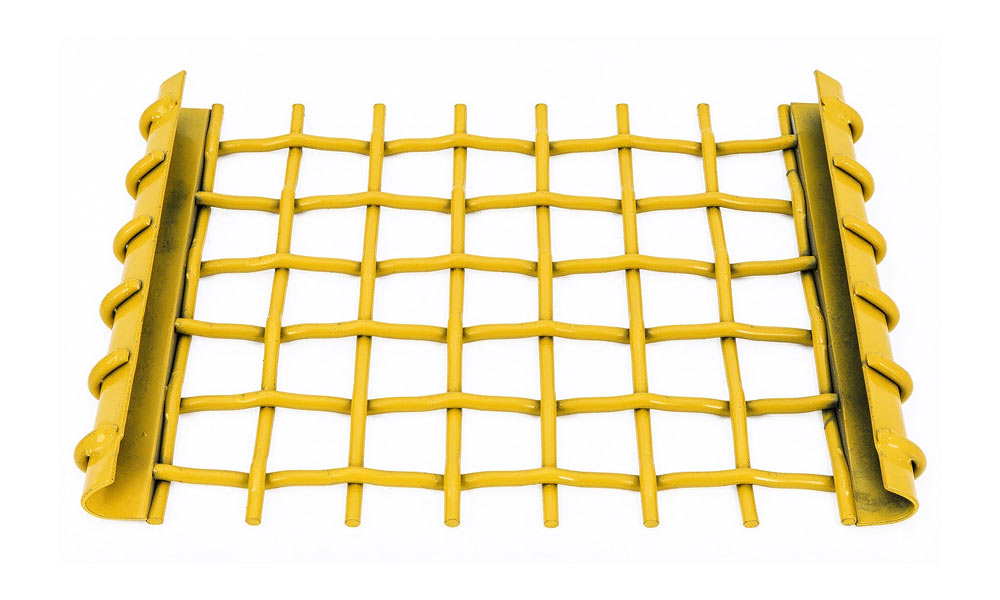
Surface chemistry is only half the battle; the installation system either protects the mesh or quietly kills it. Hot-dip galvanizing on carbon-steel metal woven screens can work in neutral-pH aggregate duty, but in acidic mining slurry the zinc layer can break down unevenly, leaving white rust, exposed steel, and local acceleration of attack. Where carbon steel must be used for wear or cost, pre-galvanized wire, thick epoxy or phenolic powder systems, or rubber/polyurethane edge caps can extend life—but coatings belong mostly on frames, feed boxes, and support structure, not on the working aperture where wear-through instantly ruins cut size. The edge is the real trap: a reinforced hook with a steel insert, a PU or rubber seal lip, and a dielectric gasket between the mesh and the carbon-steel deck stops the side plate from becoming a galvanic battery. Galvanic corrosion loves humid acidic mines—stainless mesh bolted straight to untreated carbon steel, with slurry as the electrolyte, will pit near the fastener while the frame barely notices. Good anti-corrosion practice specifies matching fastener metallurgy, neoprene or nylon isolation, and side seals that keep acidic fines from wicking into the crimp-to-bar gap.
Critical Preparation: Surface Blasting to Near-White Metal
Next, you’ve got to prep the surface before putting any coating on. That means abrasive blasting —and not just a quick once-over. Get down to near-white metal, getting rid of every speck of rust, mill scale, or grime. This leaves behind a clean, rough surface the coating can really grip onto. Half-baked prep work here leads to underfilm corrosion, and your expensive screens won’t make it.
Barrier Application: Multi-Layer High-Performance Coating
Now it’s time for the barrier itself — the multi-layer coating. In wet, acidic mining conditions, you need something tough: usually, that’s a three-layer setup. Start with an epoxy zinc-rich primer for extra protection, add a thick epoxy intermediate coat, then finish with a polyurethane topcoat that shrugs off chemicals. For really nasty acidic spots, you’re better off with coatings like fluoropolymer or ceramic-filled epoxy. The trick is making sure you hit the right film thickness — 250 to 400 microns — so the whole coating acts as an unbroken shield.
Verification and Maintenance: Ensuring Long-Term Performance
After all that, you need checks and regular upkeep. Measure the coating thickness with a gauge and run a holiday test to find any tiny misses in the coverage. Once the screen’s in use, keep an eye on it. Check every few weeks, especially where the slurry hits hardest. If you find chips or scratches, don’t wait around — patch them up with a touch-up kit before rust creeps in and spreads.
Doing all this isn’t just busywork. It adds years to the life of your screens and cuts down on replacement costs. Get the right alloy, prep it like you mean it, throw on a tough coating, and stay on top of repairs. If you’re not sure about the best combo for your mine’s humidity and pH, talk to a specialist. That way, you end up with screens that actually last.