Self-Cleaning Screen: Understand Stress to Extend Service Life
A Self-Cleaning Screen lives or dies by stress it cannot show you. On the surface it just flexes, throws out near-size particles, and keeps the deck open—but underneath that motion sits a continuous cycle of tension, compression, bending, and impact that, left untraced, finds the hook land, the clamp rail, or the slot root and cracks it open. Plants usually measure wear by how thin the crown looks, then act surprised when a panel with plenty of rubber left tears itself off the frame. Real life extension starts with reading where the stress actually concentrates, not with hoping the elastomer is tough enough. The screen is not failing randomly; it is failing at the points the stress map predicted all along.
Where the Stress Actually Lands
The first job is a stress map, even a rough field one. On a PU strip or harp-wire deck, the highest strain sits at the unsupported span midpoint and—more dangerously—at the clamp or molded root where the flexible element is gripped by the frame. Flip-flow panels add a second hot spot: the elastomer hinge where the mat snaps between the two vibrating masses, often running 30–50 G at the surface. A Self-Cleaning Screen that blinds is annoying; one that fatigues at the root is expensive. Capped support bars, rounded crown profiles, and a hook land that spreads load instead of pinching the strand turn a stress spike into a manageable gradient. If you only ever look at crown wear, you are watching the bruise while ignoring the broken bone.
Compound, Hardness, and Fatigue Reserve
Stress is filtered through the material. A Self-Cleaning Screen running too hard—pushed to 92–95 Shore A "for wear life"—loses rebound, the strand stops snapping back, and bending strain accumulates until micro-cracks start at the slot edge. Too soft, and the element over-deflects, scrubs against the support bar, and abrades itself to death while still "cleaning nicely." Polyether MDI polyurethane with tuned tear strength and compression-set resistance usually outlasts a cheap ester blend in wet, saline, or clay-loaded circuits because it keeps its elasticity instead of chalking under cyclic load. The life-extension lever here is not "harder," it is "enough hardness plus enough fatigue reserve to keep flexing after 10 million cycles." Tear strength and rebound matter more than the durometer number on the COA.
Motion Tuning Before Media Swaps
No compound survives a mistuned machine. Excess amplitude hammers the clamp, wrong frequency lets the bed pack instead of stratify, and a deck running near a resonance band turns every self-cleaning cycle into a shock load. A Self-Cleaning Screen wants stroke and frequency matched to the ore and the panel type: flip-flow needs the secondary mass phased to the mat, harp wire wants vertical energy without fatiguing the clamp, PU strips want enough orbit to relieve the slot without slapping the bar. Re-tension after the first shift, log stroke at feed and discharge ends, and kill resonance during run-up and coast-down. Most "premature" panel failures are really vibration settings the commissioning crew never checked with a meter.
Zoned Wear Strategy and Retirement by Evidence
The last move is to stop retiring panels by calendar. Feed-end modules take the lump and should be reinforced or swapped early; the fine sticky zone does the most flexing and needs the most rebound; the discharge lip usually wears thin from drainage drag. A Self-Cleaning Screen program that logs crown loss, slot drift, blinded area after 30 minutes, and rebound decay turns replacement into a per-zone decision instead of a full-deck scramble. Pull the worn third, leave the rest, reinforce the root, cap the bars, and the same panel family suddenly runs months longer. Life extension is rarely one miracle material—it is stress-aware geometry, tuned motion, and a wear log that tells the truth before the deck tears.
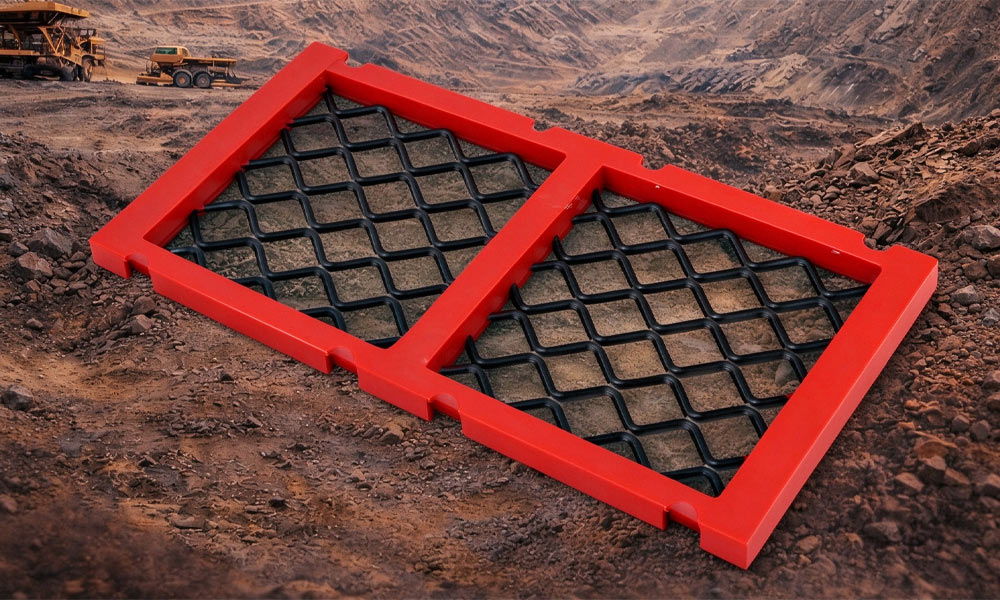
If your self-cleaning decks keep tearing at the clamp, losing flex after a month, or dying with crown still left in the middle, the stress was never measured—only the price was. Send us the ore type, moisture and slime load, PSD and near-size band, deck model, stroke and G-force, current panel photos, and where the cracks actually start, and we will spec a Self-Cleaning Screen life-extension package instead of another roll of hope: stress-mapped slot and root geometry, zoned Shore A from reinforced feed nose to flexible fine zone, polyether MDI compound with fatigue reserve, cushioned support bars, phased flip-flow or harp tuning, re-tension procedure, and retirement by crown loss, rebound, and aperture drift. Do that, and the panel stops committing suicide at the clamp—it wears slowly where the ore hits it, keeps snapping near-size particles out of the hole, and runs the campaign on evidence instead of on the shift supervisor's bad feeling.