Design of the Embedded Steel Wire Skeleton of Rubber Screen Panels and Deformation Resistance
The long-term performance and reliability of rubber screen panels in harsh screening environments hinge on a crucial internal component: the embedded steel wire skeleton. This framework is not a simple add-on but a core engineering element that directly defines the panel's structural integrity and deformation resistance. A well-designed skeleton prevents the rubber from stretching, warping, or failing under the high tension of installation and the continuous stress of operation, ensuring the screen maintains its shape, aperture accuracy, and secure fit throughout its lifespan.
Why the Steel Skeleton, Not the Rubber Thickness
Buyers naturally ask for a thicker Rubber Screen Panel when blinding or stretching becomes a problem, yet thickness is mostly a wear-budget decision, while dimensional honesty under load comes from the skeleton hiding inside. Rubber wants to flow: under thousands of vibration cycles, elevated deck temperature, and the repeated punch of coarse lumps, the polymer creeps, and without internal reinforcement the apertures elongate, the panel lips roll, and the discharge grade quietly drifts. An embedded steel wire structure acts like a tendon system—it does not make the panel rigid like steel plate, which would kill the rubber’s anti-blinding bounce, but it sets an elastic envelope so the panel returns to shape instead of taking a permanent set. The wire layout has to follow the stress paths: more steel near the tensioning hooks and support edges, balanced distribution across the open area so the crown between apertures does not drum, and enough bond surface that the rubber grips the wire under shear instead of letting it slide. A Rubber Screen Panel with a poorly bonded skeleton is worse than none at all, because the steel eventually walks, punctures the wear face, and leaves the operator staring at a rust streak where a clean screening surface used to be.
Wire Geometry, Embedment Depth, and the Art of Controlled Flex
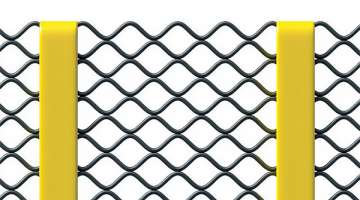
The skeleton is not a single straight rod frozen into the mold; in well-designed panels it is a mapped lattice—straight tension wires, curved edge reinforcements, sometimes crimped or woven inserts—chosen so the Rubber Screen Panel flexes locally at the aperture but stays stiff globally across the deck. Embedment depth is where many suppliers cut corners: too shallow and the wire sits near the wear face, exposes itself to abrasion, and becomes a corrosion seed; too deep and it stops controlling surface deformation, leaving the rubber crown free to peg and flutter. Wire diameter and tensile grade matter too, but only in context—a high-tensile thin wire may control creep beautifully yet puncture during lump impact, while a heavy low-carbon rod may resist punch-through but make the panel sluggish and prone to permanent bulge. alive” on the deck—bouncing sticky fines, absorbing impact, yet holding aperture—it is usually because the skeleton was drawn like a suspension bridge, not thrown in like rebar offcut.
Providing Core Structural Integrity
The skeleton's primary function is to act as an internal backbone. High-tensile steel wires, arranged in a precise grid, are fully vulcanized into the rubber screen mesh. This integrated structure carries the mechanical loads—especially the installation tension across the deck—that pure rubber cannot handle. It counteracts rubber's natural tendency to creep or elongate, keeping the panel taut and flat. This dimensional stability is essential for consistent screening performance and preventing edge failures.
Key Design Elements for Optimal Performance
The skeleton effectiveness of rubber panel is determined by specific design choices. The geometry of the wire mesh is optimized to evenly distribute stress. The gauge of the wires is selected based on panel size and operational tension; larger panels demand thicker, stronger wires. Most critically, the quality of integration during vulcanization is paramount. The steel must be perfectly bonded to the rubber. Any delamination creates a weak point where stress concentrates, leading to localized deformation and premature panel failure.
Direct Contribution to Durability and Cost Efficiency
A strong skeleton keeps the panel stable, so it resists bending or stretching along its length, doesn’t curl at the edges, and stays flat as it should. In tough environments, it helps soak up and spread out force, which protects the rubber screen from getting punctured or torn. All this means the panel lasts longer, you don’t have to stop as often for replacements, and running the whole screening operation just costs less in the long run.
While the surface of rubber screen panel handles wear, the embedded steel wire skeleton is the foundational element that ensures long-term durability and shape retention. Its design is a critical engineering consideration tailored to specific screening demands. Choosing panels with a properly engineered skeleton is an investment in predictable performance, guaranteeing that the screens maintain their critical deformation resistance under sustained industrial stress. Reach out to our engineers to learn more about reinforced rubber screen panel solutions for your mineral screening plant.