Structural Advantages of Polyurethane Screens In Preventing Clogging for Screening Sticky Materials
Processing sticky, high-moisture materials like clay-rich spodumene is a constant fight against screen blinding. The structural design of polyurethane screens tackles this problem at its source, turning a maintenance-heavy bottleneck into a reliable process stage. Unlike traditional steel decks, these features are engineered to prevent material adhesion before it starts, cutting daily cleaning time by over 70% for many mineral processing plants.
Inverted Tapered Aperture Geometry
The key anti-clog feature of polyurethane screen plate is the inverted tapered opening, where the top is narrower than the bottom. This expanding shape prevents near-size sticky particles from wedging in place, allowing them to slide through once they pass the narrow entry. Australian lithium sites report this single change reduces lodged-particle blinding by over 60% when processing 9% moisture feed.
Elastic Flex: The Panel That Slaps the Mud Back
The first structural trick is rebound. A woven wire screen is stiff; when a sticky particle lands in the aperture, the wire barely moves, the particle sticks, the next particle lands on top, and within minutes the opening is gone. A polyurethane screen panel has elastic stored energy: the deck stroke flexes the panel locally, the near-size clot deforms, and on the rebound the panel snaps back harder than the slime’s adhesion can hold. That micro-bounce is why PU panels "self-clean" instead of blind—not because the material is magical, but because the structure returns energy to the particle instead of inviting it to stay. On high-frequency fine screening this matters even more: the panel vibrates at a rate the sticky cake cannot track, so the bond between particle and surface keeps breaking. A good polyurethane screen panel is not maxed out on hardness; it runs in a Shore band where rebound stays high enough to reject the clot but the crown is still tough enough not to tear on angular gangue. Sticky feeds punish rigid screens and reward resilient ones, and elasticity is the structural reason why.
Tapered Slots: Built to Reject, Not Trap
Square holes are traps for sticky stuff; the top and bottom of the aperture are the same width, so once a damp lump enters halfway, it is wedged by surface tension and bed pressure. The polyurethane screen panel wins here because the slots are usually tapered—narrower at the feed face, wider toward the underside. A sticky near-size particle enters the tight top, meets vibration and gravity, and instead of locking it gets pushed into a widening channel where adhesion loses its grip and the particle is ejected back into the bed. This is structural design, not coating chemistry: the aperture itself is shaped to make clogging geometrically unfavorable. Long slotted profiles also let elongated sticky particles orient along the slot and travel instead of pegging across it. A polyurethane screen panel with 0.3 mm top / 0.5 mm bottom slots will keep screening long after a steel square mesh of "similar size" has turned into a clay sheet, because the steel mesh has no taper to forgive the feed.
Surface Skin and Low Stick Geometry
Polyurethane can be molded with a smoother, lower-surface-energy skin than wire crowns that carry drawing marks, rust micropits, and crimp scars where slime loves to grab. A well-cast polyurethane screen panel has a polished top skin, rounded ridge tops, and molded relief features—dimples, pyramids, corrugations—that break the contact patch between the sticky bed and the panel. Flat steel wire gives the sludge a continuous ledge; a ridged PU panel gives it a few tiny contact points and a lot of air. Water and fines slide along the crest while the valleys drain, so the bed never gets a flat wet mattress to adhere to. Some formulations add anti-stick additive packages or release-friendly mould finishes, but the bigger lever is geometry: a polyurethane screen panel that looks "busy" on top is usually the one that stays open, because every ridge is a little ramp telling the sticky fraction to keep moving or fall through, not park.
Independent Flexible Rib Layout
Instead of a rigid sheet, these PU screen mesh use narrow, independently flexing support ribs. Each rib moves slightly out of sync during vibration, constantly micro-shifting aperture shapes to break apart sticky clusters before they form a solid mat. This eliminates dead zones where slime builds fastest, extending runtime between full deck washes by 10+ hours without losing efficiency.
Smooth, Rounded Aperture Edges
Cast polyurethane apertures have naturally smooth, rounded edges, unlike machined steel which leaves tiny burrs. These burrs act as anchor points for fine slimes to grip and start caking. By removing these anchors, polyurethane screen mesh stops the gradual blinding that can seal off 30% of a steel deck's open area in a single shift.
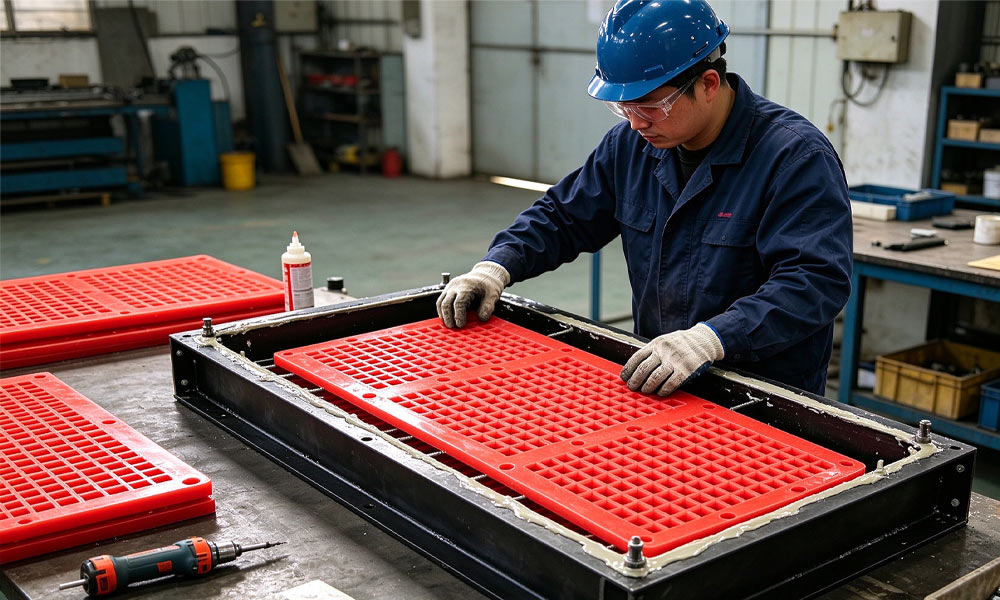
If your operation is wasting hours scraping blinded steel screens, these are not lab theories but daily gains. Most sites see a payback on upgraded polyurethane screen panels in under 7 months through higher throughput and less downtime. Contact a screening specialist familiar with your ore type for a trial panel matched to your feed conditions.