Analysis of Wear and Acid Resistance of Polyurethane Screen Panels in Phosphate Ore Beneficiation
Phosphate ore beneficiation is tough on screening equipment. You’re dealing with abrasive minerals, and most of the water running through these plants is acidic from flotation or leaching. Polyurethane screen panels sound like a great choice—they’re known for standing up to wear—but if they can’t handle both the grinding and the acid, you’re going to see a lot of downtime and wasted money.
Abrasive Wear from Phosphate Gangue Minerals
Let’s talk about wear first. Phosphate ore isn’t just phosphate; it’s packed with hard minerals like quartz and silica sand. These particles scrape and gouge the screen through three-body abrasion—that means hard bits get caught between the panel and the passing ore, chewing away at the surface. The best PU panels for this job aren’t the standard ones. You want a high durometer Polyurethane screen, sometimes filled with ceramic or mineral particles. These fillers make the panels tougher—they resist cutting and last much longer.
Silica Gangue, Not the Phosphate Mineral, Does the Cutting
Operators often say “phosphate is soft, so PU should last forever,” but the soft francolite or collophane is rarely what destroys a Polyurethane Screen Panel; the gangue is. Sedimentary phosphate deposits ride with quartz, chert, silicified limestone, heavy minerals, and coarse sand that behave like embedded cutting tools every time the deck throws material forward. The wear mode is usually three-body abrasion: sharp fines get trapped between the passing bed and the panel surface, the crown between slots sees concentrated micro-cutting, and the support rib roots take fatigue from cyclic flexing under vibration. Polyester-based polyurethane can post excellent dry-abrasion numbers because its hard segments and tighter chain packing resist cutting, but phosphate circuits are rarely dry, and that is where the plot twists. A high-durometer panel around 90–95 Shore A resists slicing better on coarse scalping, yet if the feed carries slabby lumps or the screen box is mistuned, the same hardness makes the polymer brittle under millions of stress reversals and cracks start at the aperture bridge. The practical answer is zoned resilience: impact nose soft enough to absorb the feed landing, main deck hard enough to resist silica cutting, and aperture walls formulated for tear strength rather than raw hardness. A Polyurethane Screen Panel that wears gradually and keeps its slot width is worth far more than a harder panel that resists cutting for six weeks and then cracks across the rib.
Hydrolysis Is the Slow Murder Polyester Panels Don’t Survive
Phosphate plants love to talk tonnage and grade, but the process water tells the real material story, because flotation circuits, acid leach, scrubber overflow, and phosphogypsum handling can leave slurry acidic, warm, and chemically busy. Polyester polyurethane has great dry-abrasion credentials, yet its ester linkages are hydrolytically labile: water plus acid penetrates the matrix, nucleophilic attack cleaves the soft segment, the polymer loses tensile strength, the crown chalks, the panel swells, and the aperture that was 0.8 mm on arrival drifts enough to ship off-spec concentrate. Polyether-based polyurethane is the steadier choice for phosphate washing and dewatering because the ether bond is chemically indifferent to water, water uptake is lower, and with carbodiimide anti-hydrolysis stabilizers the panel keeps rebound and tear strength through months of pH-swung duty. MDI-based prepolymer systems also give better dimensional stability than loose TDI blends, especially when the deck sees warm acid slurry, steam from washers, and sunlight on the outdoor screen house in the same week.
Acid Softens, Abrasion Finishes, and Datasheets Lie About Both
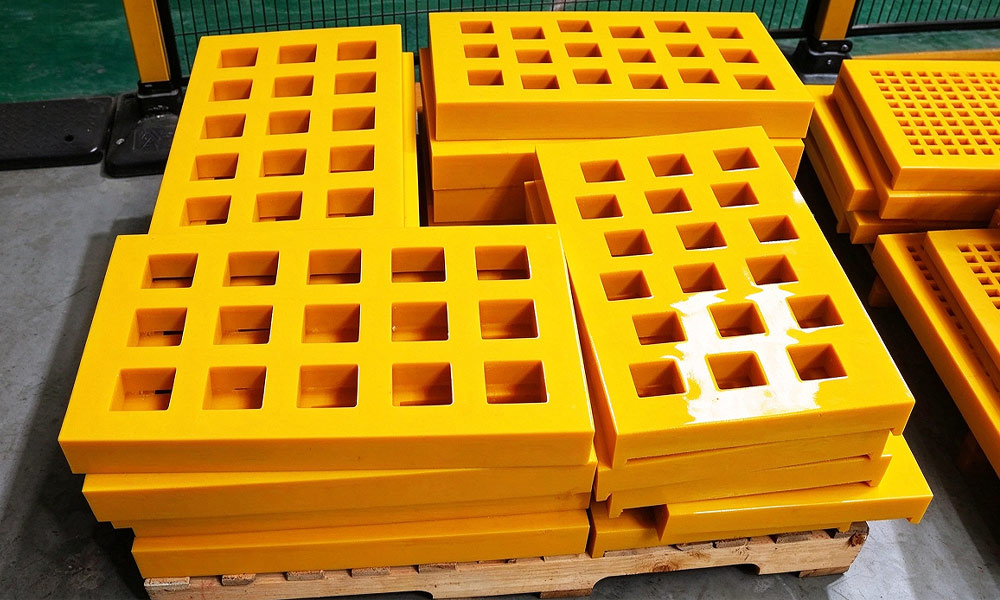
The failure that ruins budgets is synergistic, not additive, because acid attack and abrasive wear feed each other in a loop the procurement spreadsheet never models: acid or warm process water hydrolyzes the surface, the polymer loses surface hardness and tears more easily, sharp silica then gouges the weakened crown, abrasion exposes fresh polymer, and acid attacks the fresh surface again. That is why a Polyurethane Screen Panel can show “good acid resistance” in a static phosphoric-acid beaker and “excellent abrasion resistance” in a dry sand wheel, yet still fail early in a phosphate deslime deck where acid, heat, fines, and vibration arrive together. Smart operators stop trusting single-property brochures and ask for application-matched evidence: DIN or ASTM abrasion loss, Shore A before and after aging, tensile and tear retention after immersion in the plant’s actual slurry, water absorption, swelling percentage, and aperture enlargement after a fixed run. Fillers matter too—ceramic micro-particles, silanized minerals, or wear-grade loadings improve cut resistance but can reduce hydrolysis stability or make the compound brittle if badly balanced.
Chemical Degradation in Acidic Slurries
But abrasion is just half the battle. The process water in these plants is often acidic, especially after using sulfuric or phosphoric acid during flotation. This is where regular polyester-based polyurethanes fall short. Acids break down the polymer—chains start snapping, the surface softens and cracks, and suddenly your wear-resistant panel just isn’t tough anymore. The key is to use polyurethane screen plate to resist hydrolysis—specifically, MDI-based formulations. These are far more stable in acid, so they hold their structure and stay strong much longer.
The Synergistic Effect: Accelerated Failure
It gets worse when abrasion and acid team up. Acid weakens the polymer right at the surface, making it softer and that much easier for abrasive particles to rip it apart. At the same time, abrasion keeps creating fresh surfaces for acid to attack. That kind of synergy means real-life wear is way faster than what you’d see if you only tested for abrasion in neutral water.
Validating Performance with Application-Specific Testing
So, what do you do? Don’t trust a generic datasheet. You need application-specific testing. The best approach is to test candidate polyurethane screen panels in the lab—use real phosphate ore and acidic process water, and run them in a wear tester. Then check how much volume they’ve lost and measure any change in hardness and strength. That’s the only way you’ll get a realistic idea of how they’ll actually perform in your plant.
At the end of the day, there’s one clear rule: always start with acid-resistant polyurethane panels in phosphate beneficiation. Once you have that, look for the hardest grade you can get, ideally with added wear-resistant fillers. Work with suppliers who get these challenges and can back up their claims with real-world data. Investing in the right panels from the start saves you from expensive failures and the headaches of unexpected downtime.