Factory Quality Inspection Process for Polyurethane Screens
For mining, quarry and industrial operations that rely on Polyurethane Screen panels to run their production lines smoothly, knowing that every batch they receive has gone through a strict, documented factory quality inspection process is one of the most important ways to avoid unexpected premature failures and unplanned downtime on site. Too many teams have received shipments of screens that looked perfectly fine on the surface, only to have them tear or deform after just a few days of heavy production, because the supplier skipped critical material performance tests and only did a quick visual check before packing the order. A complete, multi‑stage quality inspection workflow for every Polyurethane Screen batch eliminates these hidden quality risks, making sure every panel that leaves the factory meets the exact performance standards the client paid for.
Raw Material Pre‑Production Performance Testing
The very first critical step in the full inspection process happens before any casting work even starts, where the factory’s quality control team takes samples from every batch of incoming polyurethane raw material to test its base hardness, tensile strength and elongation properties, to confirm the material fully matches the formulation specified for that Polyurethane Screen order. If any raw material sample fails to hit the exact hardness range or meet the minimum required tensile strength, the entire batch of raw material is rejected and never used in production, so no underperforming material ever gets cast into finished panels.
Hardness Check on the Panel and the Button
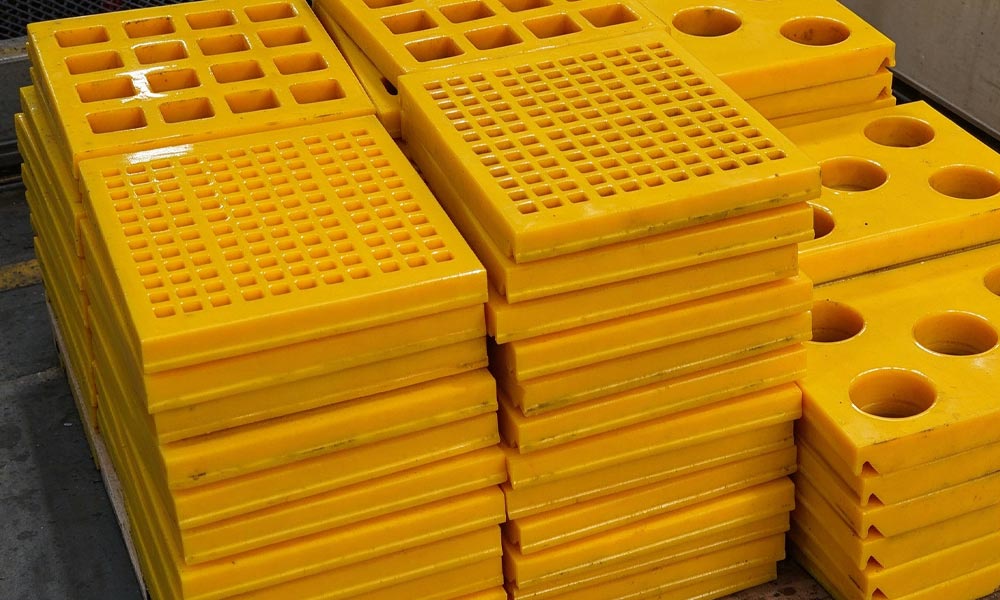
The first test on the factory floor is Shore A hardness, because it is cheap, fast, and brutally honest about cure state. A Polyurethane Screen meant for mining or aggregates usually targets a Shore A band somewhere in the 80–95 range, and Chinese national practice for polyurethane screen plates puts the nominal hardness at Shore A 80–95 with an allowable tolerance of ±3 and a same-panel difference not greater than 2 points. The technician does not jam the durometer onto the slot edge or a mold flash line; the reading is taken on a flat, clean area with no bubbles, no impurities, and no curvature that would fool the indenter. ASTM D2240 / ISO 868 thinking applies even in a workshop: specimen or local area at least about 6 mm thick, indenter at least 12 mm from the edge, durometer vertical, firm contact without shock, reading after roughly 1 second, and at least five readings averaged. If the panel is too thick or molded to measure directly, the factory uses a same-batch witness button cured from the same pour, because the button and the panel share the same chemistry, the same pot life, and the same oven history.
Tensile Strength as the Network Integrity Test
Hardness tells you how the surface resists a poke; tensile strength tells you whether the polymer chain actually holds together when the deck tries to pull it apart. In the lab, the factory molds or die-cuts dumbbell specimens—common ASTM D412 Type C dogbones around 115 mm long, 6 mm wide in the narrow section, about 3 mm thick—conditions them near 23 ± 2 °C and 50 ± 5 % RH, measures width and thickness in the reduced section, then mounts them in a universal testing machine and pulls at roughly 500 ± 50 mm/min until rupture. The machine reports tensile strength as maximum force divided by original cross-sectional area, plus elongation at break, which for many screen-grade polyurethanes sits in the several-hundred-percent range. Reference polyurethane screen-plate specs split by compound type: polyester-type plates can be specified around ≥40–48 MPa tensile and ≥500–600 % elongation, while polyether-type plates may be specified around ≥30–40 MPa tensile and ≥300–400 % elongation, with tear strength and abrasion volume loss listed alongside them. A Polyurethane Screen for wet, abrasive ore does not need the highest tensile number on paper; it needs the right balance—enough strength to resist ligament tearing, enough elongation to rebound instead of cracking, and enough tear/abrasion reserve to survive sharp particles.
Batch Release, Records, and the Audit Trail
The part buyers forget is that factory QA is only as good as the paper behind it. A mature Polyurethane Screen plant ties every test to a batch number: prepolymer NCO check, polyol moisture check, mix ratio and pot life log, mold temperature and cure time, demold time, post-cure condition, witness-button ID, hardness readings with time and location, tensile specimen ID, elongation, tear, abrasion, and—where the duty demands it—hydrolysis, compression set, rebound, and metal-backing bond strength. Dimensional inspection runs in parallel: length, width, thickness, aperture width, slot length, crown height, and fastening details are measured with caliper, gauge, or microscope, because a panel can be chemically perfect and still useless if the slot wandered 0.15 mm outside tolerance. The release rule should be blunt: one hardness point out of band triggers retest, repeated drift triggers hold the batch, tensile below the compound spec triggers root-cause on cure and mix ratio, and any panel with bubbles, cold-shut marks, exposed reinforcement, or uneven shore across the face gets rejected regardless of how good the certificate looks. Final inspection is rarely 100% destructive, but a credible program pairs 100% visual/dimension checks with statistical destructive sampling, so the tenth container behaves like the first one and the metallurgist is not the unpaid QA department.
Finished Panel Post‑Production Full Verification
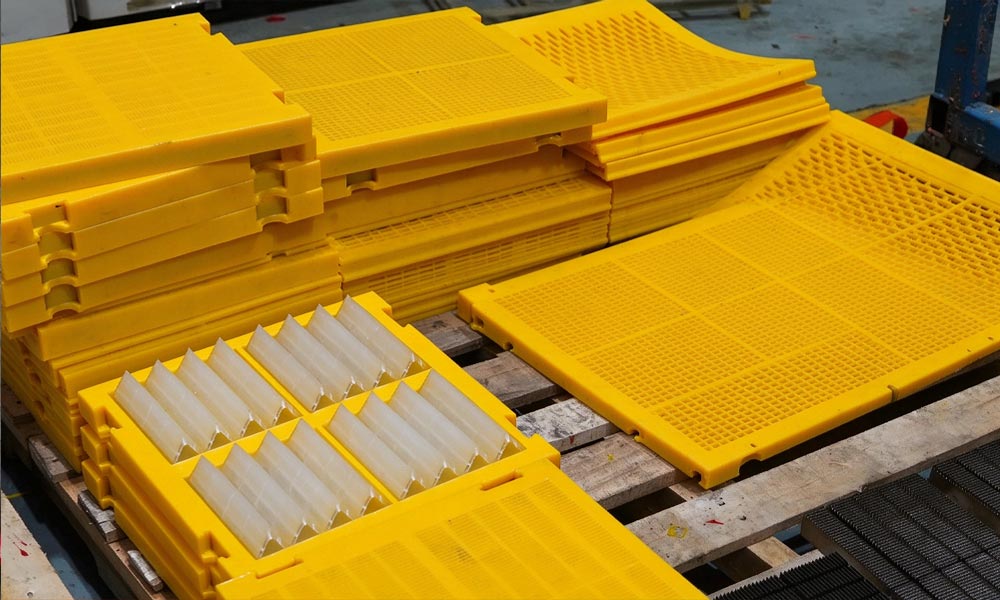
After every Polyurethane Screen panel goes through the full curing cycle, the quality team runs a second round of targeted tests on finished product samples pulled directly from the production batch, rechecking surface hardness across multiple points on the panel, running tensile tests on cut sample strips, and verifying all critical dimensional and aperture accuracy details. Only after every single test result falls fully within the pre‑agreed specification range will the entire batch be approved for final packaging and shipment to the client.
A strict, fully documented factory quality inspection process that covers hardness, tensile strength and all other core performance parameters ensures every Polyurethane Screen you receive will deliver the long service life and consistent performance you expect, instead of running into unexpected early failures that shut down your production line. If you need a supplier that can provide full test reports for every batch of screens you order, our quality control team can share full inspection data with your team before every shipment to confirm all parameters fully match your requirements.