Application of Polyurethane Dewatering Screen Panels in Mine Tailings Dry Stacking
Polyurethane dewatering panels have become essential for mine tailings dry stacking. They’re built to handle the heavy, abrasive flow of tailings you find in mining—and they do that job better than traditional metal screens. You get tailings with much less moisture left in them, and the whole process just runs smoother.
Superior Wear Resistance and Extended Service Life
The big advantage here is durability. These panels are made from high-performance polyurethane that can bear twice the load of rubber screens. Because they flex naturally, they absorb the force of fast, heavy tailings with ease. They don’t just take a beating either—they resist wear, chemical corrosion, and stay tough even when temperatures drop as low as -35°C. This means you spend less time shutting down for repairs or replacements, and your operation runs more efficiently.
Why Filter Cake Duty Looks Nothing Like Normal Screening
Anyone transferring a screening specification from a sizing deck to a tailings dewatering deck discovers the mismatch within the first shift, because the physics are almost inverted. On a sizing screen, the goal is to pass undersize and keep oversize moving, and the bed stays relatively thin and mobile. On a dewatering deck the objective is the opposite: retain nearly all of the solids, build a filter cake on the surface, and drive water out through that cake and through the apertures underneath it, so the bed is deliberately deep, deliberately slow-moving, and carrying a load that is measured in kilopascals of cake weight per square metre rather than in impacts per second. That cake is also the filter medium, which is the detail many specifications miss — the panel does not do the fine separation, the cake does, and the panel's job is to support the cake, let water leave fast enough that the stack gains strength, and hold the solids back with an aperture far finer than anything a conventional tailings screen would ever be asked to run. A polyurethane dewatering panel suits this because it can be cast with apertures in the 0.1 to 0.5 millimetre range, far finer than woven wire can hold under a heavy wet bed, and because its surface has enough resilience to release the cake at the discharge lip rather than holding a heel of material that gradually reduces the working area of the deck.
Open Area, Taper and the Rate at Which Water Is Allowed to Leave
Once the cake has formed, throughput on a dewatering deck is governed by how
quickly liberated water can get off the panel, and that is where the geometry
earns or loses its money. Water leaving a thickening cake has to travel through
the cake itself, then through the aperture, then clear of the underside of the
panel, and each stage can bottleneck the next; a panel with insufficient open
area will hold water against the cake, the cake stays saturated, and the
conveyor takes a product that slumps instead of standing. Effective open area on
these decks is typically pushed as high as the structure allows — often 30 to 40
percent — which is achievable in cast urethane because the webs between
apertures can be made thin while tapered, countersunk openings let a water
droplet exit rather than cling, and the same taper stops a fine particle from
seating permanently inside the hole. Taper matters for a second reason that
tailings operations care about directly: because the narrow end sits on the
discharge face, the effective cut stays at specification as the entry wears, so
solids reporting to the filtrate stay within the range your thickener and water
return circuit were designed around rather than slowly climbing over the life of
the panel. The trade-off against the pursuit of open area is mat strength, since
a lattice that is 40 percent aperture is mostly hole, and a cake several
centimetres deep is a genuinely heavy static load sitting on top of it.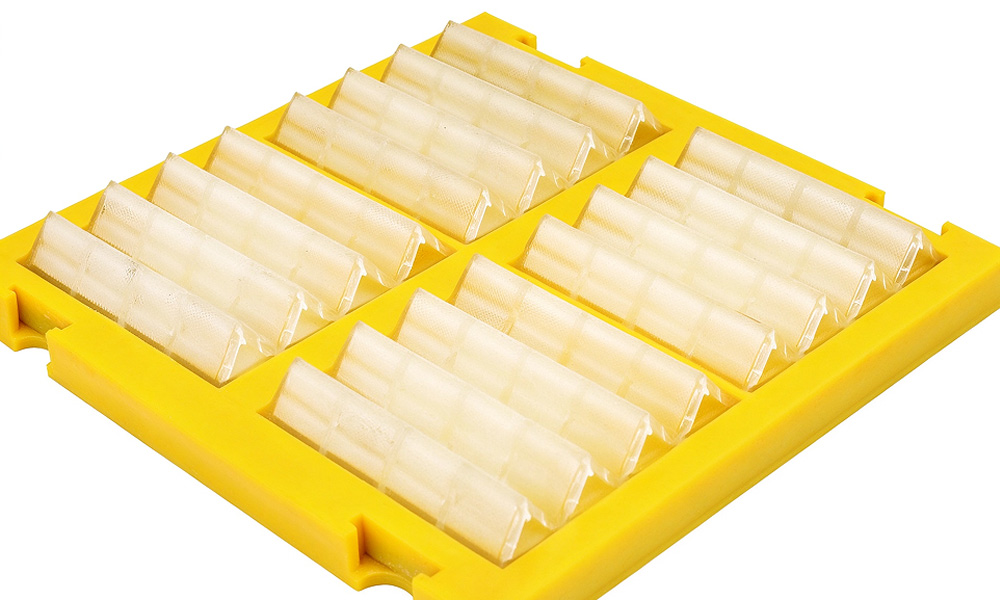
Optimized Structure for Efficient Dewatering
Design matters too. The panels have narrow, carefully cut slots that let water escape while stopping fine particles from clogging things up. Pair them with linear vibrating screens and a hydrocyclone, and you’ll see great recovery of fine sand and much drier stackable tailings. They burn through less energy than older dewatering setups, too. Plus, the modular design means you can swap out a damaged section on the fly without taking apart the whole screen—so maintenance is quicker and less of a hassle.
Noise and Vibration Reduction for a Safer Work Environment
There’s another benefit that’s easy to overlook: noise and vibration. Polyurethane is a natural dampener, so these panels run quieter than steel screens and shake the frame less. That’s better for your workers—and easier on your equipment over time.
If you’re struggling with low dry stacking rates or tired of high maintenance costs from your old screens, these polyurethane panels make a real difference. Reach out if you want a tailored solution that lifts productivity and makes your operation more efficient.