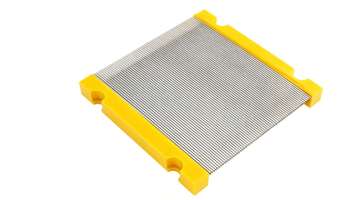
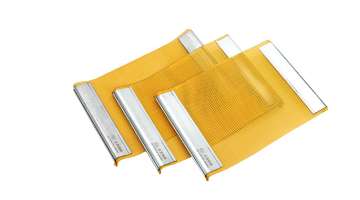
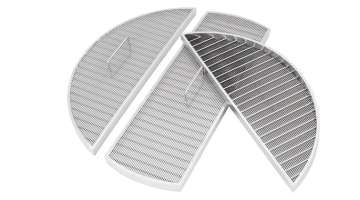
Modular Pre-tensioned Metal Woven Screen: Design for Installation Without On-site Tensioning
Most metal woven screens need skilled workers on site to tension them, and that takes time. If the tension isn’t uniform, you end up with weak spots and shorter service life. In busy field environments, getting that perfect tension is rarely easy, and results can vary—even with experienced crews. That’s where the Modular Pre-tensioned Metal Woven Screen steps in. It moves the whole tensioning process to the factory, so you don’t have to wrestle with it on site. Every panel comes ready to install, which means consistent performance, less downtime, and simpler maintenance—whether you’re working in mining, aggregates, or recycling.
Core Design: Factory Precision for Field Simplicity
At the heart of the design: all the tricky tensioning happens in the factory. They mount the woven wire screen onto a strong steel frame, tension it with precision tools, and lock it in place for good. Every modular metal woven screen leaves the factory with the exact tension it needs—no guesswork, no field improvisation.
Factory Tension as a Manufacturing Process, Not a Site Skill
The dirty secret of hook-strip screens is that the same mesh can leave the warehouse perfect and arrive at the deck compromised, because tension lives or dies in the hands that pull it, and human hands on a vibrating-frame changeout are rarely calibrated. A Modular Metal Woven Screen solves this by treating pre-tensioning as a controlled production step: warp and weft are pulled on a fixture with measured load, the cloth is allowed to relax so the crimp settles, then the perimeter is captured in a rigid frame by epoxy, weld, mechanical crimp, or overmolded edge so the tension is frozen into the structure. The crew never re-tensions because there is nothing left to tension—the module already knows what flat feels like. This matters most in fine screening, where a few percent of slack lets near-size particles ride instead of passing, invites wire-on-wire fretting at the crossings, and turns a 200-mesh quartz or lime deck into a blinding experiment. Pre-tensioned modules also kill the classic failure cascade of loose cloth: center sag, material pooling, local overload at the supports, edge tearing at the hook, and metal fragments in the product. When the factory owns the tension, the screen stops being a negotiation and becomes a component.
Cassette Geometry, Seating Tolerances, and the Art of “It Only Goes In Right”
A no-field-tensioning Modular Metal Woven Screen is only as good as the interface that receives it, because a module that “almost fits” will rattle, leak, and eventually walk out of the frame no matter how beautiful the mesh looks in the box. The design work therefore moves to the cassette: locating shoulders that prevent skew, captive wedges or spring latches that confirm seating with a visible or audible lock, gasket grooves that seal the undersize stream without gobs of silicone, and frame rails tolerant enough for worn plant equipment but tight enough that the module cannot shift under high G. Rectangular mining decks, round vibratory separators, and shale shakers all want different languages—one uses pinned hold-downs, another uses clamp rings, another uses compression bars—but the principle is identical: the module arrives pre-flat, pre-taut, and dimensionally honest, and the machine only has to accept it, not perfect it. A good Modular Metal Woven Screen system is almost insultingly simple to install, and that is the point; the complexity was spent upstream where there was light, tooling, and a quality system, not at 2 a.m. with a flashlight between the feeder and the sump.
Why Plants Quietly Save More Than Labor Minutes
People sell pre-tensioned modular screens on “faster changeout,” which is true but underwhelming, because the bigger dividend is process stability that the metallurgist notices before the maintenance manager does. Since every Modular Metal Woven Screen leaves the factory with the same tension recipe, the cut point stops drifting panel to panel, the PSD curve stays repeatable shift to shift, and contamination at the perimeter drops because there are no loose hook strips for fines to bypass under. Damage isolation is the other quiet win: when the deck is one giant hooked cloth, a dropped bar or a rogue oversize chunk can wreck the whole surface and force a full re-string; when the deck is modular, the shaker loses one cassette, the rest keeps running, and the spare cart yields a 600 mm × 800 mm replacement instead of a pallet of rolled mesh. For high-purity, pharmaceutical, food, or fine-mineral duties this is not convenience—it is traceability. The screen becomes a serialized, knowable item: mesh count, alloy, tension log, bond batch, install date, and retirement reason, instead of “the old cloth we stretched last March and never quite trusted.”
Modularity and Interlocking for Seamless Assembly
The system is modular, so you build your screen deck from several of these pre-tensioned modular woven panels. Each one includes features like interlocking edges or flange connections—simple hardware you can snap or bolt together on the support beams. As you assemble them, the panels fit tightly, creating a single, flawless surface without gaps. Weak points that can lead to early failures just aren’t an issue.
Revolutionized Installation Workflow
When it’s time to install, there’s no more unrolling, pulling, or manually tensioning big lengths of wire cloth. All crews need to do is drop the pre-tensioned modular wire woven panels into place and fasten them down. You can do it with basic tools, and the whole process goes twice as fast—sometimes even quicker. You don’t need much specialized training, either. And because the tension is already set, you avoid mistakes that cause early wear and screen fatigue.
Benefits Beyond Speed: Performance and Maintenance
This design doesn’t just save time. Each uniform tension of panel helps it survive the constant vibration stress, so the screens last longer and perform exactly as they should from day one. If a panel ever gets damaged, you can swap it out in minutes without touching the rest of the deck—maintenance is streamlined, and repairs don’t ruin your workflow.
Really, the Modular Pre-tensioned Metal Woven Screen gives you more control over uptime. By removing field tensioning, you take away one of the biggest sources of error and variability. You get solid performance, lower labor and safety risks, and faster maintenance turnarounds. If your focus is keeping equipment running and production steady, this design helps you do exactly that and you end up saving money over the long run, too.