Conversion Chart for Screen Count and Aperture Size of Mining Screens
For frontline mineral processing engineers, maintenance teams and procurement staff working with Mining Screens, mismatched units between screen count and actual aperture size is one of the most common, costly sources of operational error: a wrong conversion can lead to screens that fail to produce the required classified particle size, cause unplanned downtime or even waste thousands of dollars on spare parts that do not fit the existing process flow. Unlike general industrial screens that follow relatively simple conversion rules, Mining Screens are built with thicker high‑tensile steel wires to withstand heavy abrasive mineral loads, which means their actual open aperture size deviates noticeably from the basic theoretical calculation that ignores wire diameter, making a reliable, field‑tested conversion chart far more useful than generic mathematical formulas.
Core Conversion Logic for Mining Screens
The core conversion logic for Mining Screens does not rely solely on the number of openings per linear inch, but also accounts for the actual wire diameter used in the specific screen model, which is the key factor that most generic calculation tools overlook. For example, two 10‑mesh Mining Screens can have completely different actual aperture sizes if one uses 1.2mm thick steel wire for heavy abrasive ore processing and the other uses a much thinner wire for light aggregate classification, and a practical conversion chart must pre‑list both screen count, wire diameter and corresponding real aperture size to avoid this kind of dangerous ambiguity that can break normal production.
Mesh Count Is Not the Hole Size
The first confusion to kill: “mesh” counts openings per linear inch, not the size of the opening. A 10-mesh Mining Screen has roughly 10 openings per inch, but the aperture depends on wire diameter. Coarse scalping mesh uses heavy wire, so the practical hole is smaller than the catalogue ideal; fine dewatering or desliming mesh uses thinner wire, so the hole opens up relative to its mesh number. That is why a conversion chart should never show only “20 mesh = 0.85 mm.” It should show mesh, nominal aperture, wire diameter, open area, and which standard the number came from. Tyler 20 mesh is about 841 microns, US Standard 20 mesh is 850 microns, and ISO terms often talk in millimeters rather than “mesh” at all. On site, the screen cloth does not know the standard—it only knows whether the lump can fall through. The engineer who orders a Mining Screen by mesh alone has already delegated the cut point to whoever drew the wire one tenth of a millimeter thicker.
The Real Conversion: Mesh, mm, Micron, and Open Area
A working conversion table for a Mining Screen usually runs something like this: 2 mesh ≈ 9.5 mm aperture, 4 mesh ≈ 4.75 mm, 8 mesh ≈ 2.36 mm, 10 mesh ≈ 2.00 mm, 14 mesh ≈ 1.40 mm, 20 mesh ≈ 0.850 mm, 35 mesh ≈ 0.425 mm, 48 mesh ≈ 300 microns, 65 mesh ≈ 212 microns, 100 mesh ≈ 150 microns, 200 mesh ≈ 75 microns. Those numbers look clean until you ask the follow-up that saves the circuit: what is the open area? A 20-mesh Mining Screen at 0.85 mm with 0.43 mm wire has one open-area percentage; the same 20 mesh with 0.56 mm wire has less. Open area drives capacity, blinding, and bed depth. A conversion chart worth laminating adds a column for “typical wire diameter” and another for “approximate open area,” because the quarry manager does not care that 200 mesh equals 75 microns—he cares that the fine screen is carrying too much water and the top deck is starving. Microns matter in the lab; tons per hour matter on the deck; a good Mining Screen spec connects both without pretending they are the same religion.
Crimp, Weave, and Why the Same Mesh Behaves Differently
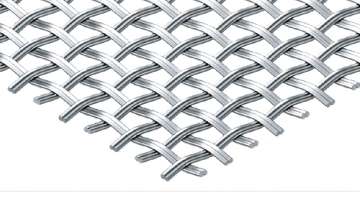
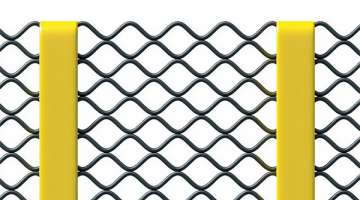
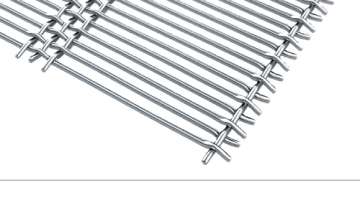
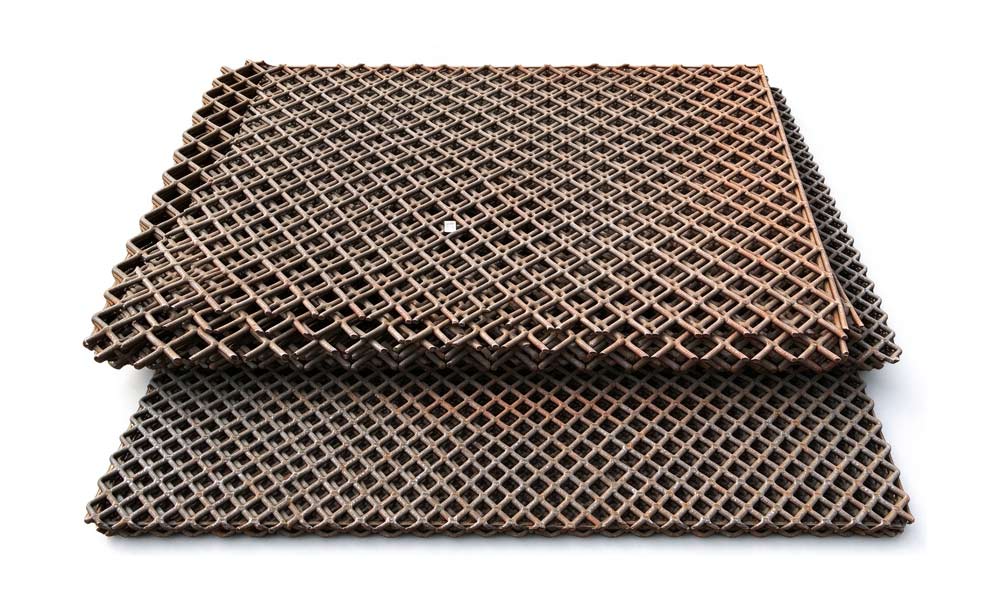
Two screens with the same mesh number can still run like different machines, and the conversion chart will not save you unless it mentions crimp and weave. A plain weave Mining Screen gives a stable square hole but lower open area on fine sizes; a double crimp or lock crimp holds shape under lump impact and keeps the aperture from walking; a slotted Mining Screen trades square accuracy for anti-pegging on elongated or clay-bound rock; a Dutch or twilled weave tightens the surface and is more about filtration than scalping. Wire diameter, crimp height, and crimp pitch change the effective aperture even when mesh count stays fixed. That is why “convert 14 mesh to mm” is a school exercise, while “specify a 14-mesh screen that will not peg on sticky iron ore” is a plant decision. The chart is the starting gun, not the race: it tells you the neighborhood, then the ore, moisture, deck angle, stroke, and G-force tell you which house actually fits.
How to Use the Chart Without Lying to the Circuit
The plants that get value from a conversion chart treat it as a translation layer between metallurgy and maintenance, not as a substitute for a test sieve analysis. You take the PSD from the cyclone overflow or the crusher product, find the target cut point—say 1 mm for a coarse reject, 150 microns for a flotation feed guard—and then read backward: 1 mm is near 18–20 mesh depending on standard, 150 microns is 100 mesh, 75 microns is 200 mesh. Then you adjust for the Mining Screen’s real open area, not the nominal mesh. A smart spec says “target passing 1.0 mm at the deck, use a screen with 1.18 mm aperture and enough open area to carry the tonnage,” because designing to the particle rather than the mesh number avoids the classic mistake of specifying 20 mesh, installing a heavy-wire 20 mesh, and wondering why the circuit suddenly retains everything like a dam. Conversion charts also settle arguments between crews: US mesh, Tyler mesh, and ISO mm all end up in the same meeting, and the screen does not care whose country the standard came from.
Practical On‑site Application of the Conversion Chart
A well‑designed conversion chart for Mining Screens should be printed in a durable waterproof format and posted near the screening deck, in the spare parts warehouse and on the plant’s internal shared document platform, so every team member can quickly look up the correct conversion result without going back to complicated reference manuals. Many operations also add their own site‑specific notes to the chart, marking the exact screen count and aperture size that matches each processing stage, which makes it far easier for new team members to get up to speed and prevents experienced workers from making conversion mistakes during busy shift changes.
A clear, practical conversion chart for Mining Screens eliminates almost all the unnecessary specification errors that waste production time and raise operating costs, and it is one of the simplest, highest‑return management tools a mineral processing site can implement. If you need a customized conversion chart that fully matches your existing screen specifications, processing requirements and on‑site working conditions, our team can create a fully tailored version with all your commonly used screen parameters pre‑filled, ready for immediate on‑site use.