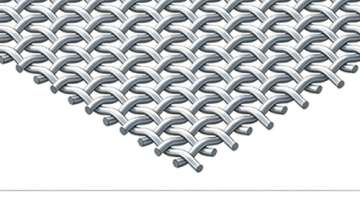
If you've ever pulled apart a worn woven metal wire mesh panel and noticed clean, crystalline fracture surfaces instead of rough, torn ones, you've seen fatigue failure firsthand. This isn't a one-time overload — it's thousands of tiny stress cycles killing the screen quietly from the inside. Understanding the fatigue fracture mechanisms in woven metal wire mesh is the only way to stop guessing why panels crack and start planning for real longevity.
What Actually Happens Inside a Fatigued Wire Mesh
Every time ore hits the screen, each wire bends minutely and springs back. Most operators never see this happening — it's microscopic. But over thousands of cycles, dislocations pile up at stress concentration points, usually where wires cross and get crimped. Tiny cracks nucleate there, then grow a little with every impact. Eventually, the remaining cross-section can't handle the load and the wire snaps clean through. That smooth, beach-mark fracture surface? Classic fatigue. It's not a design flaw — it's physics.
 The Usual Suspects That Speed Up Fatigue
Corrosion is the silent partner in crime. Even minor rust pits on a woven metal wire mesh wire act as crack starters, slashing fatigue life by 30-50%. Then there's wire tension — too loose and wires flex more per cycle; too tight and residual stress does the damage faster. Abrasion from sharp feed particles also thins wires at crossover points, giving fatigue less metal to work through before failure. These three factors together explain why two identical panels in the same plant can die years apart.
Practical Ways to Extend Service Life Right Now
Start with surface protection — hot-dip galvanizing or epoxy coating on your woven metal wire mesh cuts corrosion-assisted fatigue dramatically. Next, specify proper tensioning during installation; most failures trace back to slack wires. For abrasive feeds, go to thicker wire gauges or switch to a profile where crossover points sit above the wear zone. Rotating panels between decks also evens out fatigue accumulation across the inventory.
 Fatigue fracture in woven metal wire mesh is predictable once you know the
mechanisms. Combine coating, correct tension, smarter wire profiles, and you'll
double or triple panel life without buying more. Want a quick fatigue life
estimator based on your ore type and screen dimensions? Share the specs — happy
to run the numbers.
Fatigue fracture in woven metal wire mesh is predictable once you know the
mechanisms. Combine coating, correct tension, smarter wire profiles, and you'll
double or triple panel life without buying more. Want a quick fatigue life
estimator based on your ore type and screen dimensions? Share the specs — happy
to run the numbers.