Self Cleaning Screen Mesh Balances Flexibility And Wear Resistance
Every plant running long continuous screening campaigns knows the worst tradeoff in the industry: you can choose a soft, flexible anti-clogging mesh that stops blinding but wears out in weeks, or you can choose a hard, wear-resistant static mesh that lasts for months but clogs solid within hours. Anti-Clogging Self Cleaning Screen Mesh breaks this decades-old compromise, combining the independent flexing geometry that resists pegging and blinding with a carefully engineered material profile that delivers long service life even under highly abrasive heavy feed conditions. This is not a simple compromise that delivers mediocre performance on both fronts, it is a purpose-built design that performs well on both anti-clogging action and wear resistance at the same time. This article breaks down why the old tradeoff existed for so long, how the optimized material profile preserves both flexibility and wear life, how even load distribution extends overall service life, and how plants can tune the specification to their exact long-run duty.
The Old Industry Tradeoff Between Clog Resistance And Wear Life
The old industry tradeoff between clog resistance and wear life existed for decades because an Anti-Clogging Self Cleaning Screen Mesh design solves a fundamental material conflict that most older products never managed to resolve. Traditional anti-clogging mesh used soft, low-carbon wire that could flex easily to eject lodged particles, but this soft wire wore through extremely quickly when processing abrasive rock, sand, or mineral ore, forcing plants to swap out panels every few weeks. On the other side, high-hardness wear-resistant wire would last for months, but it was too rigid to flex, so it could not deliver any meaningful self-cleaning action, and it would crack and snap under repeated vibration stress if you tried to shape it for anti-clogging geometry. For a very long time, plant teams had no middle ground, they had to pick one performance attribute and completely sacrifice the other, accepting either constant blinding or extremely short mesh service life.
Optimized Material Profile That Balances Flex And Abrasion Resistance
Optimized material profile that balances flex and abrasion resistance is the engineering breakthrough that makes this new generation of mesh work, because an Anti-Clogging Self Cleaning Screen Mesh does not use a single uniform hardness across the entire cross-section of the wire. The surface layer of the wire is treated to a high hardness that resists abrasion from sharp, heavy mineral particles, while the inner core of the wire retains enough toughness and flexibility to bend and flex repeatedly without cracking or suffering fatigue failure. This means the outer contact surface that the material flows across wears extremely slowly, while the inner core still delivers all the independent flexing movement needed to eject lodged near-size particles and prevent blinding. Unlike old single-hardness wires that either wore out fast or snapped under repeated flex, this dual-property profile keeps delivering full anti-clogging performance for the entire service life of the panel, not just the first few days after installation.
Even Load Distribution Multiplies Overall Service Life
Even load distribution multiplies overall service life because an Anti-Clogging Self Cleaning Screen Mesh that never blinds never develops the local overloaded zones that destroy conventional panels long before their time. On a standard static wear-resistant mesh, once a small section near the feed end clogs solid, all the incoming abrasive material gets diverted onto a tiny narrow strip of the remaining open mesh, and that concentrated high-velocity abrasive flow wears that section through in a tiny fraction of the expected design life. The anti-clogging design keeps nearly the full deck surface active and open at all times, so the abrasive feed is spread evenly across every centimetre of the mesh face. No single section of wire carries a disproportionate share of the abrasive load, so the entire panel wears at a slow, perfectly uniform rate, and there are no hidden overloaded spots that will fail without warning halfway through a long production campaign.
Tuning Wire Grade And Profile For Specific Long-Run Duties
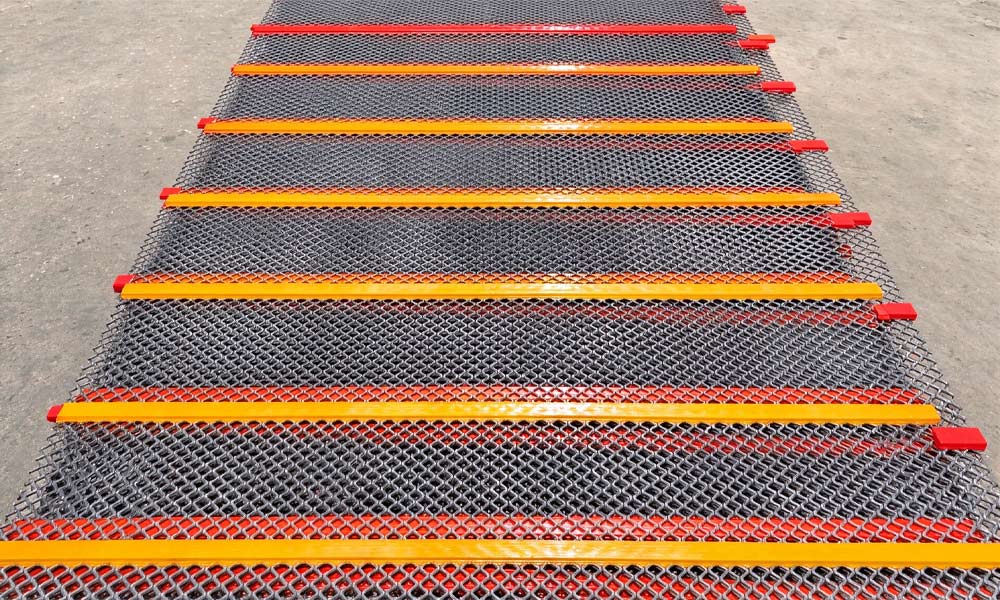
Tuning wire grade and profile for specific long-run duties is the final step that maximizes total runtime between change-outs, because an Anti-Clogging Self Cleaning Screen Mesh specification that works perfectly for one plant will not automatically deliver the maximum possible service life for another. For high-abrasion quarry aggregate duty, a thicker dual-hardness wire profile with optimized anti-clogging shaping will prioritize maximum wear life while still delivering full self-cleaning action, while for a fine sticky mineral processing duty with lower abrasion, a slightly finer wire will balance good wear resistance with the precise aperture control needed for sharp classification. The plant also has to match the tensioning setup and deck support bar spacing to the new mesh specification, to make sure the wires are not subjected to unnecessary extra stress that could shorten their working life. When this tuning is done correctly, most plants will see total mesh service life double or even triple compared to what they were getting from old-generation anti-clogging products.
For decades, processing plants running long continuous screening campaigns had no choice but to accept the frustrating tradeoff between anti-clogging performance and wear life, but anti-clogging self cleaning screen mesh eliminates that compromise completely. The dual-property wire profile delivers both the flexible movement needed to stop blinding and the hard abrasion-resistant surface that stands up to months of heavy abrasive feed, spreads the load evenly across the full deck to avoid premature local failure, and can be tuned to match almost any specific long-run screening duty. This is not a universal replacement for every extremely high-temperature or ultra-high-abrasion specialty application, which still requires custom engineered ceramic or alloy media, but for the vast majority of standard long-run mineral, quarry, and industrial screening operations, this design delivers far more total uninterrupted runtime between panel change-outs than any older generation of mesh can achieve.