Woven Mesh Screen: Versatile Screening Media for Mineral
Anyone who spends significant periods working across the various screening screens at a commercial scale sand and gravel or mineral extraction operation will recognize that woven mesh is by far the predominant form of screening media in use. It should therefore come as no surprise why this is the case, given the extreme volumes of highly abrasive rock, sand and mineral material being processed continuously over many hours each day. Screening media must provide a stable and repeatable cut-point, achieve maximum longevity, allow sufficient tonnage to pass per hour and permit relatively quick remedial action on the face of the screen. Many of the more 'exotic' forms of screening media currently offered will generally only suit a particular restricted application and will break down once taken beyond that point. As a result, users will typically need to carry and deploy a wide variety of alternative media depending on the application required at any given point, leading to increased levels of spares holding and general hassle. A purpose-developed range of Woven Mesh Screen will however perform equally effectively throughout the full breadth of your sand, gravel and mineral processing flowsheet, whether that be coarser initial removal of oversize or finer end-product specification.
Highly Flexible Range of Options to Suit Each Duty
As discussed above, there are a very large number of variables that can be specified when sourcing a range of woven mesh screens to fulfill the diverse set of screening requirements within a typical sand, gravel or mineral plant. Wire size, type of weave, mesh opening and panel size can all be varied to accommodate the screening of anything from 100mm+ coarse rock to 0.1mm fine mineral products. Despite these variations, all will share a common 'familiar' appearance to your operatives, facilitating simple deployment and rectification. There are clearly some dedicated forms of screening media e.g. closely spaced thick hole-perforations, or fine-dense Dutch weaves, that are best suited to certain coarse or fine applications respectively. However, as noted previously, the same broad family of Woven Mesh Screen can be deployed to all individual screens within your circuit. You may elect to use a heavier and correspondingly thicker crimped woven mesh at your initial scalper screen, transition to a lighter plain woven mesh across your subsequent screens, and then finish off with a tighter and finer woven mesh for your final product. Crucially, each of these will fit directly into the standard aperture of your existing screen frames, requiring no changes or adaptations. Not only does this remove the requirement to evaluate and select between multiple disparate products, but also means your operatives do not need to become proficient with alternative methods of fixing and applying the different media.
Robustness of Interlocking Crimp Weave
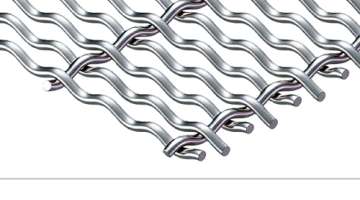
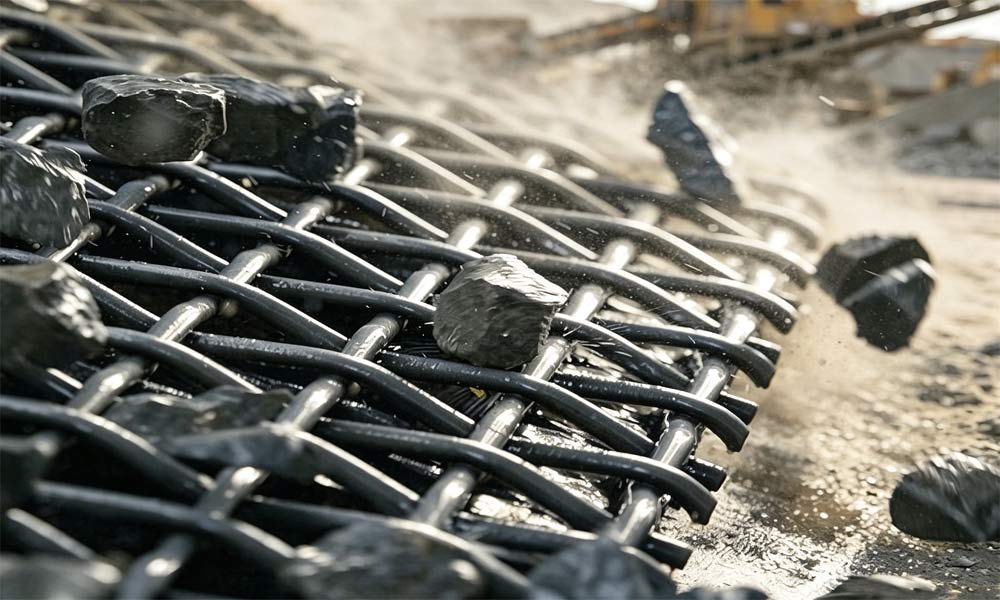
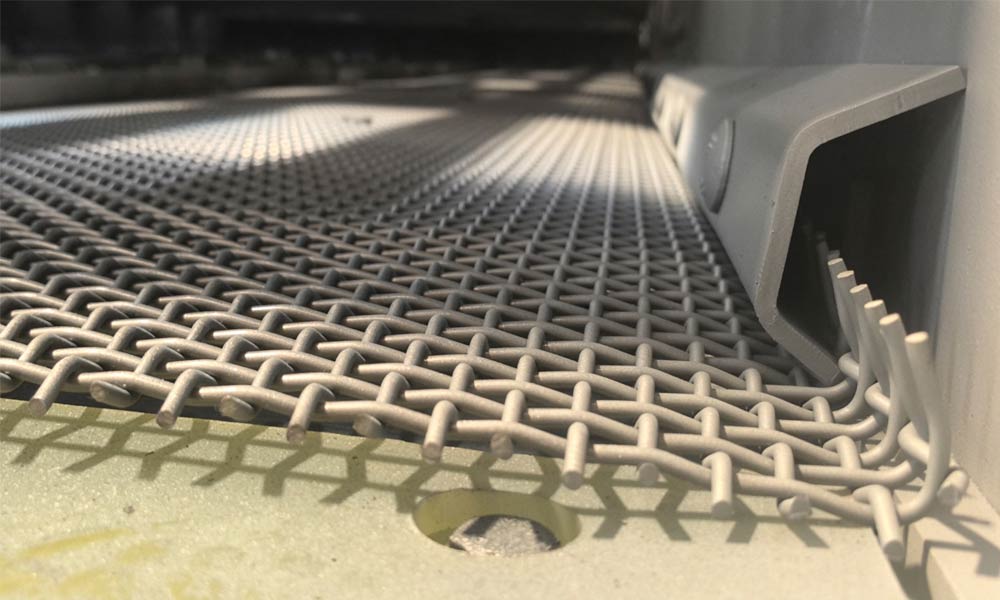
In the thicker and heavier-duty ranges of Woven Mesh Screen, each and every wire will be factory crimped and therefore fully locked into position at the points where it crosses with the orthogonal set of wires. Consequently, the mesh will remain entirely stable and retain its profile irrespective of the prolonged period of exposure to the harsh scouring effects of abrasive sand, gravel and minerals passing over it. This type of woven mesh will exhibit significantly extended periods of useful service life compared to other less substantial and non-crimped alternatives, particularly where used to classify very tough and angular materials such as siliceous sands, granites or basalts. Furthermore, because of the regular and evenly-spaced nature of the crimp pattern, the aggressive abrading action of the conveyed material will be borne uniformly across the length of each individual wire, preventing any single point(s) on the mesh from succumbing to accelerated rates of degradation. It is therefore not uncommon for end-users to experience considerably improved run-lengths with their heavy crimped woven mesh and to be able to schedule corresponding replacement programs to align with planned shutdowns.
Assurance of Tight Product Specification
Because each wire in the woven mesh is rigidly held in a fixed position relative to all adjacent wires, there is no risk that any individual opening will grow larger than its nominal dimension during extended periods of screening. Users can therefore expect a highly uniform and reproducible output from their screened products. Conversely, with some inferior quality meshes, the individual strands may elongate and pull away from one another as the screen is subjected to higher loads, giving rise to a population of erratically-enlarged openings. Any material passing through these enlarged gaps will inevitably become mis-specified in the relevant product stream, resulting in either a rejected consignment or additional re-handling to segregate the offending fraction. With Woven Mesh Screen, the apertures will remain virtually unchanged throughout the life of the panel and you can be confident that all of your end-products will meet the desired specification. In practice, end-users commonly see marked improvements in the specification of their final products and experience minimal complaints from their customers regarding non-conforming consignments.
Easy Access to Standardized Product
The product described herein is manufactured on a global scale and can be sourced from the vast majority of regional screeners and industrial suppliers. You will rarely need to place a lengthy bespoke lead-time order to receive a required panel, nor incur the significant cost uplift associated with some of the rarer, more esoteric forms of screening media. By avoiding the need to specify and hold a comprehensive range of these alternative products, users can typically expect to see meaningful reductions in their aggregate yearly spend on spares for screen media throughout their operation. They will be able to centralize their stockholding around this common product which can be readily obtained to suit any particular screen in the plant.
There is accordingly little justification to continue to employ several different forms of screening media to address the varying degrees of classification needed in your sand, gravel and mineral operation, nor suffer the downsides outlined above. The product discussed in this piece, i.e. Woven Mesh Screen, offers a highly adaptable solution to meet the full range of classification tasks across your facility, combined with the longevity provided by its crimped interlocking construction, the certainty of obtaining correctly-specified products, and the ease with which panels can be procured to minimize ongoing spares spend. The only exception to this would be the heaviest of initial scalpers handling >300mm material, where a robust thick manganese steel plate would likely remain preferable.