Application of High-Strength Woven Mesh in Primary Coarse Screening of Iron Ore
If you’ve ever stood beside a primary crushing station at an iron ore mine, watching 100+mm hard hematite chunks tumble down from a 2-meter conveyor drop onto a brand new screen that tears completely through in less than 3 days, you know exactly how much unnecessary downtime, wasted labor and lost production this seemingly trivial consumable issue causes. Many mine operations supervisors I’ve talked to over the years shared that they used to pick primary screening screens based only on low upfront cost, never accounting for the extreme impact, abrasion and continuous high-frequency vibration that iron ore coarse screening brings, leading to constant unplanned shutdowns and inflated annual spare part budgets. A properly engineered Metal Woven Mesh solves these persistent pain points completely, delivering stable high throughput and far longer service life even under the harshest primary iron ore coarse screening conditions.
Impact-Resistant Material Selection for Heavy Load Conditions
The first core performance advantage of these specialized screens is the carefully selected high-tensile 65Mn manganese steel base material, which has a natural dynamic hardening property that forms a tough, wear-resistant surface layer with hardness up to HRC60 after repeated ore impact, while the inner core of the wire still maintains excellent toughness to avoid brittle fracture under heavy shock. This unique material property lets the screen easily withstand a 12kg heavy ore chunk free falling from 1.5 meters high without any structural breakage, a performance level no ordinary low-carbon steel woven screen can match, making this high-quality Metal Woven Mesh capable of handling 200 to 500 tons of raw iron ore per hour without suffering premature structural damage.
Steel Choice: 65Mn, Manganese, and the Abrasion Math
Iron ore is abrasive in a way limestone never is. Silica gangue, goethite nodules, and hematite lumps all carry hard corners that scrape the wire crown every cycle, so the first spec decision is metallurgy. High-carbon 65Mn spring steel is the workhorse: tensile around 1600–1800 MPa, good fatigue life under vibration, and enough hardness to resist abrasive wear without turning brittle like an over-quenched tool steel. Manganese steel is the heavier hitter where gouging impact dominates—it work-hardens under pounding, so the surface gets tougher the more the ore hits it, which is exactly the behavior you want on a 150 mm lump dropping onto the feed lip. 304 or 316L enter only when the circuit is wet, leach-loaded, or chloride-exposed; stainless resists rust better but usually gives up some abrasion life compared with manganese or 65Mn. The Metal Woven Mesh order should name the steel grade, the tensile band, the surface hardness target, and the corrosion duty—because “iron ore screen” said to three different suppliers returns three different panels and only one of them matches your actual ore.
Crimp, Wire Diameter, and Why Plain Weave Quits Early
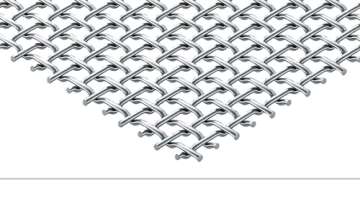
On a primary scalp deck, plain weave is a rookie move. The wires are not pre-formed, so under continuous impact they creep, the intersections loosen, and the aperture quietly grows until oversize starts leaking into the crusher product. Heavy-duty Metal Woven Mesh is almost always pre-crimped: double crimp for maximum locking force under strong vibration, lock crimp where each wire intersection is mechanically seated so it cannot migrate, and flat-top crimp when the plant wants a smoother wearing face that lets angular iron ore slide instead of gouging the knuckle. Wire diameter on coarse scalping typically runs 3.0–6.0 mm and can go heavier for 100 mm+ ROM feed; too thin and the wire snaps under the first boulder, too thick and open area collapses so the deck strangles its own throughput. A practical rule plants learn the hard way: the wire should be fat enough to outlive the impact zone, while the aperture stays wide enough that the deck scalps instead of sizes. Primary coarse screening is not there to make a pretty PSD—it is there to keep boulders out of the jaw and keep the vibrating surface alive.
Pre-Crimped Interlock Weave for Stable Classification Accuracy
The second key functional benefit comes from the optimized pre-crimped interlocking weave structure, where every individual thick metal wire is pre-bent before weaving to lock tightly against adjacent wires at every intersection, eliminating tiny sliding gaps that would otherwise shift and create irregular oversized openings under continuous high-frequency vibration. This stable structure ensures every mesh opening stays perfectly consistent across the entire screen surface even after thousands of hours of heavy operation, blocking all oversize iron ore chunks larger than the target separation size from slipping through to the downstream secondary crushing stage, and achieving a classification efficiency of over 95% that drastically reduces unnecessary crushing load, making this Metal Woven Mesh a critical upgrade that directly boosts the overall throughput of your entire primary crushing circuit.
Parameter Calibration for Extended Service Life
The third practical operational optimization is fine-tuning key parameters such as wire diameter, aperture size and open area to strike the perfect balance between processing capacity, structural strength and service life, rather than blindly picking the thinnest wire possible to maximize open area. For most primary iron ore coarse screening tasks targeting 10 to 50mm separation size, you can select a 3.0 to 6.0mm thick manganese steel wire paired with a 40% to 50% open area, which creates enough free space for qualified fine ore particles to pass through smoothly, while ensuring the screen has enough structural rigidity to withstand continuous heavy ore impact. This careful parameter calibration avoids the common mistake of over-specifying overly thin wires that break quickly, and ensures your Metal Woven Mesh can deliver stable high performance for 45 to 60 days of continuous operation, 2 to 3 times longer than the average service life of generic woven screens in the same harsh primary coarse screening environment.
Following these targeted material selection, structure optimization and parameter calibration rules will drastically reduce your screen replacement frequency, keep your primary iron ore coarse screening classification accuracy stable, and directly improve your entire mine’s overall crushing circuit throughput significantly.