Square Woven Screen for Dry Iron Ore
If you’ve ever worked a 12-hour shift at an iron ore processing plant watching your screening deck choke up with blinding near-size particles, while your downstream ball mill sits idle waiting for consistent well-sized feed, you know exactly how much a poorly optimized screen can derail your whole circuit’s throughput and final iron concentrate recovery rate. Many iron plant operations supervisors I’ve collaborated with over the years shared that they used to struggle to hit their target classification efficiency for dry iron ore, until they swapped out their old slotted and perforated plate screens for a purpose-built square woven screen for dry iron ore, and immediately saw their deck throughput jump 35% while also delivering far more consistent sizing accuracy. This practical, field-tested guide skips generic marketing talking points and breaks down exactly why a purpose-built square woven screen for dry iron ore outperforms every other screening media type in dry iron ore classification workflows, and how you can deploy it to unlock far better circuit performance.
High Open Area for Maximum Dry Ore Throughput
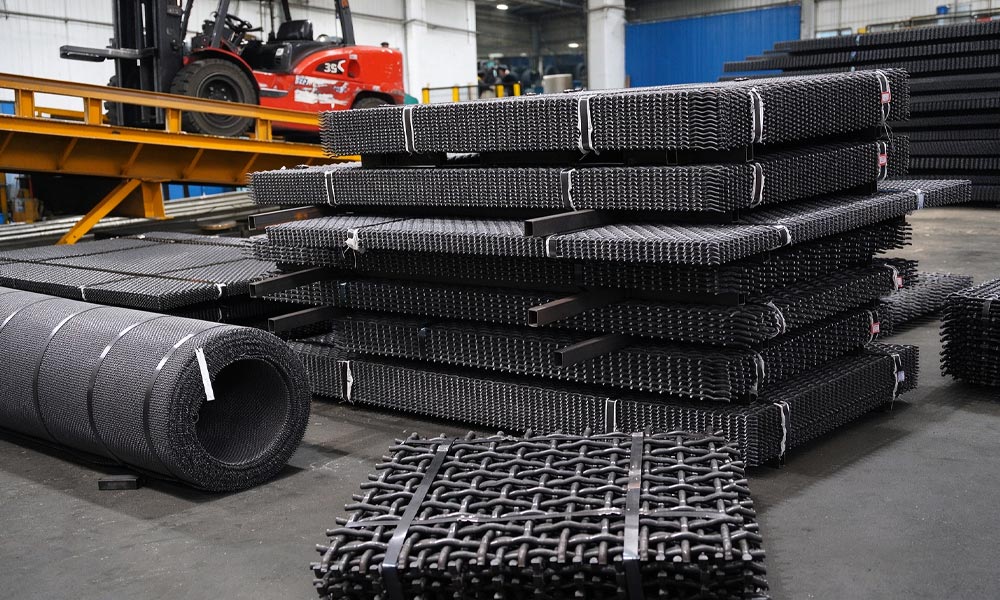
The first biggest performance advantage that makes a purpose-built square woven screen for dry iron ore perfectly suited for dry classification workflows is its industry-leading high total open area, which eliminates the massive throughput bottleneck that plagues old perforated plate and slotted woven screens. Traditional perforated plate screens for iron ore classification rarely deliver more than 25% total open area, because the thick solid steel plate between round drilled holes leaves huge amounts of unused non-screening surface across the deck, forcing you to run your deck at far lower tonnages to avoid overloading the material bed. A well-designed square woven screen for dry iron ore arranges perfectly uniform square apertures in a tight repeating grid pattern, delivering total open area between 42% and 48% that lets free-flowing dry iron ore particles pass through the deck far faster, with no unnecessary resistance from large solid plate sections. This massive jump in usable open area immediately boosts your screening deck’s hourly throughput by 30% to 40% without any modifications to your existing vibrating screen motor, exciter unit or deck structure, letting you push far more dry iron ore through your classification circuit without sacrificing sizing accuracy.
Uniform Aperture Geometry for Consistent Sizing Accuracy
The second critical performance benefit that makes a square woven screen for dry iron ore far superior to alternative screen types is its perfectly uniform non-deforming square aperture geometry, which delivers far more consistent classification accuracy that directly boosts your downstream iron concentrate recovery rate. On slotted woven screens commonly used in older iron ore processing plants, the elongated narrow openings allow flat, flaky dry iron ore particles to slip through sideways even when they are technically oversize, sending inconsistent poorly sized feed into your ball mill that creates wide unpredictable fluctuations in your grinding circuit’s particle size distribution. A purpose-built square woven screen for dry iron ore has perfectly equal-sided square apertures that do not create any easy sideways slip path for oversize flaky particles, so every single particle has to be smaller than the exact target separation dimension to pass through the opening, delivering extremely tight, consistent sizing that stays stable across thousands of hours of operation. This perfectly consistent sizing means your ball mill receives a uniformly graded feed every single hour of the day, eliminating the unpredictable fluctuations in grinding efficiency that used to make your downstream flotation recovery rate swing up and down by 4% to 6% from shift to shift. Many operations that switched to this screen reported that their overall final iron concentrate recovery rate increased by 2.5% to 3% immediately.
High-Manganese Wire Formulation for Abrasion Resistance
The third core design feature that drastically extends total service life is the specialized high-manganese steel wire formulation built into every heavy-duty square woven screen for dry iron ore, which is specifically engineered to stand up to the extremely high abrasiveness of hard hematite and magnetite dry ore particles. Dry iron ore particles are far more abrasive than most other crushed rock and mineral materials, so generic mild steel woven screens will wear through completely in less than 2 weeks of continuous operation, forcing your maintenance team to perform frequent time-consuming changeouts that create constant unplanned downtime. A purpose-built square woven screen for dry iron ore uses 65Mn high-manganese spring steel that goes through a proprietary double quenching and tempering process, bringing its surface hardness up to HRC54 while retaining enough flexible core toughness to absorb repeated heavy ore impact without shattering. This perfectly balanced material property makes these screens 3 to 4 times more abrasion resistant than standard mild steel screens, delivering average service life between 60 and 90 days of continuous all day operation, drastically cutting your monthly screening consumable costs and reducing the total number of screen changeouts your maintenance team has to perform.
Zero-Peg Interlocked Weave for Minimal Blinding
The final practical operational advantage that drastically cuts down on manual maintenance labor is the optimized interlocked zero-warp weave structure on a purpose-built square woven screen for dry iron ore, which minimizes pegging and blinding even when processing high volumes of near-size dry iron ore particles. Dry iron ore classification workflows often have 35% to 40% near-size particles that are very close to the exact aperture dimension, which can get wedged into apertures and create permanent pegs that block open area, forcing your crew to stop production every few hours to manually pry wedged particles out of the deck. A purpose-built square woven screen for dry iron ore uses a double pre-crimped interlocked weave structure that locks every single wire intersection completely solid, creating clean sharp square aperture edges that make it far harder for near-size iron ore particles to wedge tightly into place. The high-frequency vibration of the deck easily shakes loose any partially stuck near-size particles, so your screen maintains its full 40%+ open area across a full 12-hour production shift, with almost no manual cleaning required. This eliminates the hours of unplanned maintenance labor your team used to spend digging pegged particles out of the screen deck, letting them focus on more critical preventive maintenance tasks elsewhere in the plant.
For dry iron ore classification workflows where maximum throughput, consistent sizing accuracy, long service life and minimal blinding are your top operational priorities, a purpose-built square woven screen for dry iron ore outperforms every other traditional screening media option on the market, delivering a massive return on investment that pays for itself in just a few weeks of full production operation.