In overseas mining operations, screening equipment plays a critical role in ore classification and production line stability. The installation quality, structural design, and service life of wear components such as screen panels and blind plates directly impact operational efficiency, equipment reliability, and maintenance costs.
A large open-pit mining company in the Democratic Republic of Congo (DRC), specializing in non-ferrous metal ore mining, crushing, and screening, encountered persistent operational failures after commissioning its production line. Two major problems became severe bottlenecks affecting stable production:
- Frequent jumping and dislodgement of screen panels
- Abnormally rapid wear of feed-end blind plates
These recurring failures significantly disrupted continuous production, increased downtime, and raised spare part replacement costs, becoming a major operational challenge for the mine.
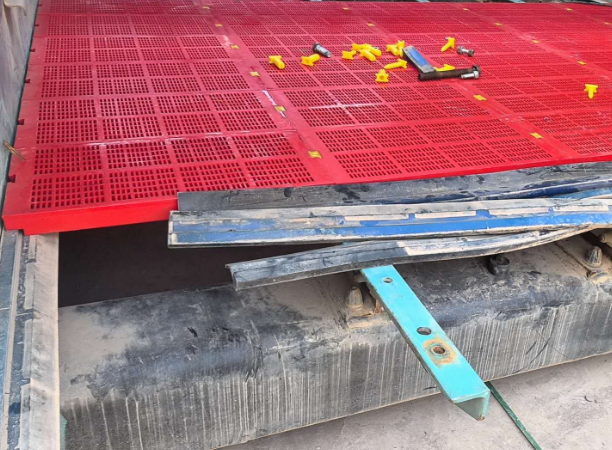
Project Challenges: Repeated Equipment Failures Disrupt Production
The mining project operates under demanding conditions, including high throughput, hard ore materials, and continuous heavy-duty screening processes. Due to prolonged high-load operation, equipment issues became increasingly severe.
1. Frequent Screen Panel Jumping and Detachment
Because of limitations in the original installation structure, unsuitable fastening methods, and poor compatibility between vibration parameters and screen panel fixing systems, the vibrating screen experienced repeated panel movement under high-frequency vibration.
During operation, screen panels became loose, shifted position, and even detached completely. This resulted in:
- Poor screening accuracy and oversize material contamination
- Frequent emergency shutdowns for maintenance
- Reduced daily processing capacity
- Production delays caused by unexpected stoppages
Routine maintenance, fastening, and replacement efforts failed to eliminate the problem at its root cause.
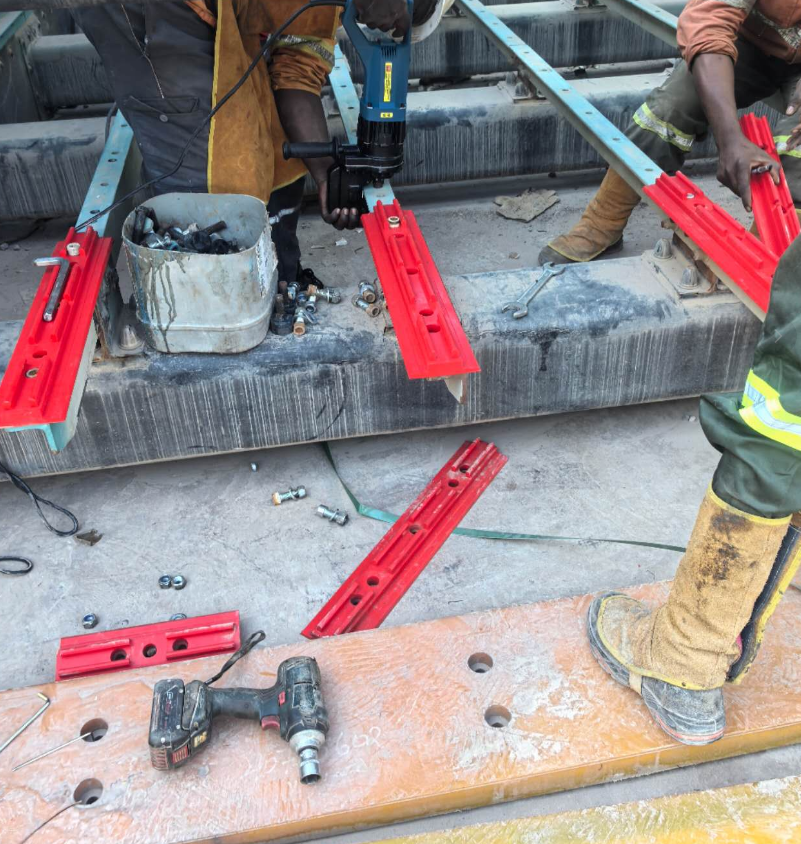
2. Excessive Wear of Feed-End Blind Plates
At the feed inlet, ore materials continuously impacted the blind plate at high velocity. Due to an unreasonable feed distribution structure and concentrated material impact, localized wear developed rapidly.
The original system suffered from:
- Uneven material distribution
- Severe one-sided abrasion
- Short replacement cycles
- High spare parts consumption and maintenance costs
Frequent blind plate replacement increased overseas operational expenses and placed additional burdens on maintenance teams.
After repeated unsuccessful repair attempts, the client sought a long-term technical solution and contacted Red Star Screens for professional engineering support.
Accurate Diagnosis: Root Cause Identification Through Technical Assessment
Upon receiving the request, Red Star Screens immediately launched a dedicated overseas mining support process and assembled a professional technical service team.
Through close communication with on-site personnel and detailed analysis of operating conditions, the team systematically evaluated:
- Vibrating screen models and specifications
- Frequency and amplitude parameters
- Feed rate and material particle size
- Ore hardness and operating load
- Existing screen panel and blind plate materials
- Installation structures and fastening systems
After comprehensive evaluation, the technical team identified the root causes:
1. Structural Defects in Screen Panel Installation
The original fixing system used standard clamps and simple compression methods that lacked sufficient strength and vibration resistance.
Under continuous high-frequency vibration, locking components loosened, causing panel instability and detachment.
2. Improper Fastening and Poor Structural Fit
Insufficient contact between screen panels and support beams created vibration gaps and resonance movement, significantly increasing the risk of loosening and displacement.
3. Imbalanced Feed Distribution Design
Ore materials concentrated their impact on a single area of the blind plate, without proper buffering or material dispersion, leading to localized overload and premature wear.
Rather than simply replacing worn components, Red Star Screens adopted a root-cause engineering approach and developed a customized integrated solution combining:
- Screen panel mounting system optimization
- Feed system redesign and upgrade
Customized Solution: Structural Optimization for Targeted Problem Solving
Based on actual operating conditions at the DRC mine site, Red Star Screens implemented a fully customized technical rectification program, providing engineering guidance, technical support, installation assistance, and commissioning services throughout the project.
1. Comprehensive Upgrade of Screen Panel Installation Structure
The original installation system was redesigned completely.
The team optimized:
- Panel clamping structures
- Limiting and positioning systems
- Fastening mechanisms
- Locking accessories
Installation spacing, compression force, and assembly procedures were standardized to eliminate vibration gaps and resonance risks.
High-strength, vibration-resistant screen panels suitable for hard ore applications were also selected to improve durability and operational reliability.
As a result, panel jumping, loosening, and detachment were eliminated at the structural level.
2. Feed-End System Optimization to Reduce Blind Plate Wear
To address abnormal blind plate wear, the feed system was redesigned.
The optimization included:
- Material guiding improvements
- Feed flow redistribution
- Buffering and impact reduction structures
- Improved material dispersion
The upgraded system enabled smoother and more even ore feeding, reducing concentrated impact forces on the blind plate.
At the same time, high wear-resistant feed blind plates and improved installation geometry further extended service life.
Throughout implementation, the Red Star Screens technical team provided continuous remote engineering guidance to ensure accurate installation, efficient commissioning, and minimal production interruption.
Results: Complete Resolution of Long-Term Equipment Problems
Following technical optimization and commissioning, the mine successfully eliminated its long-standing screening equipment failures.
1. Screen Panel Failure Completely Eliminated
The upgraded mounting system achieved stable and reliable operation under continuous heavy-duty conditions.
No loosening, jumping, or detachment occurred during operation, significantly improving equipment reliability and production continuity.
Unexpected downtime caused by screen failures was eliminated.
2. Blind Plate Wear Greatly Reduced
Following feed system optimization, ore materials entered more evenly and smoothly.
Abnormal localized wear was effectively resolved, and blind plate service life increased significantly, greatly reducing replacement frequency and spare parts costs.
3. Higher Productivity and Lower Maintenance Costs
With dramatically reduced equipment failure rates, screening efficiency and separation accuracy became stable and reliable.
Maintenance workload, emergency repairs, and spare part consumption were substantially reduced, enabling the mine to improve productivity while lowering operational costs.
Professional Service for Global Mining Operations
This successful DRC mining rectification project once again demonstrates the overseas technical service capability and engineering expertise of Red Star Screens.
Facing complex mining environments and demanding working conditions, Red Star Screens remains committed to solving customer problems at the source—not simply replacing parts.
By combining technical diagnosis, customized engineering solutions, and practical implementation support, we help mining customers worldwide achieve:
- Stable equipment performance
- Reduced downtime and maintenance costs
- Improved screening efficiency
- Higher productivity and operational reliability
Deeply rooted in the screening industry, Red Star Screens continues to provide high-quality screening components and customized screening solutions for global mining operations, helping customers overcome complex equipment challenges and achieve long-term operational success.