Self Cleaning Screen Mesh – Harp Design for Anti-Blinding Performance
As mentioned above, one of the greatest hidden costs incurred by aggregates, mining and sand producers is that of material blinding. It is remarkably common that near size material becomes firmly 'wedged' in the screen face, locks in position and over the course of a few hours will blind 30-50% of the available open area in a screen deck. With Self Cleaning Screen Mesh, we have overcome this issue which has plagued the industry for many years by implementing a novel harp design. By deploying a series of separate and freely moving parallel wires across the screen face, material can be dislodged from any point of potential blinding. Importantly, our harp design differs significantly from conventional 'harp' type products, which continue to experience varying degrees of blinding. We have therefore been able to develop a comprehensive range of screening solutions to negate the principal causes of material blinding encountered in today's processes. In this blog we describe why the use of a parallel spaced harp configuration negates near-size blinding; the effect of allowing each wire to move individually to promote ongoing self-cleaning; the role of the smooth curved harp wire geometry in avoiding flat particle blinding; and finally the benefit of maintaining a consistently elevated open area throughout the working shift.
Negates Near-Size Blinding via Parallel Spaced Harp Geometry
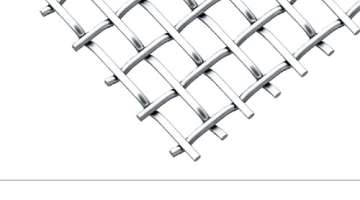
The first key feature of Self Cleaning Screen Mesh is that it allows the screen face to be constructed from a series of parallel harp wires. That is, all of the wires in the mesh are laid out longitudinally and equally spaced along the complete breadth of the screen. This stands in stark contrast to the cross-hatched construction of conventional woven screening media. With conventional mesh, each screen opening takes the form of a square with 4 sides defined by the superimposed orthogonal sets of wires. As such, near-size material can become trapped and firmly locked in any given aperture due to the 4 rigid surfaces available to 'key' the particle in position. However, by reducing the screen face to a series of elongated slots, we remove 2 of these 4 surfaces, meaning that there is no opportunity for near-size particles to firmly lock themselves into position within the screen. Further, even if a particle of exactly the appropriate size to become 'wedged' in a conventional mesh could find itself positioned between 2 parallel harp wires, it would not be sufficiently constrained to remain in this state and would quickly be shaken free during normal screen operation. Therefore, the adoption of the parallel harp wire configuration addresses the bulk of instances of chronic and severe blinding.
Enables Constant Passive Self-Cleaning via Free-Moving Wires
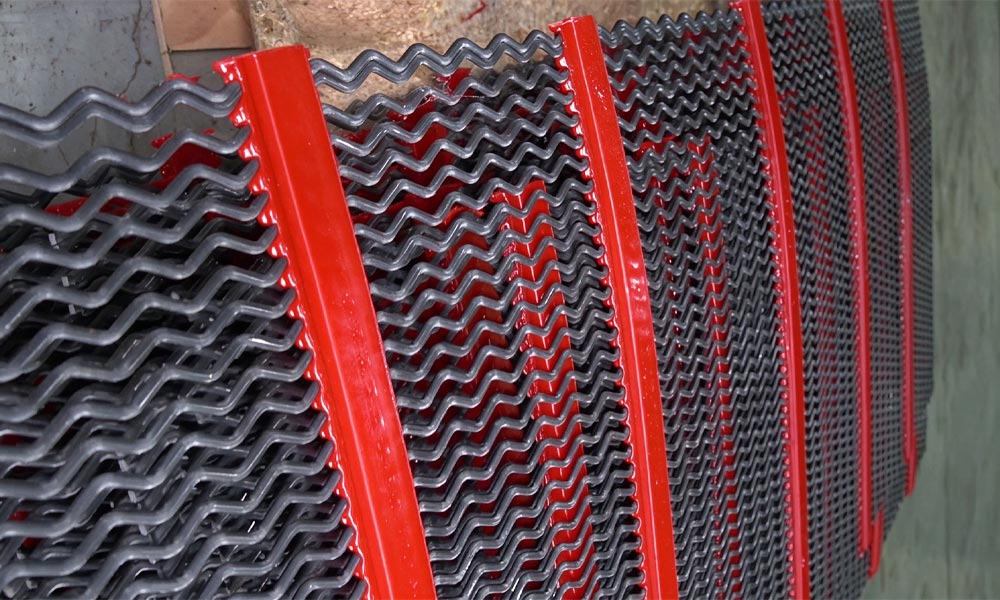
In addition to the parallel wire arrangement described above, the individual harp wires of Self Cleaning Screen Mesh are also permitted to move freely. Specifically, each wire is fixed only at the 2 extremities to the screen support structure, and hence the entire span of the wire between these points is unconstrained and able to respond to the motion imposed by the vibrating screen. Consequently, each wire will oscillate at a marginally different rate to the surrounding wires, causing a continual low-level relative displacement between the individual parallel harp elements. This serves to repeatedly increase the dimension of the slot between each adjacent pair of wires, thereby preventing any particles from becoming established and progressing to a state of significant blinding. This process occurs continuously throughout the life of the screen, without the need to implement additional deck features or undertake regular deck clean-downs. It has been found that some customers see >70% reduction in blinding induced lost time once they begin to utilize the product.
Smooth Curved Round Wire Prevents Flat Particles from Laying Flat
Finally, the harp wires employed in Self Cleaning Screen Mesh consist of smooth, highly tensile steel wire. This contrasts to the typically coarsely crimped wire construction of conventional meshes. Flat and thin pieces of rock e.g. shale, slate and siltstones, are responsible for much of the worst forms of blinding, whereby large contiguous areas of the screen deck can become covered by a dense layer of such material lying flat on top of one another. Due to the round cross-section and smooth finish of the harp wires, there is no plane on which these particles can sit, and they will tend to sit on-edge and move with the flow across the deck. Should some number of particles become temporarily located across consecutive parallel wires, the independent oscillation of the wires will rapidly shake them free, precluding any substantial build-up of blinding material.
Avoids Loss of Throughput Mid-Shift due to Decreased Open Area
The final implication of the features outlined above is that Self Cleaning Screen Mesh avoids the mid-shift loss of screen open area experienced when operating conventional mesh. Typically, following a period of screening, the cumulative effect of blinding can lead to a reduction in the throughput capacity of the deck by ~25%. In order to preserve the desired product split, it may be necessary to reduce the input rate to the screen, or alternatively accept the oversupply of undersize to subsequent stages of the circuit. By retaining an open area close to the rated value for the duration of the shift, the site will be able to maintain a higher continuous input to the process, and thus generate substantially greater volumes of saleable product. No other significant changes to the wider plant will generally be required to realize this gain.
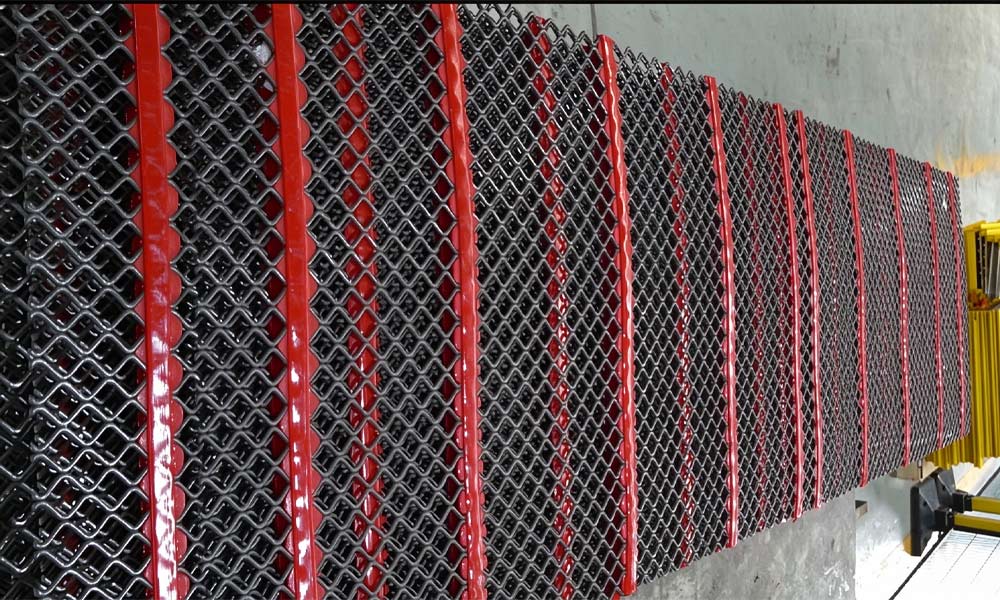
In summary, material blinding can be eliminated in the screening of aggregates, minerals and sands by switching to the dynamic harp design of our Self Cleaning Screen Mesh. The parallel wire configuration precludes near-size particles from locking in the screen face, the ability for each wire to move freely ensures perpetual self-cleaning, the round smooth profile of the harp wires avoids flat particles from laying flat, and the result is a consistent, maximized throughput across the complete length of each shift. Of course, for certain very coarse scalping applications , the superior robustness of perforated metal will continue to be the preferred option, but for most downstream applications our harp design offers a clear advantage in terms of minimizing the impact of blinding.