Comparison of Round, Square, and Slotted Apertures in Polyurethane Screens and Respective Application Scenarios
Picking aperture shape on a Polyurethane Screen sounds like a drafting detail until you stand next to a deck that will not blind, a grade that keeps drifting, or a crusher eating material it was never supposed to see, and then the humble hole shape suddenly looks like a process decision with attitude. Round holes are the quiet generalists, square holes are the honest sizers, and slotted openings are the sticky-material negotiators—but none of them is “best,” because each one changes how particles present themselves, how near-size material behaves, how open area and wear life trade off, and how the polyurethane flexes under a vibrating frame. A plant that specifies aperture shape from habit usually leaves throughput, blinding resistance, and product gradation on the table, while a plant that matches the hole to the ore body, moisture, particle shape, and deck motion gets a Polyurethane Screen that feels like it was tailor-made for the circuit. The trick is to stop asking which shape is strongest and start asking which shape lets the material make the right decision a few thousand times per minute.
Round Holes: The Forgiving Generalist That Hates Near-Size Surprises
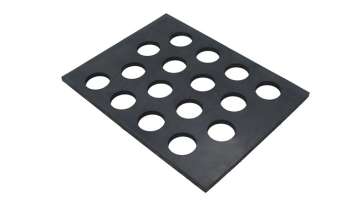
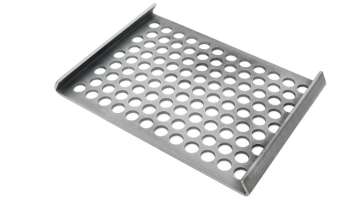
A round aperture on a Polyurethane Screen is the closest thing the screening world has to a polite default: the opening is the same in every direction, particles roll rather than bridge as easily as they do on square mesh, and the molded hole edge can be radiused so sticky fines have fewer sharp corners to grab onto. In coarse scalping, washed aggregates, moist coal, and many mineral duties where exact cut points matter less than keeping the deck alive, round holes earn their keep by being mechanically calm—stress distributes evenly around the circumference, the polyurethane crown between holes wears uniformly, and the panel does not develop the directional cracking you sometimes see with long slots under the wrong stroke. The downside is open area: for the same nominal size, round holes usually give less through-area than squares, so if you chase capacity with round holes you either open the deck too much or accept a thicker bed and slower stratification. Round holes also struggle with flaky or elongated material, because a flat particle can tip, find a diagonal path, and sneak through where a cube would not—so a Polyurethane Screen with round apertures is brilliant for “keep it moving and don’t blind,” but a nervous choice when the product spec is tight and the feed carries lots of near-size slivers.
Square Holes: The Honest Sizer With a Short Temper for Stickiness
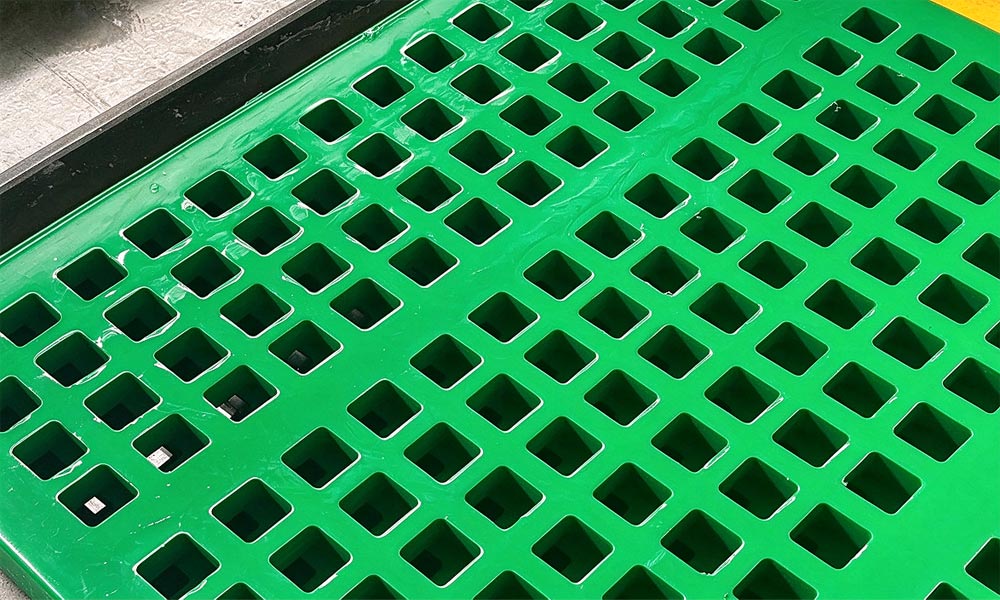
Square apertures are what most engineers picture when they hear “screen,” and on a Polyurethane Screen they deliver the cleanest mental model: a 10 mm square roughly passes 10 mm cubical material and rejects the rest, which makes gradation easy to defend in a report. Open area is usually better than round holes at the same pitch, so fines escape faster, bed depth stays thinner, and high-frequency or fine-sizing circuits love that efficiency. The catch is that squares are socially awkward with moisture and slime: four hard corners make lovely little ledges, near-size particles love to straddle the opening, and once a film of fine material wets the polyurethane surface, blinding sets in faster than it would on a rounded or slotted profile. That is why a square-hole Polyurethane Screen shines in dry or lightly moist, free-flowing, cubical products—frac sand, dried minerals, screened aggregates, finished products—and looks unglamorous in clay-bound phosphate, sticky bauxite, or high-moisture iron ore fines. The smart plants keep squares where the feed behaves and switch shapes the moment the ore gets moody, because square holes reward discipline and punish surprises.
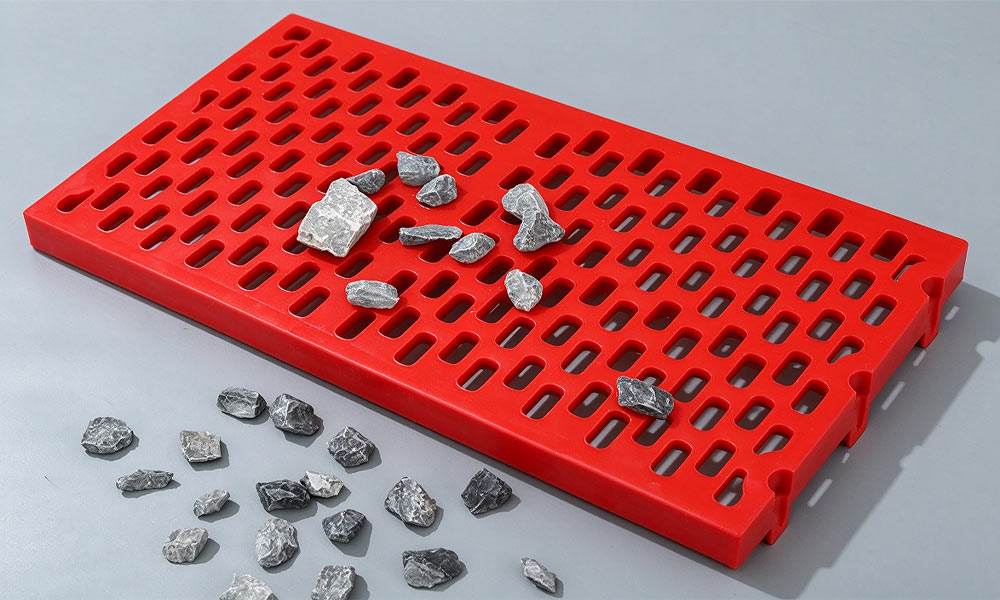
Slotted Openings: The Sticky-Material Negotiator That Protects Throughput
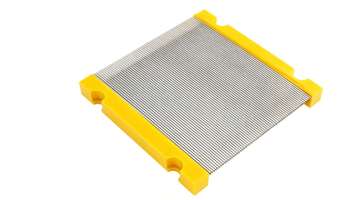
A slotted Polyurethane Screen is where things get interesting, because the long axis changes particle psychology: elongated, flat, or sticky particles tend to align with the slot, near-size granules get carried or rejected instead of wedging on four corners, and the flexing polyurethane strand turns the opening into a living gap that resists pegging. In moist coal, potash, phosphate with clay seams, recycled concrete, and fine iron ore with slime, slots often outperform rounds and squares by a country mile, not because they are “better holes” but because they refuse to offer the static bridge that clogging needs. Tapered slots take it further: the opening can be wider at the top and narrower at the wear face, so a particle enters, feels the deck move, and either passes or rides off without locking the aperture shut. The trade-off is cut-point interpretation—slots size more by width than by area, so spec writers have to stop thinking in “square mesh equivalents” and start thinking in slot width, aspect ratio, and deck motion. A Polyurethane Screen with well-designed slots, correct stroke, and sensible support pitch can keep a wet, nasty circuit open while a square screen beside it turns into a paste board; the slot is not magic, it is just geometry tuned to the way ugly material actually moves.
If your deck blinds with squares, pegs with rounds, or ships off-spec with slots sized by guesswork, the problem is rarely the polyurethane compound alone—it is that aperture shape, deck angle, vibration orbit, and feed character were never negotiated in the same room. Pull the PSD shoulder, moisture range, particle shape, clay or slime content, target cut size, and the last three failure photos, then ask a screen specialist not for “a polyurethane panel” but for the shape that fits your worst operating day: round for gentle scalping and uniform lumps, square for dry free-flowing products where gradation must be defensible, slotted for sticky, near-size-heavy, or elongated feeds where blinding costs more than a slightly fuzzier cut point. Trial the Polyurethane Screen on the nastiest deck rather than the easy one, and score it on blinded area after eight hours, on-spec recovery, oversize contamination, wear at the crown, and changeout labor—not on how tidy the hole looks in a brochure.