Reinforced edge design for polyurethane screen panels to extend service life
In mineral processing, vibrating screen panels face constant stress, and failure often begins at the edges. While panel aperture determines separation, edge integrity dictates overall lifespan. Standard polyurethane screen panels can fail prematurely at the edges due to tearing or delamination under tension and impact. A dedicated reinforced edge design is therefore a critical engineering strategy to extend service life, reduce downtime, and lower replacement costs.
The Edge: A Critical High-Stress Zone
The edge of a polyurethane screen panel is the key structural interface with the machine deck, secured by screen tensioning hooks. This junction endures intense dynamic loads: the constant pull from tensioning and the repetitive impact of feed material. Without reinforcement, these concentrated stresses cause the polyurethane to fatigue, stretch, or crack at the bead, leading to failure that compromises the entire panel's performance.
Why Edges Fail Before the Screening Face
The screening face is designed for the ore; the edge is designed for the machine, and the machine is meaner. Every stroke pushes the Polyurethane Screen Panel against the support bar, every clamp bolt tries to crush the lip, every temperature swing makes the elastomer expand and relax, and every splash of acidic or chloride-laden slurry looks for a micro-crack to crawl into. A standard edge—just molded polyurethane with no insert, no steel backbone, no double-shot reinforcement—relies entirely on thickness and friction. That works in a gentle duty: dry sand, low stroke, perfectly level frame, polite operators. It falls apart in zinc, iron ore, copper tailings, or recycled-aggregate duty, where slabby lumps hit the feed end, the deck runs steep, and the clamp rail was last aligned during a different management team. Once the edge mushrooms, the panel creeps, the seal opens, fines bypass the screen entirely, slurry starts dripping down the side plate, and the support bar begins to wear a groove that no new panel will ever sit straight in again. The cruel part is that the screening face still looks fine in the shutdown photo, so the report says "panel OK," while the edge has already written the failure date.
Steel Inserts, Double-Shot Molding, and Load Paths
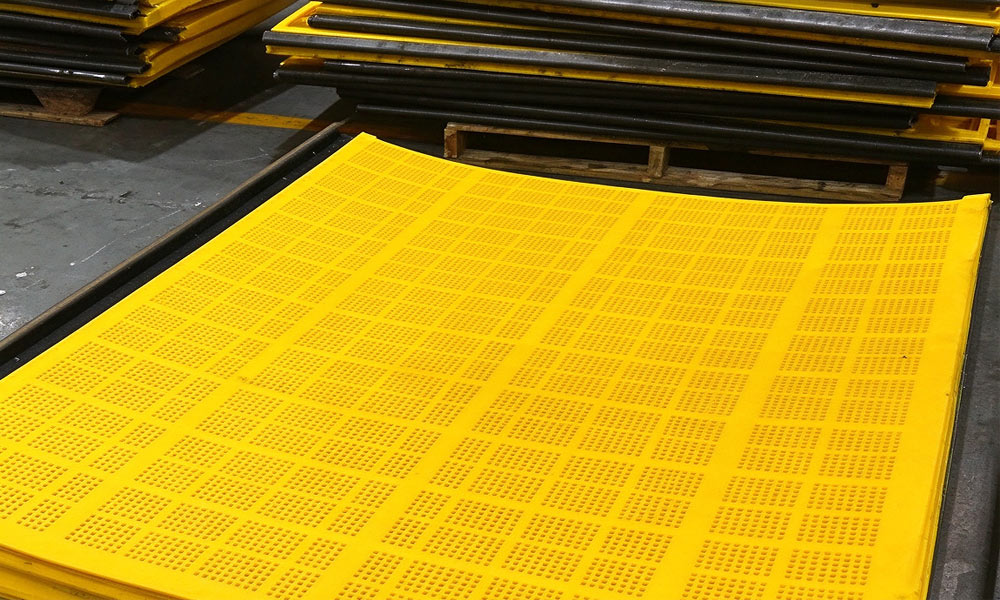
Reinforcement is not one trick; it is a small family of tricks, and the buyer should know which one the factory actually used. The simplest serious upgrade is a steel or spring-steel insert cast into the edge—a flat strip, a folded hook, or a perforated backbone that gives the Polyurethane Screen Panel something to resist deformation even when the polyurethane wants to cold-flow. The insert carries the clamp load, the PU carries the sealing and cushioning, and the vibration has somewhere to go besides tearing the lip. A step up is double-shot or co-molded construction: a harder, higher-durometer PU along the edge and a more elastic grade across the screening face, so the panel grips like a tire tread but flexes like a conveyor skirt. Some designs add a molded hook profile that wraps the support bar instead of sitting on top of it, which removes the reliance on bolt torque alone. Others build a raised compression bead along the seam line so adjacent panels press against each other and close the gap that slurry loves. The load path is the real story: a reinforced edge does not just "look stronger," it redirects vibration, clamp force, and impact into steel or high-duro polymer instead of into the thinnest, most exposed part of the elastomer.
Seal, Seat, and Side-Plate Reality
A reinforced edge earns its money at the side plate, not just at the clamp bar. On many plants the biggest tonnage loss is not blinding, it is bypass: fine material leaking between the Polyurethane Screen Panel and the deck side, never screened, never counted, just quietly lowering recovery and clogging pumps downstream. A good reinforced edge includes a profiled seal lip—sometimes a flexible fin, sometimes a compressed bulb, sometimes a stepped overlap—that follows an imperfect side plate instead of assuming the welder finished the frame to laser accuracy. In wet zinc or copper circuits this matters twice: the seal keeps slurry on the deck, and it keeps slurry out of the gap where it would otherwise sit, crystallize from reagents, and lever the panel outward like a wedge. Seating matters too. A reinforced edge with a proper locating tongue drops into the same position every time, so the aperture rows stay parallel, the stroke acts uniformly, and the operator is not hammering the panel into place with a block of wood and a grudge.
Key Reinforcement Methods for Durability
Manufacturers employ specific reinforced edge design techniques to overcome these challenges. A common method is embedding high-tensile synthetic or steel cords into the polyurethane along the panel's perimeter during molding. This creates an internal skeleton that evenly distributes tension. Another approach is molding a thicker, more robust edge profile for added structural rigidity. For the most severe applications, some polyurethane screen panels feature a fully encapsulated steel or composite frame, offering maximum edge strength and stability.
Operational and Cost Benefits
Investing in a robust reinforced edge design delivers direct operational benefits. It drastically reduces edge-related failures, allowing the polyurethane screen panels to reach their full wear potential across the screening surface. Consistent edge integrity ensures the panel maintains uniform tension, which is vital for stable screening performance and preventing premature blinding. The result is longer intervals between changes, lower spare parts costs, and maximized equipment uptime, directly improving overall screening efficiency.
When specifying polyurethane screen panels, evaluating the reinforced edge design with the same rigor as aperture and compound is essential. By discussing the specific reinforcement method with your supplier and ensuring it matches your machine's tensioning system and material type, you make an informed investment that protects productivity and extends the value of your screening operation.