Custom Polyurethane Modular Panels for Wet Sticky Ore
If you’ve ever finished a full 12-hour night shift at a mineral processing plant, only to walk out and find that a sudden unexpected heavy rain left your entire screening deck caked solid with wet sticky clay, forcing your whole team to stay 3 extra hours scraping every single aperture open just to get production back online, you know exactly how much this kind of material can turn a supposedly reliable screening circuit into a persistent daily headache that eats through spare parts, wastes man-hours and derails every weekly production target. After years of chatting with operations leads across lateritic bauxite mines, southern China ion-adsorption rare earth sites and high-moisture northern lignite washing plants, nearly every single one shared that they used to burn through standard generic PU panels and still deal with non-stop blinding, until they explored targeted custom design tweaks that completely eliminated their most frustrating sticky ore pain points. This no-fluff field-tested guide breaks down the practical, on-site proven custom configurations for Polyurethane Modular Panels built specifically for wet and sticky ore screening, no empty marketing buzzwords, just insights pulled straight from hundreds of real operational logs across different sites.
Hydrophobic PU Formulation Prevents Fine Clay Surface Adhesion
The first highest-impact custom upgrade that cuts more than 70% of stubborn surface slime caking is a specially modified hydrophobic molecular blend for Polyurethane Modular Panels, engineered to break the natural water-based adhesion force that makes wet fine clay stick so firmly to most screen surfaces. Standard generic PU panels have a relatively high surface energy that lets water molecules and fine clay particles bond tightly to the panel top, building up a thick 5-10mm caked layer across the whole deck in less than three shifts that completely blocks all fine particle movement and free drainage. This custom modified formulation integrates specialized non-polar hydrophobic additives deep into the PU cross-linked molecular structure, so wet sticky clay particles can’t form a stable bonded layer on the panel surface, and slide right off with the natural flow of ore slurry instead of sticking and accumulating. Multiple large lateritic bauxite mines shared that after switching to this custom formulation, they completely eliminated the 2-hour daily deck scraping work they previously needed to clear caked clay off the screen surface.
Non-Wedging Double-Taper Aperture Eliminates Near-Size Particle Locking
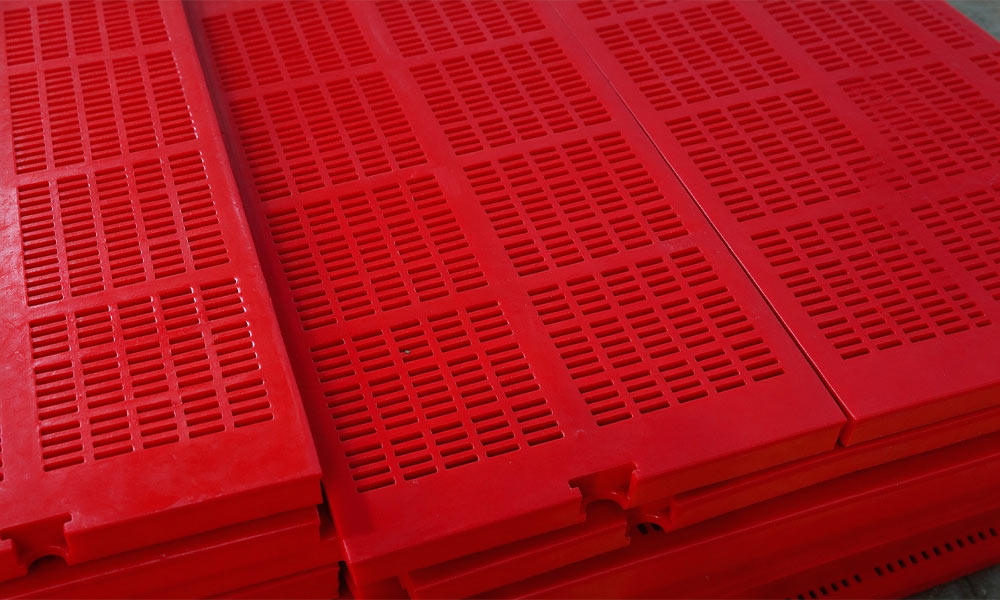
The second critical custom design that prevents near-size sticky particles from jamming tight in openings is a precision-molded double-taper aperture structure for Polyurethane Modular Panels, a unique geometry that widens slightly from the top feed surface down to the panel midpoint, then widens again from the bottom discharge surface back up to the midpoint, leaving no narrow restricted waist at all. Standard single-sided tapered apertures still have a narrow waist at the panel center that traps sticky near-size clay particles, wedging them so tight that even maximum deck vibration cannot shake them loose, blocking the aperture completely even when 90% of the rest of the panel is still fully functional. This double-taper design means any near-size particle that tries to wedge into the opening gets pushed back out by the panel’s natural flex motion, no matter which direction it enters from. Multiple high-moisture lignite coal washing plants shared that their total aperture blinding rate dropped by more than 80% after switching to this custom double-taper aperture design.
Segmented Soft-Hard Composite Layer Boosts Local Self-Cleaning Motion
The third underrated custom configuration that drastically improves continuous non-clog operation is a segmented soft-hard composite top layer on the working surface of Polyurethane Modular Panels, where soft high-flexibility PU strips are embedded between harder rigid PU sections around every aperture to create far more localized independent micro-flex motion under standard deck vibration. A standard full-hard solid PU panel only flexes slightly across its full entire body under vibration, which is not enough to shake loose thin sticky clay films that form a partial seal across the top of apertures, slowly reducing effective open area over the course of a single shift. The small independent soft PU segments flex differently with every single vibration cycle, creating constant tiny localized movement that breaks apart and shakes off even thin partial clay seals that would otherwise block the opening. Multiple weathered rare earth processing sites shared that this custom composite layer kept more than 90% of all their apertures fully open for 3+ months of continuous operation, even when processing ore with 25%+ moisture content.
Zoned Custom Aperture Mix Layout Matches Progressive Ore Drying
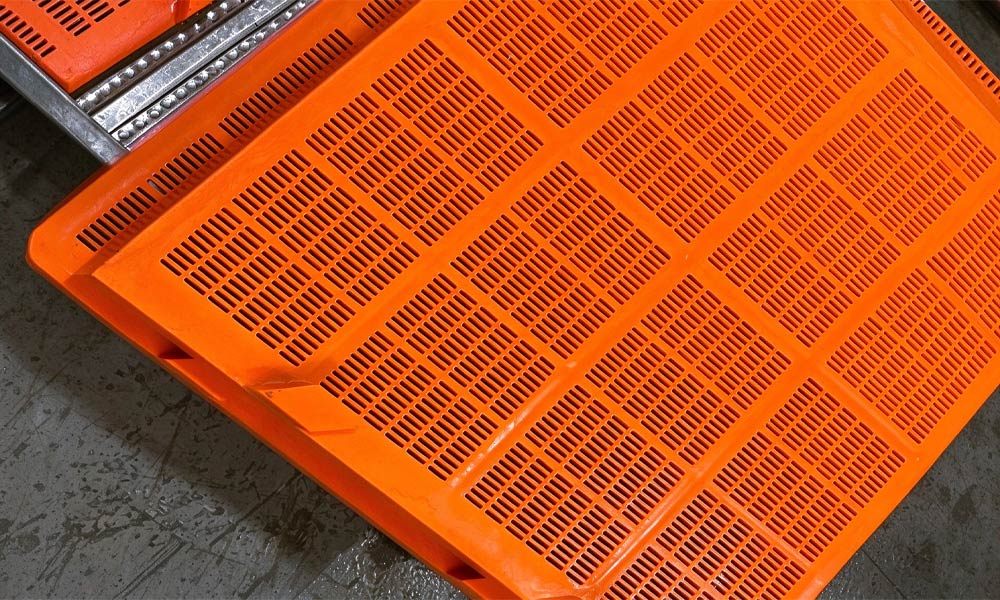
The final extremely flexible custom option no full one-piece screen can deliver is a zoned custom aperture mix layout across the full set of Polyurethane Modular Panels on your deck, where you gradually adjust aperture sizes, shapes and flex characteristics from the feed end all the way to the discharge end to match the changing material properties as wet sticky ore moves across the deck and slowly loses moisture. On a standard uniform aperture deck, the feed end that carries the thickest, wettest, highest concentration of sticky fine particles gets blinded far faster than the discharge end, even though the discharge end no longer needs the same large opening size for fast drainage. This custom zoned layout uses larger curved anti-clog apertures on the feed zone to handle the thick incoming wet slurry, then gradually reduces aperture size and increases panel hardness as material gets drier and finer moving toward the discharge end to maintain precise classification accuracy. Multiple clay-heavy manufactured sand quarries shared that this custom zoned layout boosted their total screening throughput by more than 35% compared to a standard uniform aperture deck.
By combining the hydrophobic PU formulation, non-wedging double-taper apertures, segmented soft-hard composite top layer and zoned custom aperture mix layout, you can build a perfectly tailored set of Polyurethane Modular Panels that almost completely eliminates blinding, cuts your daily maintenance workload drastically, and delivers consistent high screening efficiency even in the wettest, stickiest ore processing conditions that would completely shut down standard generic screen panels.