Custom Aperture Design For Polyurethane Fine Screen In Mining
No two mining projects present the same screening problem, and the aperture that suits an iron ore operation may be entirely wrong for a coal preparation plant or a gold tailings circuit, which is why custom aperture options for a polyurethane fine screen mesh have become a routine part of project specification rather than a special request. The aperture defines where the separation happens, and because ore bodies differ in size distribution, moisture, and the proportion of near-size particles, a standard catalogue figure rarely lands exactly on the cut a flowsheet needs. Customization allows the panel to be matched to the duty instead of the duty being adjusted to the panel. This article examines how different mining applications place different demands on aperture design, how size, shape, and tolerance can be tailored to suit them, what else should be customized alongside the aperture, and how to specify and verify a custom panel so that it performs as intended once it is installed.
Why Different Mining Projects Need Different Apertures
The case for customization rests on the fact that mining projects vary in ways that directly affect screening, and a Polyurethane Fine Screen Mesh ordered from a standard list will always be a compromise somewhere. An iron ore circuit may need a tight cut to protect downstream grinding, a coal plant may be more concerned with moisture and blinding, and a tailings operation may be handling a fine slurry where the aperture has to stay open under wet conditions. Capacity requirements differ as well, since a high-tonnage operation needs more open area than a smaller one at the same cut point, and the available panel dimensions may not support that open area at a standard aperture. Downstream equipment imposes its own limits, because a crusher, a dense medium vessel, or a dewatering stage will each have a preferred feed size. Custom apertures exist to reconcile these competing demands, and treating them as an exception is what leaves plants accepting separations that are close enough rather than correct.
Tailoring Aperture Size, Shape And Tolerance
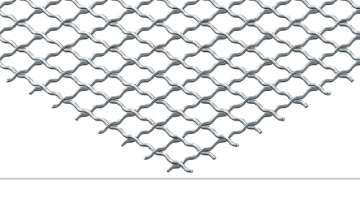
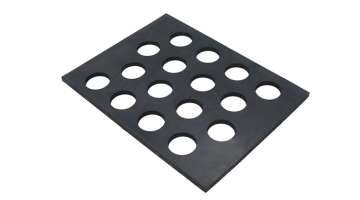
The most familiar custom option is size, but a Polyurethane Fine Screen Mesh can also be tailored in shape and tolerance, and those details often decide whether the cut holds in service. Aperture size should be set from the target cut point and the acceptable proportion of near-size material, and it should allow for the slight enlargement that occurs as the panel wears, so a panel specified at the exact target may pass oversize well before the end of its life. Shape is a second lever, since square, rectangular, and tapered apertures pass particles differently, and a tapered profile can improve the passage of near-size material or sharpen the cut depending on how it is formed. Tolerance is the third and least visible option, because a tighter tolerance around the nominal aperture gives a more consistent cut across the panel and between replacement sets, which matters most where the product specification is tight. Specifying all three rather than only the size is what produces a panel that actually holds the cut.
Customizing Beyond The Aperture Itself
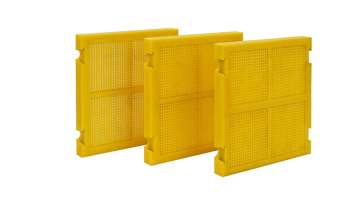
Aperture options are the headline, but a Polyurethane Fine Screen Mesh can be customized in other ways that affect how well the aperture performs under real load. Panel dimensions and fixing arrangements can be matched to the machine so that the deck is fully covered without cutting or patching, and the thickness and compound hardness can be adjusted to suit the abrasion level and the flexibility the deck needs. Open area can be balanced against strength, since a more open panel screens better but must still carry the load without excessive deflection, and the frame or backing can be specified to suit the support structure. Where a plant runs several machines with different duties, customizing each panel to its position avoids the common practice of fitting one specification everywhere and accepting that some decks perform below their potential. These details are less visible than aperture size, but they decide whether the custom aperture delivers its advantage.
Specifying And Verifying A Custom Panel
Customization only pays off when the specification is clear and the result is verified, and that requires more from the buyer than a nominal aperture figure. A Polyurethane Fine Screen Mesh order should state the target cut point, the acceptable tolerance, the feed conditions including moisture and near-size content, the required capacity, and the machine details that constrain dimensions and fixing. It should also state how the panel will be checked on arrival, because a custom aperture is only useful if it matches what was ordered, and measurement of a sample of apertures across the panel is a reasonable acceptance check. Once in service, the panel should be sampled against the product specification early enough to catch a mismatch before it affects production, and the results should be recorded so that the next order can be adjusted if needed. Treating customization as a specification exercise rather than a simple purchase is what turns a tailored aperture into a reliable separation.
Custom aperture options give mining projects the ability to match a polyurethane fine screen mesh to the ore, the flowsheet, and the machine rather than forcing the duty to fit a standard product. Size, shape, and tolerance are the levers that define the cut, while dimensions, thickness, hardness, and open area determine how well that cut holds under real load. The value of customization depends on how clearly the requirement is stated and how carefully the delivered panel is checked, because a tailored aperture that is never verified is no better than a standard one that happens to be close. Projects that treat aperture specification as an engineering decision, with the feed and the downstream limits written down, tend to get separations that hold and panels that last, while those that order by habit keep finding that close enough was not.