Heavy-Duty Structural Features for Long Service Life Under Vibration
If you’ve ever stood beside a vibrating screen machine on a mine site after a 12-hour peak production shift, staring at a generic screen panel that tore completely loose from its mounting hooks, you know exactly how much a flimsy, poorly built panel can derail your whole operation’s weekly production schedule and waste thousands of dollars in unplanned downtime. I’ve spent dozens of hours on-site with mineral processing maintenance teams across iron, copper and gold mine sites, and almost every single one of them has a story about a supposedly “heavy-duty” budget panel that failed catastrophically in the middle of a busy week, forcing the whole circuit to shut down for 6 hours while the crew rushed to rig up a temporary replacement. This practical, field-tested guide breaks down exactly what makes a truly dependable set of Mining Screen Panels hold up to the nonstop high-vibration, high-impact abuse of 24/7 vibrating screen operation, with no empty marketing buzzwords, just real insights pulled from hundreds of on-site panel changeout logs.
One-Piece Forged Hook Mounts Eliminate Premature Edge Tear-Out
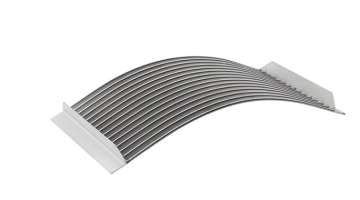
The first non-negotiable heavy-duty feature that separates a reliable set of Mining Screen Panels from cheap disposable alternatives is their full one-piece forged hook mounting system, the part that almost always fails first on low-quality panels. Budget generic panels just bend loose wire ends over a thin sheet steel strip to form the mounting hooks, so the constant high-frequency vibration and heavy ore impact makes individual wires pull loose and unravel from the edge after only a few days of operation, tearing the whole panel apart completely. The heavy-duty forged hook design clamps every single wire end securely inside a solid machined alloy steel channel, then locks everything in place with high-pressure cold forging, so no wire can ever slip loose or tear out no matter how much continuous vibration and heavy impact it takes. Mine sites that upgraded to these forged hook panels reported that they completely eliminated the extremely common premature edge tear-out failure that used to ruin perfectly good panels weeks before their expected end of life.
Reinforced Internal Steel Skeleton Stops Mid-Panel Sagging
The second easily overlooked structural feature that drastically extends total service life is a fully integrated reinforced internal steel skeleton, the hidden support structure inside high-performance Mining Screen Panels that stops the center of the panel from sagging under maximum full-load tonnage. Cheap panels skip this internal support structure entirely, so the middle of the 1-meter wide panel starts to bend and sag down after a couple of weeks of 800+ tons per hour continuous operation, creating uneven material flow that piles up in the center of the deck, causes massive blinding and wears out the middle section 3 times faster than the edges. The heavy-duty internal skeleton builds 8mm thick high-tensile steel support ribs directly into the panel every 200mm across the full width, adding enough structural rigidity that the panel will stay perfectly flat and level even under maximum full-load operation. Most mineral processing operations that installed these reinforced panels found that their total deck throughput jumped by 20%, and uneven localized wear across the panel was completely eliminated.
Precision Calibrated Tapered Apertures Resist Permanent Near-Size Wedging
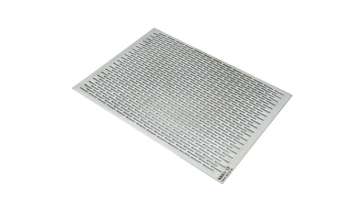
The third critical performance feature that keeps your ore gradation consistent for the full life of the panel is precision calibrated tapered apertures, the core design detail in top-tier Mining Screen Panels that stops near-size ore particles from getting permanently wedged inside openings and ruining your screening efficiency. Straight-walled square apertures on generic panels let near-size ore particles lock themselves completely inside the gap, and these permanently stuck particles act like tiny built-in grinding stones that scoure away the surrounding material every time new ore slides across the deck, while also blocking the opening and cutting down your effective screening area. The gradual tapered design makes every aperture widen slightly from the top deck surface down to the bottom, so no near-size particle can lock itself permanently inside the gap, and any stuck particle will get shaken loose automatically by the vibrating screen machine’s normal operation. Mine sites that tested this tapered aperture design found that their screening efficiency stayed above 95% for the full service life of every panel, with zero unexpected off-spec fine ore batches.
Anti-Loosening Interlocking Panel Locking System Stops Rattles and Shifting
The real game-changer for reliable performance is a full anti-loosening interlocking panel locking system. This setup lets each Mining Screen Panel snap firmly into the next, so there’s no slack or wobbling—everything fits tight, edge to edge. Generic panels usually rely on simple bolted clamps, but those bolts work themselves loose from constant high-frequency shaking. When that happens, panels start to slide, gaps open up, and loads of unscreened ore slide right through onto your fine ore pile. The interlocking design uses molded tabs and slots on every side, so as the panels go down, they form one solid, unbroken deck. No matter how long the machine’s running or how hard it shakes, those panels won’t budge or pull apart. Most mines that switched to this system stopped having to re-tighten clamps every maintenance round, and the problem of panels shifting or failing mid-shift just disappeared.
When you focus on these four heavy-duty, proven design details instead of just chasing the lowest sticker price, you slash your annual panel costs, almost eliminate surprise breakdowns, and keep your entire processing circuit humming along at full speed, month after month.