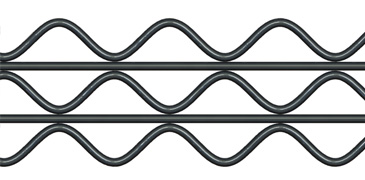
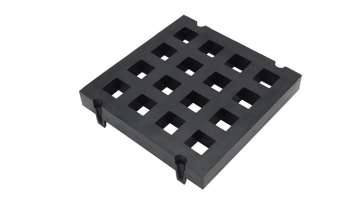
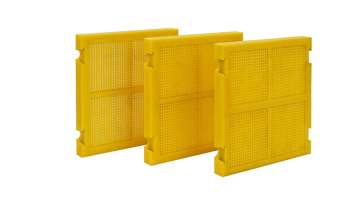
Flat-Top Woven Screen Aperture Selection
If you’ve ever installed a brand new flat-top woven screen on your aggregate deck, only to find that 20% of your near-size target aggregate is slipping through the apertures and contaminating your fine stockpile, or large oversize chunks are bouncing across the deck and getting carried off into your finished product, you know how much a bad aperture sizing call can ruin your whole plant’s product gradation and profit margins. Many quarry operations supervisors I’ve worked alongside over the years shared that they used to just copy the aperture size they used on their old standard crimped screens when upgrading to flat-top panels, and kept running into unexpected sizing issues for months, until they learned that the flat-top’s unique smooth surface changes how particles interact with the apertures. This practical, field-tested guide skips generic sizing charts and breaks down actionable, site-specific tips for flat-top woven screen aperture selection, based on real-world data collected from dozens of aggregate and mine processing decks.
Account for the Flat-Surface Particle Slide Effect
The first most critical tip for accurate flat-top woven screen aperture selection is adjusting your target opening size to account for the unique smooth, low-friction particle slide behavior that does not exist on standard crimped woven screens. On a standard ridged crimped screen, particles bounce and tumble erratically across the bumpy surface, so they only get a few short chances to fall through the aperture before they are carried off the deck, which means you can run an aperture size 10% larger than your exact target separation dimension without getting too much oversize material in your finished product. On a flat-top screen, the perfectly smooth level surface lets particles slide steadily and evenly across the mesh, giving every near-size particle 3 to 4 extra opportunities to line up perfectly with the aperture and fall through. This means if you use the exact same aperture size you used on your old crimped screen, you will end up letting far more near-size material pass through than you planned, ruining your finished product gradation. Most operations that adjusted their aperture size down by 5% to 8% from their old crimped screen specs found that they hit their exact target separation cut point perfectly, with zero unexpected oversize carryover.
Match Aperture Shape Consistency to Your Product Tolerance
The second key tip for flat-top woven screen aperture selection is leveraging the flat-top’s perfectly uniform, zero-distortion square aperture geometry to match your exact customer product specification tolerance, instead of building in extra safety margin like you had to do with standard woven screens. On old standard crimped woven screens, uneven loom tension and warped crimp wires make aperture sizes vary by 10% to 15% across a single panel, so you had to pick a much smaller nominal aperture size to make sure the largest out-of-spec opening on the panel still did not let oversize material slip through, which drastically reduced your deck’s total open area and throughput. A properly manufactured flat-top screen has every single aperture perfectly aligned to within ±0.1mm of your exact nominal dimension, with zero distorted, stretched or misaligned openings across the entire panel. This means you can select a nominal aperture size that sits almost exactly at your maximum allowed product size, instead of building in a huge unnecessary safety buffer, which boosts your deck’s total open area and hourly throughput by 20% to 25% without letting any oversize material pass through. Most aggregate operations that made this adjustment reported that they hit their strict DOT road base gradation requirements perfectly, while pushing 200+ extra tons of material through their deck every single day.
Adjust for Wet Sticky Material and Near-Size Pegging Risk
The third practical field tip for flat-top woven screen aperture selection is making a small targeted adjustment to your opening size based on your site’s unique moisture content and near-size particle percentage, to eliminate pegging risk without sacrificing separation accuracy. Even though flat-top screens have far better anti-pegging performance than standard crimped screens, if your feed carries more than 25% of material that is 90% to 95% the size of your target aperture, those near-size particles can still get wedged into the opening if you run your aperture too close to their exact dimension. If your site regularly processes wet, sticky material with a high near-size fraction, you can shift your nominal aperture size 5% smaller than your target cut point, and pair it with a slight 2-degree increase in your deck’s operating angle to make particles move across the deck faster, reducing the amount of time they sit directly over the aperture and get stuck. This simple adjustment keeps your apertures from pegging even during rainy high-moisture shifts, while still delivering the exact separation accuracy you need, without the huge drop in throughput you would see on a standard crimped screen with the same smaller aperture.
Aperture Sizes Across Multi-Deck Circuits for Full System Optimization
The final high-impact tip for flat-top woven screen aperture selection is tiering your aperture sizes across every deck in your multi-deck circuit, to take full advantage of the flat-top’s consistent sizing and high open area, instead of treating each deck as an isolated independent unit. For a typical 3-deck aggregate circuit, you can set your top scalping deck with a 100mm flat-top aperture to remove all large boulders fast, your middle classification deck with a 31.5mm aperture to produce your main coarse aggregate product, and your bottom fine sizing deck with a 5mm aperture to separate your fine manufactured sand fraction. Because every deck on the circuit delivers perfectly consistent sizing, you eliminate all the cross-contamination between product fractions that used to happen with mismatched standard crimped screens, so every single finished product stockpile stays consistently on spec, and your total circuit saleable yield jumps by 7% to 10%. Most full-circuit aggregate operations that optimized their full set of flat-top apertures together reported that they completely eliminated the need to reprocess off-spec material, adding tens of thousands of dollars in extra profit every single month.
Taking these four practical, site-specific steps for flat-top woven screen aperture selection will help you unlock the full separation performance potential of your flat-top panels, delivering far more consistent product gradation, higher hourly throughput and higher total saleable product yield than you ever got out of your old standard crimped woven screens.