Dutch Weave Woven Screen For Fine Particle Industrial Filtration
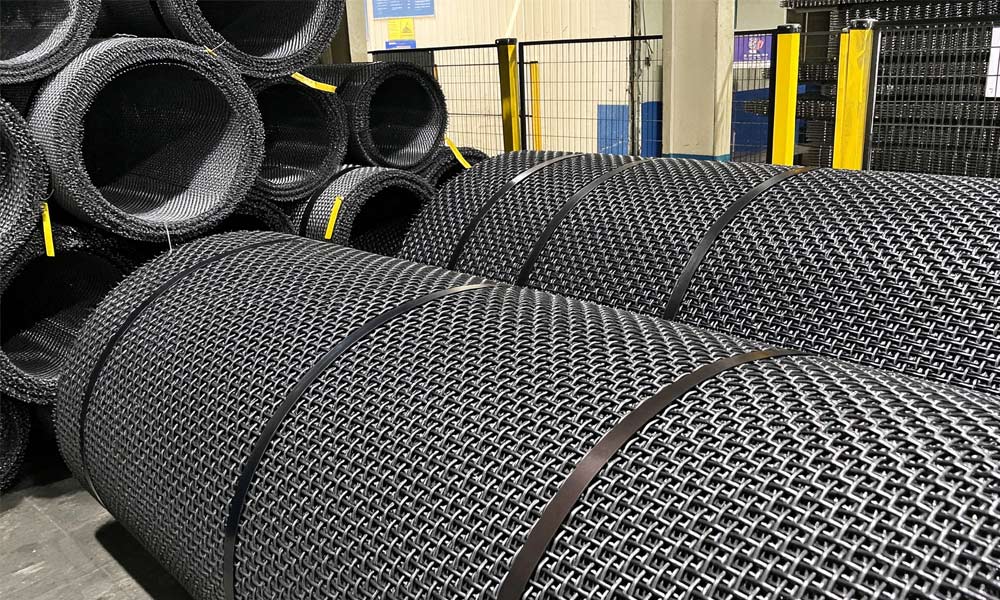
Separating and filtering fine particles represents one of the greatest technical challenges facing industrial filtration applications. Plain woven mesh simply is not capable of forming a sufficiently small and regular opening pattern to filter and classify very fine material, yet still retain adequate load-bearing capacity and free area for efficient processing. Dutch Weave Woven Screen overcomes this difficulty through its distinctive non-symmetrical weave construction, whereby relatively large diameter, widely-spaced warp yarns are woven with significantly smaller, densely packed crimped weft. As a consequence, it can provide far superior fine particle classification that is unachievable using any other form of equal-wire woven fabric. It has also been developed and improved upon over many years to meet the requirements of contemporary industry for optimum fine separation, mechanical robustness and steady flow characteristics. In this article we look at why Dutch Weave delivers such exceptional levels of fine separation, avoids build-up and particle leakage, ensures constant free area throughout its working life and is able to withstand severe duty.
Enables finer separations due to non-symmetrical construction
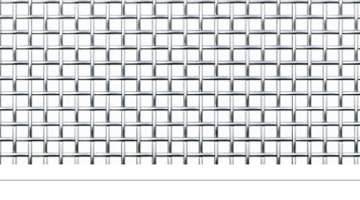
The primary reason why Dutch Weave Woven Screen can enable finer levels of separation than plain woven mesh is the non-symmetrical nature of the fabric. The warp wire has a substantially larger cross-section and is spaced further apart, giving the woven fabric good mechanical integrity. Conversely, the weft wire is very fine, and crimped such that the resulting openings are minute and regularly shaped. It is therefore possible to control these openings to very small values, whereas if similar sized wires were used in a plain woven construction, the woven fabric would lack any significant load bearing capability and fail almost immediately. Accordingly, Dutch Weave allows the user to call for a specific degree of fine particle separation, while retaining a robust fabric suitable for demanding service.
Reduces risk of particle entrapment and leakage
A second key advantage of Dutch Weave is the greatly reduced potential for fine particles to become trapped within the woven construction. With no true through-hole as seen with other types of woven media, there is no opportunity for near-size material to penetrate and embed itself into the depth of the fabric. Rather, fine particles will tend to deposit uniformly across the upper face of the Dutch Weave. Furthermore, there is no risk of larger particles leaking through irregularly-shaped distorted holes in the fabric, as may occur with some other fine-mesh products following initial periods of operation. A Dutch Weave screen will continue to prevent any passage of oversize material until such point as the fabric itself fails.
Provides very constant free area and hence flow
Because of the above factors, the free area of a Dutch Weave Woven Screen will remain virtually unchanged from initial installation to the point of failure. The coarse warp wire will be unaffected by operating pressures and similarly the fine weft cannot distort or spread, so the overall percentage free area of the fabric will be constant. Users can therefore rely on the free area quoted by the manufacturer to predict the actual pressure loss and flow achieved when the product is put into use. In addition, there will be no unforeseen increases or decreases in pressure loss or flow as the screen progresses through its life, nor the necessity to continually re-calibrate the process to suit variations in the media. For many finely-controlled separation processes this is a highly desirable feature.
Withstands frequent and rigorous backwashing
Finally, as noted earlier, the high proportion of coarse wire in a Dutch Weave Woven Screen confers a very high degree of rigidity on the woven fabric. Therefore it is highly resistant to distortion when subjected to high-velocity backwashing (and indeed other forms of mechanical and hydraulic cleaning). Likewise, the dense arrangement of fine weft will ensure that individual wires cannot become displaced or lost from the construction, so the screen will retain its original properties for prolonged periods of time. Operations can accordingly apply vigorous backwash and similar regimes to remove filter-cake from the face of the woven fabric, knowing that the fine-mesh element will remain intact, thereby maximizing the length of time that the Dutch Weave can be utilized.
Overall, the Dutch Weave Woven Screen offers users the ability to carry out fine-particle classification and separation with an unrivalled degree of accuracy, coupled with the assurance of a correspondingly long product life. The combination of an ultra-fine contoured opening size, resistance to material build-up and bypass, fixed free area and durability to harsh operating environments make it ideally suited to a wide range of industrial applications involving fine powders and liquids. It should of course not be considered for screening coarser materials e.g. aggregate, but continues to be a leading choice for woven filter cloth around the world for demanding fine-mesh duties.