Crimped Woven Wire Mesh For Industrial Filtration
There are only a limited number of screening fabrics that can meet the requirements imposed by industrial filtration and sifting processes. They must provide a fixed and reproducible opening pattern; possess sufficient tensile and structural integrity to withstand the repetitive pressurization and mass application of solids; and continue to perform effectively over extended periods to minimize the risk of stopping production due to fabric failure. All of these criteria are met by Crimped Woven Wire Mesh, allowing it to see widespread use throughout the process industries. A key benefit is that it is applicable to a broad spectrum of sifting and filtration processes, from wet or dry operation to high pressures and large volumes of solids applied. As a result, it can offer an exceptionally long working life in service. Here we set out how the inherent pre-locked nature of the fabric ensures tight control of the filtration aperture, its resilience to repeated pressurization and loading, reduced tendency to blind compared to other weaves, and its suitability for many varied industrial uses.
Fixed Opening Pattern Ensures Tight Control Of Filtration Cut Point
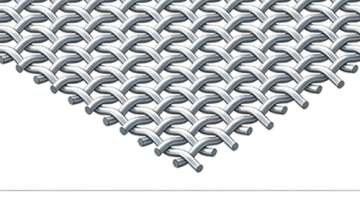
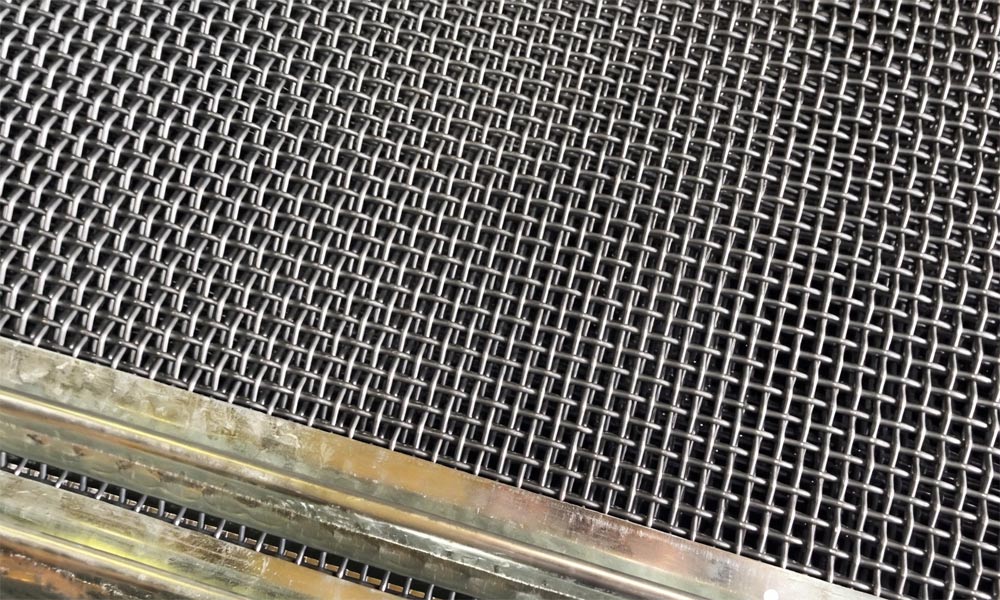
A Crimped Woven Wire Mesh will have a precisely defined and unvarying opening pattern in service as each individual aperture is formed during manufacture to a known fixed dimension. Prior to being woven together, the warp and weft wires will both carry a corresponding crimp profile such that each wire locks securely into place with the adjacent ones, giving an overall regular and robust face of wire. As a consequence, there will be no variation in the dimensions of each aperture around the face of the fabric, and the user can therefore be assured that their filtration process will operate at the desired particle cutoff. There will be no pockets of abnormally large or small apertures to allow oversize solids to pass or restrict fluid passage across the sifting surface respectively. It is difficult to produce equivalent levels of control using other types of plain woven fabric.
High Structural Integrity To Withstand Repeated Pressurisation And Solids Application
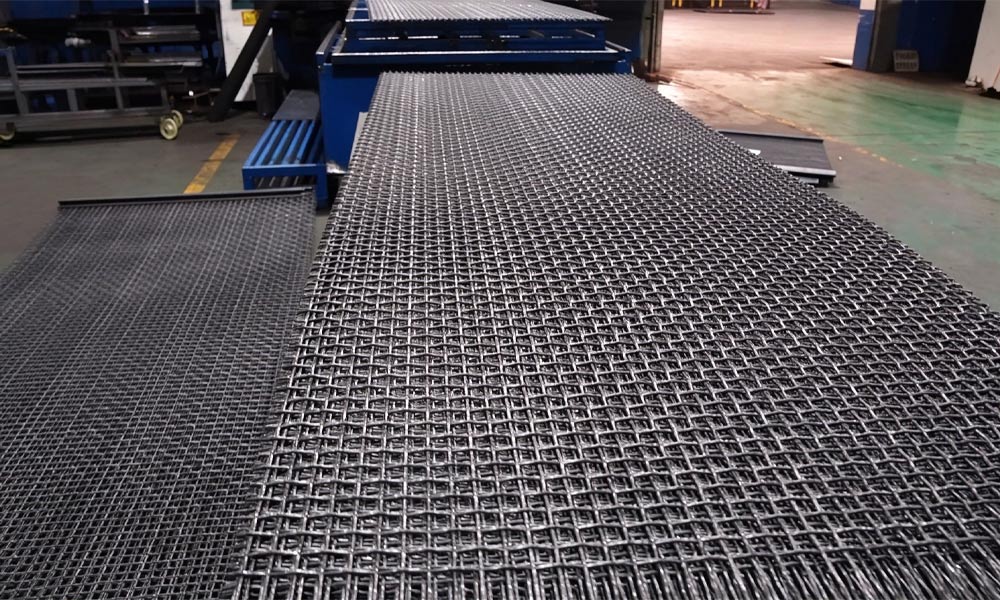
As explained above, the crimped wire construction provides a very strong and stable platform from which to build a Crimped Woven Wire Mesh. Compared to a plain woven equivalent, using the same size and specification of base wire, the fabric is able to tolerate significantly greater levels of applied and fluctuating forces during its working life. Typically, industrial sifting and filtration equipment will impose frequent and repeated periods of increased pressure and substantial quantities of product applied to the filtering area. Such loading could quickly lead to a loss of tension, distortion and individual wire movement in a plain weave. However, with a crimped weave, these loads are shared across the whole fabric and no one location will experience any undue stress. The fabric will therefore remain true to its original form and tension throughout its life, eliminating the possibility of compromising the containment of the product being processed.
Reduced Blinding Through Undulating Fabric Surface
The crimp also results in a slightly raised, wave-like finish to the top of the Crimped Woven Wire Mesh. While this is minimal, it is nevertheless sufficient to prevent the accumulation and settling of fine 'near-size' material on to the face of the filter as occurs with a fully planar plain weave. Small variations in fluid velocity around the crests and valleys of the crimp promote some degree of self-cleaning action, helping to prevent build up and reducing the likelihood of the fabric becoming blinded. Furthermore, as discussed earlier, the fabric retains a high and relatively constant effective open area in service. Users will find that they require less time to manually strip and wash out the filter surface, and that their backwashing procedures will be completed much faster.
Wide Range of Applicable Base Materials
Finally, the range of wire materials that can be used to construct a Crimped Woven Wire Mesh enables the fabric to be deployed in a vast array of industrial settings and duty requirements. From simple low-grade steels to sift inert materials and aggregates, through the various stainless steel alloys for use in the food, medical and process chemistry industries, to super-alloys for extreme heat and corrosive environments, the principle of locking the wires together via a crimp remains unchanged. Therefore, existing experience and knowledge of how to install and maintain a particular type of filter or sifting screen can be readily transferred to accommodate changes in the process stream. Users will not face a steep learning curve in switching to this alternative fabric.
In summary, there is no need to look further afield for exotic, niche products if your application requires a highly durable, robust and accurate filtering or sizing fabric. Crimped Woven Wire Mesh will provide the required performance in terms of maintaining a stable and consistent opening pattern, enduring repeated pressurization and product loading, minimizing fabric blind and accommodating a wide variety of wire specifications to suit the process conditions. Of course, where ultra-low micron levels of filtration are required using dedicated synthetic or non-woven products, this will not be appropriate. But for the majority of common industrial sieving, grading and filtering operations, crimped woven wire mesh is an outstanding option.