Crimped Wire Screen Mesh For Heavy-Duty Vibrating Screen Deck
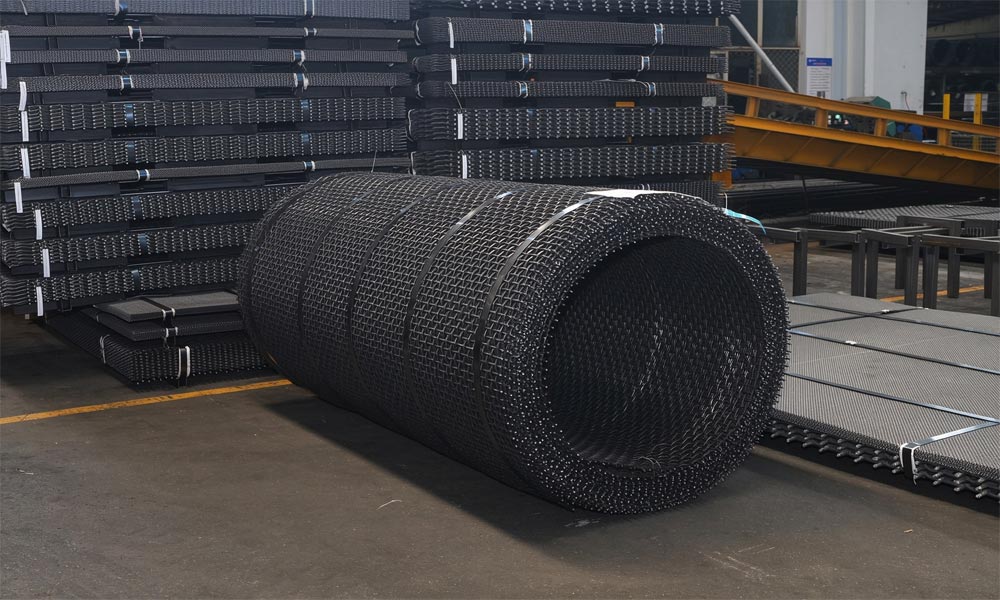
As described earlier, screening on a vibrating deck is probably the most onerous task imposed on any screen fabric used in the minerals industry. Not only does the screen fabric experience thousands of vibration events per minute, but it must also support and allow the flow of a thick charged mass of angular, highly abrasive ore over its face.Crimped Wire Screen Mesh is ideally suited to operate under these severe conditions, due to the inherent properties of its pre-crimped construction. A wide range of issues associated with normal plain woven screen fabric on a vibrating deck are essentially negated, and as such, it addresses a suite of problems that have been intrinsic to this type of screening duty since its inception. Here we examine why the crimped construction avoids the effects of vibration, inhibits displacement of the screen wires, retains the integrity of the screen aperture dimensions and provides greater service life.
Avoidance of Vibration Induced Fatigue
The primary advantage of the crimped wire screen mesh is that it avoids the issue of vibration induced fatigue. As mentioned above, the load applied to the fabric from continuous vibration is borne uniformly along the length of the crimp. In contrast, plain woven mesh consists of circular section wire which will only make point-to-point contact with the opposing cross-wire(s). With each vibration event, these contact points are reloaded, resulting in progressive fretting of the wire and eventual fracture. The extended length of contact provided by the crimp ensures that the load is shared across a far greater proportion of the wire cross-section, removing any risk of fatigue failure at discrete points. Consequently, the fabric is very robust to the millions of vibration events experienced during normal operation.
Prevention of Screen Fabric Shifting
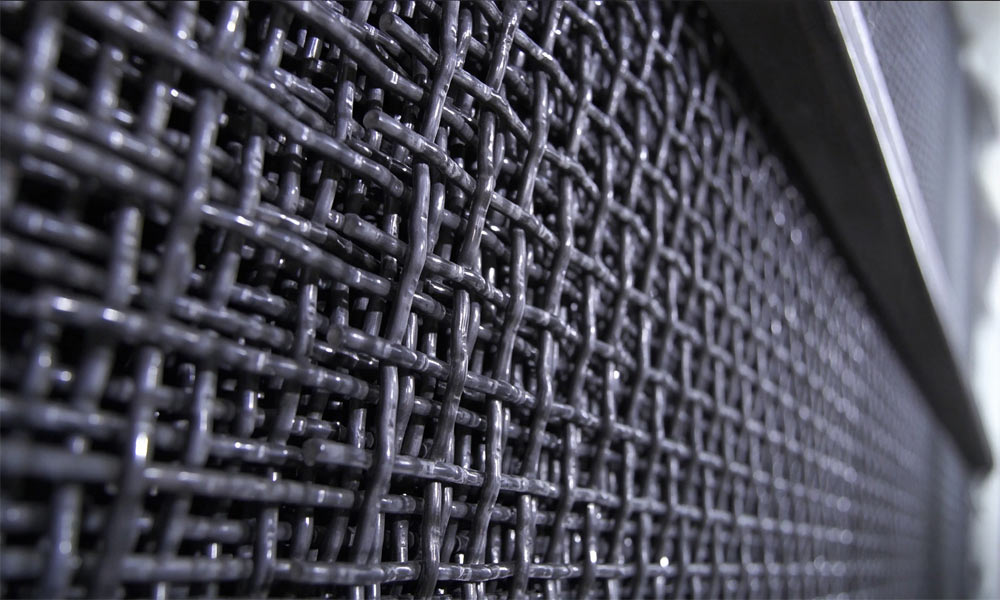
A further key benefit is that the fabric will not experience any shifting of the individual screen wires from their designed location. The fixed crimp profile allows the screen wire to nest tightly within the corresponding crimps of all adjacent crossing wires, forming a secure 'key' that is impervious to any displacement. Where a thick charge of near-size material is fed onto a plain woven fabric, it can drive the screen wires out of register, elongating the apertures and causing a deterioration in the screen's ability to separate the required size fraction. Such a problem is completely avoided using the fixed crimped configuration, irrespective of the magnitude of the driving force exerted by the feed stream. The fabric will therefore remain true and free of any distortions or protruding areas throughout its working life.
Integrity of the Effective Cut Size
The preceding point also serves to maintain the cut size of the fabric. Because the apertures are determined solely by the distance between the two fixed crimped wire , once the fabric has been stretched to fit the screen frame, the size and form of the aperture will not change. Plain woven fabric may exhibit varying degrees of stretching across the width and length of the screen, changing the actual operating cut point from the original specification. Therefore, with crimped wire screen mesh, the user can be assured that the material discharged from their vibrating screen will conform to the desired size distribution, eliminating the risk of oversized and undersized material being misdirected.
Minimization of Fretting Wear at Support Bar Locations
Finally, the absence of any free-moving screen wire minimizes the potential for fretting wear of the fabric where it sits on the supporting bar of the screen box. Loose wire on a plain woven fabric will oscillate slightly during each vibration event and rapidly wear away at these locations, consuming a disproportionate amount of the available wire life before the remainder of the fabric has appreciably reduced in thickness. By virtually eliminating this mode of failure, the rate of reduction in fabric thickness will be dictated principally by the severity of the feed material, leading to a more even rate of consumption of the fabric and hence an increased working life of the complete screen panel.
Clearly there are some speciality screening applications where a plain woven fabric may still be preferable, but for the vast majority of heavy duty vibrating screens, the superior characteristics of the fixed crimped wire screen mesh will ensure many months of trouble free operation.