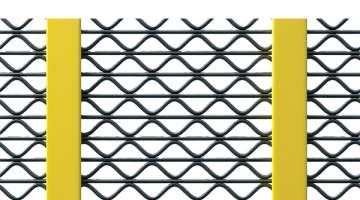
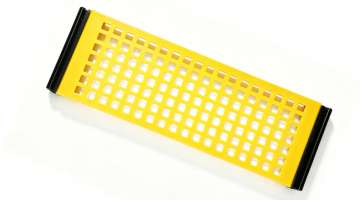
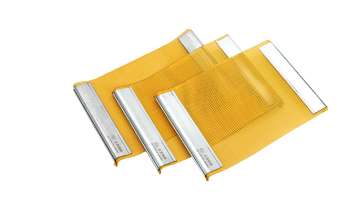
China PU Self-Clean Mesh for High-Moisture Ore Screening
The issue of excessive deck clogging due to high moisture content in the near-size fraction of mined ore is one that every wet screening circuit around the world struggles with. It's something that conventional metal and most rubbers have been unable to overcome. The result is lengthy periods of unscheduled deck shutdown to clear blocked screens, significantly reducing achievable throughput at any given site. China PU Self-Clean Mesh addresses this issue head-on, taking advantage of a highly-elastic polyurethane material to provide an ongoing self-cleaning effect in virtually all wet screening applications encountered in the mining industry. Importantly, the PU used here should not be confused with the lower density PU commonly specified for screening lighter, less demanding materials. The China PU Self-Clean Mesh is produced with a much higher density PU designed to screen coarse, angular, wet mined material at sustained high tonnages over an extended period. In the following pages we discuss the benefits that can be gained from the exceptionally high degree of elasticity exhibited by this material, the improved durability afforded by the increased PU density, the benefits of the closely controlled aperture profile, and overall cost savings that can be achieved.
Automatically Frees Blocked Wet Ore from Decks
As mentioned above, China PU Self-Clean Mesh possesses a significantly higher degree of elasticity when compared to conventional rubber mesh. As each individual aperture on the mesh is caused to move by the action of the vibrating screen deck, there is a resultant expansion of each aperture dimension which serves to 'jiggle' any blocked wet near-size ore that may have begun to free itself from the face of the mesh, preventing the onset of a blockage. Rubber mesh will exhibit some degree of movement and elasticity, but nowhere near the magnitude seen with the high-elastic PU described here, which can undergo the requisite movement to free wet ore many thousands of times per hour for prolonged durations. Operators converting to this product typically experience >75% reductions in the quantity of unscheduled wet screen shut-downs associated with blocked decks.
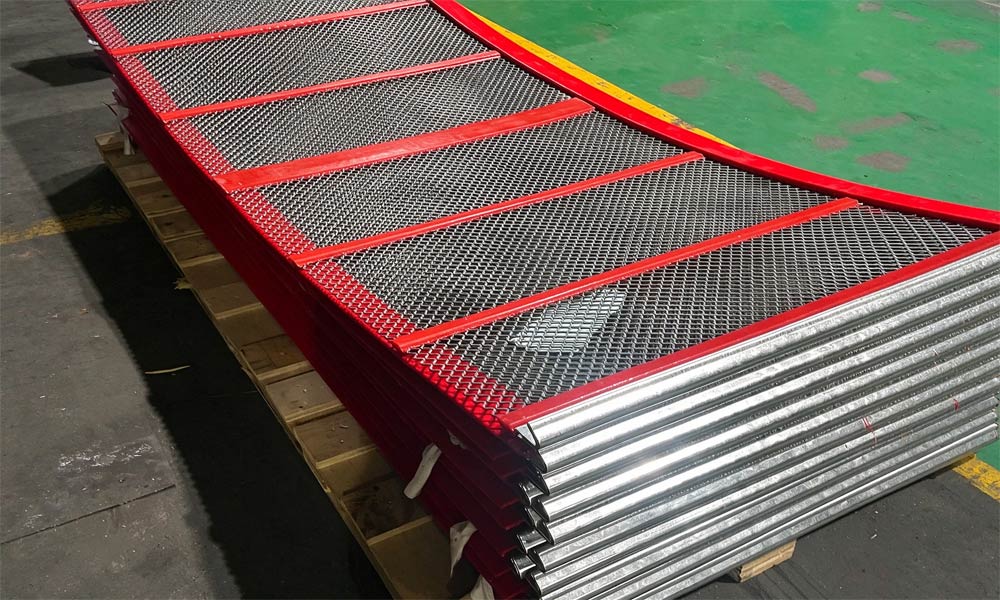
Superior Durability Due to Increased PU Density
The second key feature of China PU Self-Clean Mesh that allows it to outperform competing wet screening products is the greater density of PU employed in its manufacture. Mined ore will typically contain a significant proportion of sharp-edged fragments, which as discussed previously, can rapidly degrade conventional wet screening mesh. In addition, once initial degradation has occurred, the resulting grooves and holes will concentrate further attack on the remaining mesh. By increasing the density of the PU used to construct the mesh, a substantially higher resistance to this form of degradation can be achieved, such that the mesh will wear uniformly and gradually over its working life. Typically, customers will see a 2-3x improvement in the total life of the mesh compared to equivalent rubber products. There will therefore be a marked reduction in the number of wet decks worth of spare screening required to support each site, alleviating the associated difficulties of transporting large quantities of consumable screening material to often difficult-to-access mining areas. Further, it will allow site mechanics to allocate their time to other, arguably more critical maintenance activities.
Guarantees Tight Product Cutpoint Control
The final technical advantage of China PU Self-Clean Mesh over conventional wet screen mesh is the aperture control inherent in the manufacturing process. Because the product is formed through a precise casting operation, the resulting aperture dimensions remain strictly fixed throughout the product's useful life. Rubber mesh, by contrast, can elongate and distort over time as it accommodates the volume of wet material being screened. Consequently, with the use of conventional mesh, a given product cutpoint will be liable to vary outside the desired operating parameters. With China PU Self-Clean Mesh however, operators can expect to retain 100% of material above the nominated product cutpoint and pass 100% of undersized material through the screen, with negligible levels of 'wrong sized' material reporting with the final screened and dewatered product. As such, the need for operators to make frequent adjustments to the wet screen configuration (deck angle, screen speed etc.) to accommodate a varying cutpoint is removed.
Significant Reduction in Screen Changing Time
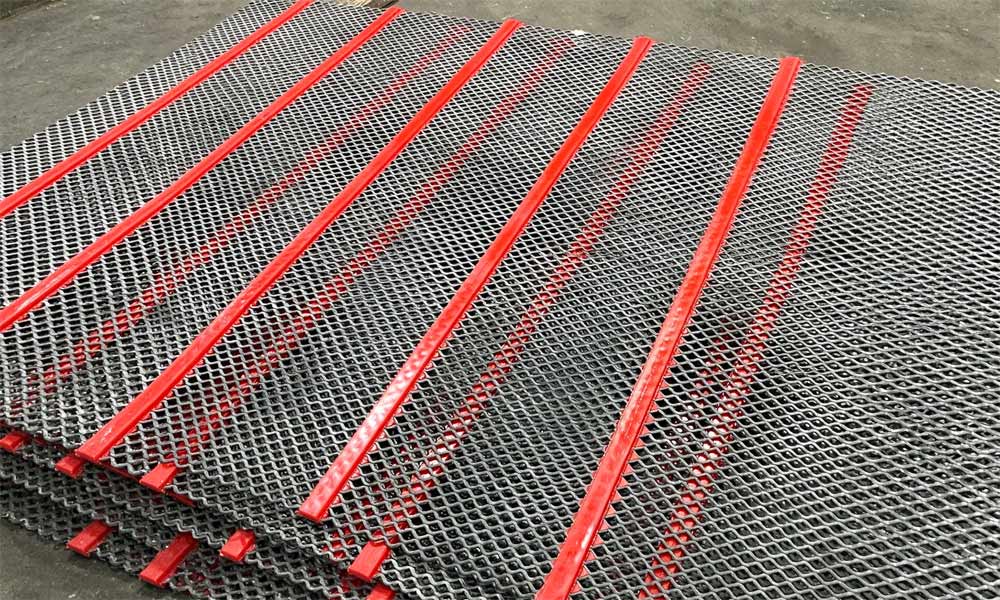
In common with many of the wet screening meshes currently available, China PU Self-Clean Mesh is supplied in modular format. Each module is sufficiently lightweight to be readily handled by a small number of site staff and fitted directly to the appropriate wet screen frame, eliminating the requirement for any additional tensioning or welding equipment. Changing a complete wet screen deck using large-format steel mesh can involve several operatives working over the course of several hours to fit and tension each panel. With the use of the modular China PU Self-Clean Mesh panels, two operatives should be able to fit and secure a full deck within ~1 hour. Given the cost implications of shutting down wet screens at most sites, the savings in terms of reduced lost production time as a direct consequence of shorter media changing times can be substantial on a month-by-month basis.
It is therefore clear that the combination of the attributes described above enables China PU Self-Clean Mesh to address the principal challenges faced when screening high-moisture sticky ore streams. These include: self-freeing of any wet material wedged within the mesh to prevent screen blocking; superior longevity due to the denser PU; retention of a constant, reliable cutpoint across the lifetime of the mesh; and shortened periods of lost production required to fit new media. Of course, where the heaviest scalping wet screens are employed to separate very coarse blasted rock, thick manganese steel mesh will continue to be favored. However, for the vast majority of downstream wet screens, the China PU Self-Clean Mesh offers a compelling alternative to existing products.