Heat-Treated Advantage of 65 Mn Woven Mesh Used in Abrasive Mining Material
If you’ve ever stood beside a mineral processing plant’s screening deck mid-shift, watching your team spend hours swapping out a generic woven screen that wore completely through in less than a week under the constant impact of sharp, abrasive mining materials, you know exactly how much unnecessary downtime, wasted labor and lost production this seemingly trivial consumable issue causes. Many mine operations supervisors I’ve talked to over the years shared that they used to pick screens based only on low upfront cost, never accounting for the extreme abrasion, heavy impact and continuous high-frequency vibration that harsh mining material screening brings, leading to constant unplanned shutdowns and inflated annual spare part budgets. A properly engineered 65 Mn Woven Wire Mesh that goes through standardized precision heat treatment solves these persistent pain points completely, delivering far more stable wear resistance and longer service life even under the harshest abrasive mining material processing conditions.
Microstructure Transformation for "Outer Hard Inner Tough" Performance
The first core advantage brought by professional heat treatment is the complete directional transformation of the internal metal microstructure, which turns the ordinary as-woven 65Mn steel that only has mediocre mechanical properties into a high-performance material with perfect balance of hardness and toughness. The full process starts with heating the woven mesh to the precise critical austenitizing temperature, holding it for a set period to make the internal crystal structure form a uniform solid solution, followed by controlled rapid quenching to transform the high-temperature austenite into fine, high-hardness martensite, and then matched with medium-temperature tempering to make the supersaturated carbon precipitate into tiny, evenly dispersed carbide particles. This carefully controlled sequence eliminates the brittleness that would otherwise make the screen crack easily under heavy ore impact, creating a unique structure where the outer surface hardness reaches HRC 58 to 60 while the inner core still maintains excellent toughness, making this heat-treated 65 Mn Woven Wire Mesh easily withstand the continuous impact of 10kg+ sharp abrasive ore chunks without suffering brittle fracture.
What Heat Treatment Actually Does to 65 Mn
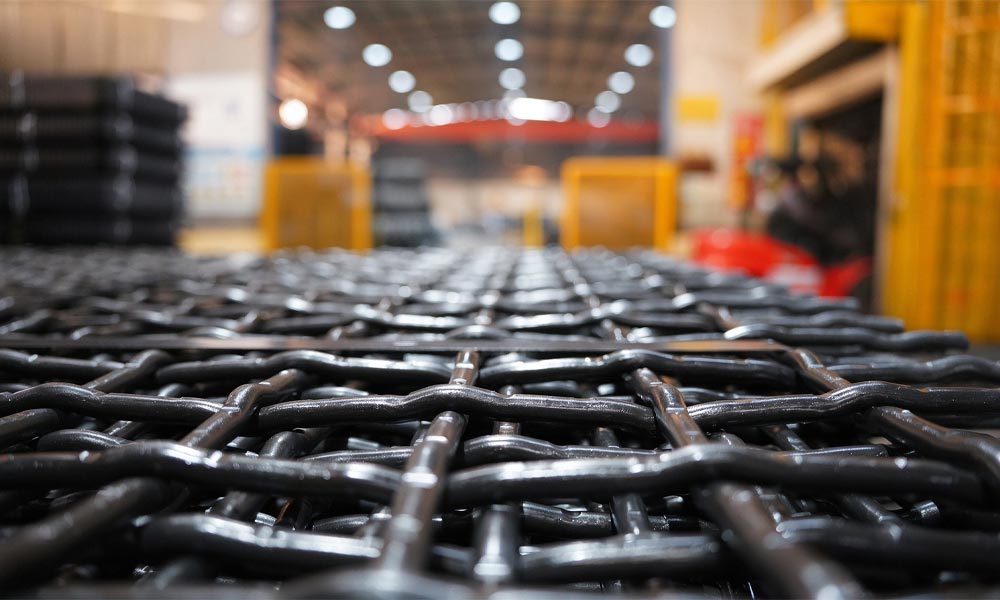
65 Mn is roughly 0.62–0.70% carbon with manganese for hardenability, so after rolling it can be quenched to martensite and then tempered back to a useful state. Quench-hardening pushes surface and core hardness up, which is exactly what the wire crown wants when angular grit slides across it fifty times a second. Tempering afterwards is the grown-up step most cheap mesh suppliers skip: it relieves the internal stress, trades a little hardness for ductility, and stops the wire from cracking under cyclic load. The result is a heat-treated 65 Mn Woven Mesh with high tensile strength, good fatigue life, and enough toughness to absorb the lump that lands on the feed lip without snapping the knuckle. Untreated or only cold-drawn 65 Mn may look fine on a tensile report, but in the field it work-hardens locally, loses plasticity, and breaks above the support bar—exactly where you cannot see it coming. Heat treatment turns the alloy from “strong on paper” into “predictable under pounding.”
Abrasion Versus Impact: The Trade Nobody Escapes
Every abrasive circuit is really two wear modes at once. The fine fraction scrapes—low load, high frequency, crown loss—and that favors harder wire. The coarse fraction hits—high load, low frequency, impact denting—and that favors toughness. A heat-treated 65 Mn Woven Mesh is specified by temper, not by brand: a lower tempering temperature keeps hardness high for silica-heavy scalping, while a higher tempering temperature backs off the hardness a few points and buys fatigue resistance on a vibrating deck that runs 24/7. Plants that only ask “how hard is it” end up with a brittle panel that resists abrasion for three days and then cracks at the hook. Plants that ask “what temper, what tensile band, what elongation” get a mesh that gives up crown metal slowly and predictably. On abrasive mining feed, predictable wear is cheaper than heroic hardness—because a panel that dies on schedule costs less than one that dies dramatically and takes a crusher liner or a shift of downtime with it.
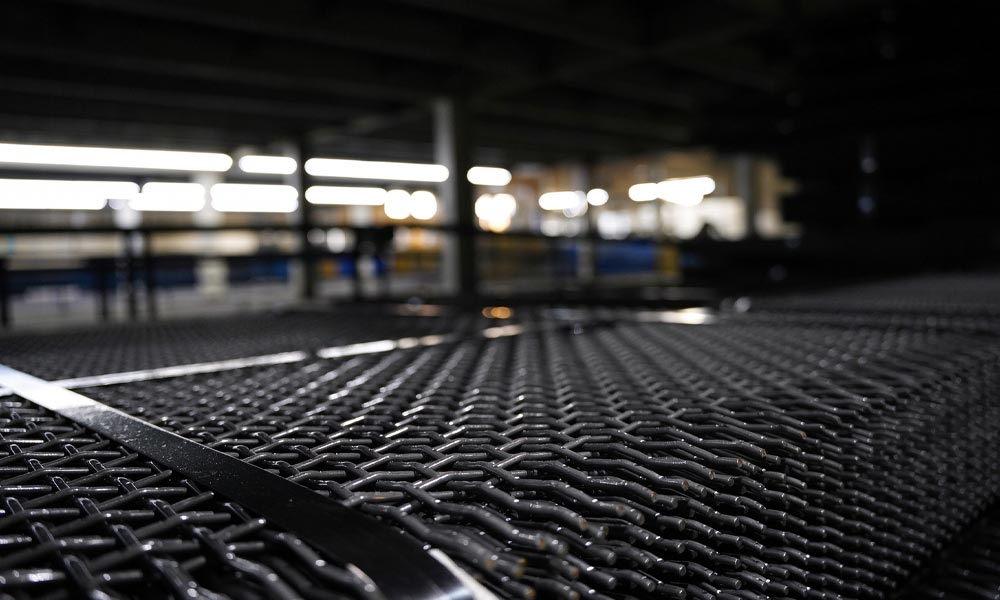
Dramatically Improved Wear Resistance and Extended Service Life
The second key practical benefit of proper heat treatment is the massive improvement in overall abrasion resistance, which directly extends the usable service life of the screen by 3 to 5 times compared to non-heat-treated ordinary 65Mn woven wire mesh. The evenly distributed hard carbide particles on the surface act like tiny wear-resistant armor that resists the continuous scouring and cutting of sharp abrasive mining materials such as quartz sand, granite and high-hardness iron ore, with measured mass loss rate as low as ≤0.15g/m²·h in standard quartz sand abrasion tests. Many mine operations teams that switched to this properly heat-treated product reported that their screen replacement frequency dropped from once every 7 days to once every 45 to 60 days, drastically cutting the labor cost for frequent screen swapping and reducing unplanned downtime by more than 70%, making this heat-treated 65 Mn Woven Wire Mesh far more cost-effective even with a slightly higher initial procurement price.
Enhanced Fatigue Resistance for Long-Term Vibration Working Conditions
The third critical performance upgrade brought by precision heat treatment is the great improvement in anti-fatigue performance, which solves the most common failure mode of woven screens in mining scenarios: fatigue fracture under thousands of hours of continuous high-frequency vibration. The tempering step after quenching fully releases the internal residual stress generated during the weaving and quenching process, and refines the internal grain structure to effectively hinder the initiation and expansion of tiny cracks under repeated alternating stress. Field test data shows that the fatigue life of heat-treated 65Mn woven wire mesh under 960rpm continuous vibration is more than 40% higher than that of non-heat-treated products, and the tensile strength of the wire can reach 1200 to 1600 MPa, far exceeding the 400 to 600 MPa tensile strength of ordinary low-carbon steel woven screens. This stable anti-fatigue performance ensures that this heat-treated 65 Mn Woven Wire Mesh can maintain its complete structural integrity and consistent classification accuracy even after thousands of hours of continuous operation, without suffering unexpected sudden breakage that forces emergency shutdowns.
Following these targeted performance selection and verification rules will drastically reduce your screen replacement frequency, cut unnecessary downtime and labor cost, and keep your abrasive mining material screening line running at stable high efficiency for far longer.