Heavy-Duty Woven Wire Screen Used in High Pressure Grinding Rolls Circuit
For all day mineral processing plants running high pressure grinding rolls closed circuits, the constant high-impact feed of hard, semi-liberated crushed ore and intense continuous vibration often wears out ordinary screens in less than a week, leading to frequent unplanned shutdowns, inconsistent particle classification and wasted grinding efficiency that drags down overall plant throughput. Many on-site maintenance teams shared that they previously struggled for years with generic screens that tore unexpectedly mid-shift, wasting huge amounts of spare part budget and lost production output. Properly selected Heavy-Duty Woven Screen solves these persistent pain points perfectly, bringing far more stable classification performance and longer service life to the harsh HPGR circuit working conditions.
Pre-Crimped Interlock Weave for High Impact Resistance
The first core performance advantage of these screens is the heavy-duty pre-crimped interlocking weave structure, where every thick high-tensile manganese steel wire is pre-bent before weaving to lock tightly against adjacent wires at every intersection, eliminating tiny sliding gaps that cause wire breakage under repeated high-velocity ore impact from the HPGR discharge stream. This specialized weave design can easily withstand the continuous impact of 50mm and larger hard ore chunks discharged directly from the rollers, making this Heavy-Duty Woven Screen far more durable than ordinary plain woven alternatives that deform and tear quickly under the same heavy load.
Feeding the Rolls Without Hurting Them
The screen before the HPGR has one unglamorous job that plants underestimate: keep objects near or larger than the operating gap out of the nip. Oversize rock burdens the tyre surface, raises peak load, and accelerates roll wear; tramp metal near the gap can create local pressures wildly beyond steel’s compressive strength and dent or crack the tyre and studs. A Heavy-Duty Woven Wire Screen on the scalping or safety-screen position is the last physical barrier before that damage happens. It does not need to be the finest cut in the plant—it needs to be honest about top size, resistant to the lump that arrives at the belt speed of bad luck, and tough enough that a 120 mm piece of country rock does not fold the panel like foil. In a flowsheet where the HPGR runs in closed circuit with vibrating screens, the oversize reports back to the rolls and the undersize moves on; if the woven deck lets borderline material sneak forward, the rolls compensate with pressure, the skew control works overtime, and the tyre life chart starts lying to the maintenance planner.
Weave, Wire, and Why Plain Mesh Dies Young
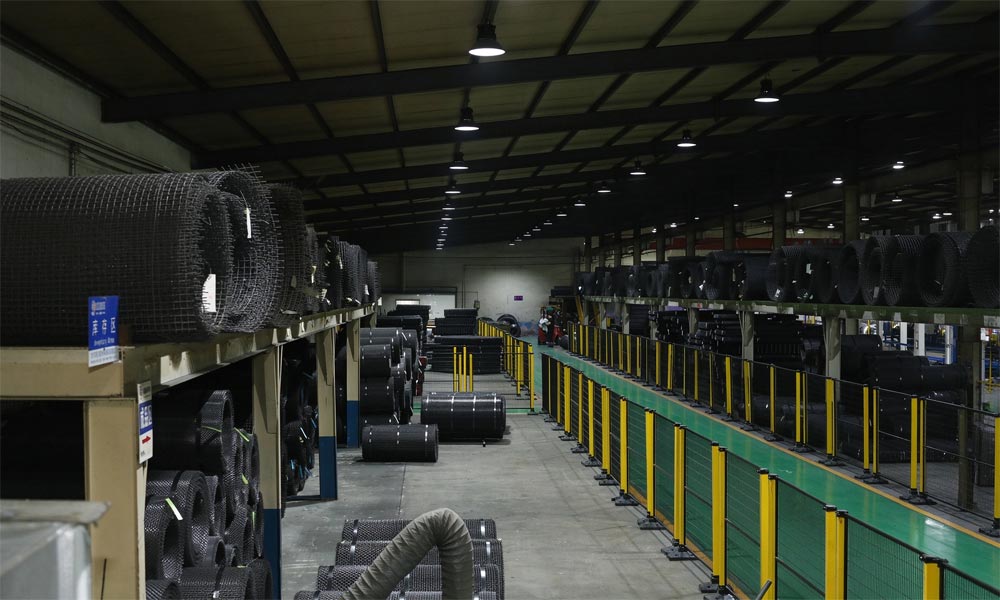
HPGR circuit feed is not gentle. Even ahead of the rolls, the material is hard, often siliceous, sometimes damp, and always in a hurry. A light plain-weave Woven Wire Screen will seat nicely in the frame and then lose its aperture in a week because the warp and weft were never pre-formed to carry load. Heavy-duty practice moves to pre-crimp, double-crimp, lock-crimp, or flat-top constructions, where the wire is bent before weaving so the junction does not creep every time a pebble lands on it. Wire grade matters just as much: high-tensile high-carbon steel, 65Mn spring steel, or manganese-bearing alloys take the dent without snapping; 304 or 316L enter the spec when process water, oxidation, or sulphate chemistry starts corroding the crown faster than abrasion wears it. The aperture and wire diameter are a negotiation, not a catalogue pick—too thin a wire and the sharp HPGR recycle cuts the knuckle; too heavy a wire and open area collapses, bed depth balloons, and the banana or multi-slope screen behind the rolls starts stratifying like a traffic jam. A Heavy-Duty Woven Wire Screen earns its name when the crimp locks the hole, the wire shrugs off the impact, and the panel still looks like the same cut point at 40,000 tonnes that it did at commissioning.
HPGR Discharge Screening Is a Different Beast
People confuse the screen before the HPGR with the screen after it, and that confusion costs media budgets. HPGR discharge carries a broad PSD, a lot of freshly generated fines, and often agglomerated “flake” that needs de-agglomeration before it will screen honestly. The discharge screen is usually a large banana or multi-slope machine because recirculation loads can sit around 200 percent and the bed wants to get deep fast. A Heavy-Duty Woven Wire Screen still has a place here on coarser decks, scalping grids, and wear-zone inserts, but the fine cut may shift toward modular PU, rubber, or wedge surfaces depending on moisture and blinding risk. The woven panel’s job on discharge is often hybrid: take the coarse recycle without tearing at the feed lip, keep the oversize reporting back to the rolls consistent, and not let the support bars pound the crimp into retirement. Plants that instrument this deck—measuring blinded area, oversize-in-undersize, recirculation tonnage, and aperture growth—quickly learn the woven screen was never “the fine separator,” it was the coarse disciplinarian that lets the fine media do its job without drowning in return load.
Precision Aperture Control for Closed Circuit Classification
The second key functional benefit comes from the tightly controlled uniform mesh openings with tolerance kept within ±3%, which ensures every single oversize particle that has not been fully crushed by the HPGR is accurately blocked and sent back to the roller feed hopper for re-grinding, preventing unqualified coarse material from slipping through into the downstream fine grinding mill. This consistent classification performance eliminates the common "over-grinding" or "under-grinding" issues that waste mill processing capacity, making this Heavy-Duty Woven Screen a critical upgrade that directly boosts the overall throughput of your entire HPGR closed circuit by 10% to 15% in most mineral processing plants.
Reinforced Edge Structure for Extended Service Life
The third practical operational optimization is the fully reinforced wrapped edge design with extra thick steel tension hooks, which distributes the high tension load evenly across the entire screen panel instead of concentrating all stress on a few weak edge points that often snap under high-frequency heavy vibration. This structural upgrade prevents the screen from coming loose or tearing at the mounting points even after thousands of hours of continuous operation, extending the average service life of the panel by 2 to 3 times compared to standard woven screens, making this Heavy-Duty Woven Screen far more cost-effective even with a slightly higher initial procurement price.
Following these targeted application and selection rules will drastically reduce your screen replacement frequency, keep your HPGR closed circuit classification accuracy stable, and directly improve your overall mineral processing plant throughput significantly.