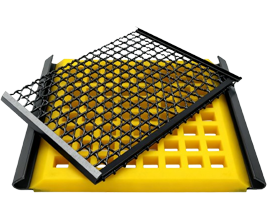
Polyurethane screen panels are widely used in mining and aggregate industries
due to their excellent wear resistance and high elasticity. However, a common
and costly issue encountered in their manufacturing and application is the
bonding failure between the polyurethane matrix and the embedded steel
framework. This delamination not only shortens the service life of the screen
panels but also leads to unexpected downtime and increased maintenance costs.
Understanding the root causes of this bonding failure and implementing effective
process improvements are therefore essential for manufacturers aiming to produce
high-quality, durable screening media. This article explores the primary reasons
behind the poor adhesion and outlines practical methods to enhance the bonding
process.
Root Causes of Adhesion Problems
The primary reason for bonding failure between polyurethane and steel
framework in polyurethane screen panels often lies in inadequate surface
preparation of the metal. Steel surfaces are typically contaminated with rust,
oil, or mill scale, which creates a weak boundary layer that prevents the
polyurethane from forming a strong mechanical and chemical bond. Additionally,
the thermal expansion coefficients of polyurethane and steel differ
significantly; during the curing process, thermal stress can build up at the
interface, leading to micro-cracks and eventual separation. Furthermore, the
selection of an inappropriate adhesive primer or the use of an incompatible
polyurethane formulation can severely compromise the bond strength, making the
panel prone to delamination under the dynamic loads of screening operations.
Effective Process Improvements for Stronger Bonds
To overcome these challenges, manufacturers should adopt a multi-step process
improvement strategy focused on surface activation and material compatibility.
First, the steel framework must undergo thorough abrasive blasting to achieve a
clean, roughened surface profile that maximizes mechanical interlocking.
Applying a high-quality, compatible primer immediately after blasting is crucial
to prevent oxidation and to create a chemical bridge between the steel and the
polyurethane. Moreover, optimizing the casting process by carefully controlling
the mold temperature and the curing cycle can minimize thermal stress, ensuring
a more uniform bond line. By integrating these process improvements,
manufacturers can significantly reduce the incidence of bonding failure and
deliver polyurethane screen panels that offer superior reliability and
longevity.
In conclusion, addressing the causes of bonding failure between polyurethane
and steel framework in polyurethane screen panels requires a keen focus on
surface preparation and process control. By implementing the outlined process
improving methods, manufacturers can enhance product durability and reduce
operational costs. If you are looking to optimize your production line or need
expert advice on polyurethane bonding solutions, our team is ready to help you
achieve consistent, high-quality results.


Leave A Reply
By using form u agree with the message sorage, you can contact us directly now